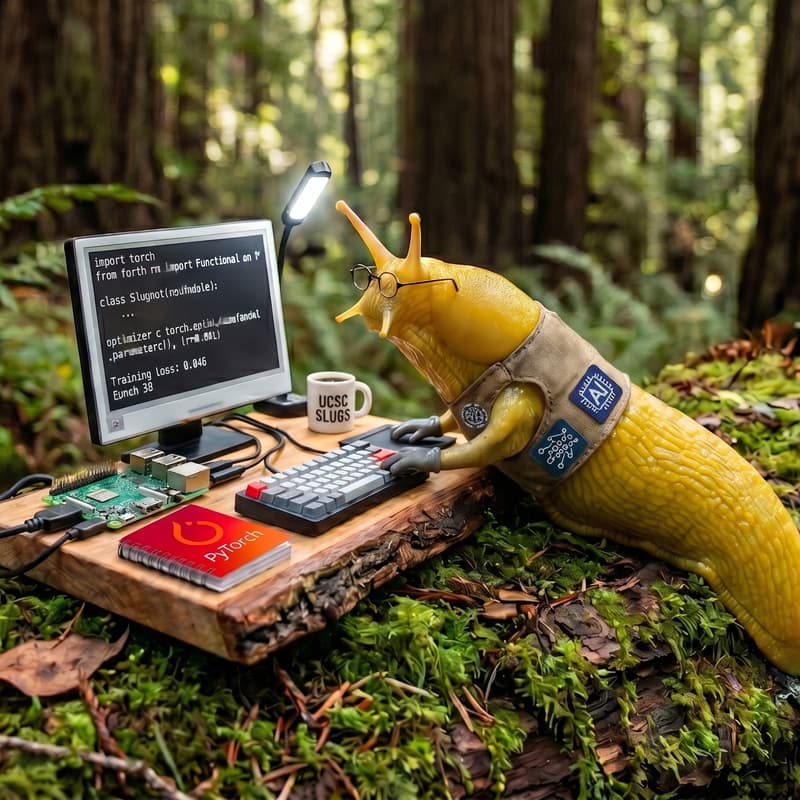

PyTorch Santa Cruz Meetup
Food, Socializing, and Excellent talks from the PyTorch Ecosystem
5:30 - 6:30 Food and Socializing
6:30 - 7:00 Rob Timpe - Using and Debugging Torch.compile
7:00 - 7:30 Roy Shadmon - EdgeFL and Federated Learning
7:30 - 8:00 Utkarsh Gupta - Visualizing Gradients in Scientific Research
Talk 1:
Using and Debugging Torch.compile
Torch.compile promises great speedups with a one line change, but can give cryptic error messages when it fails. We'll describe some common failures and how to fix them, as well as recent efforts to both reduce failures and make the remaining ones easier to debug.
Rob Timpe is a software engineer at OpenTeams where he works on the front end of torch.compile (Dynamo). Previously he was an ML engineer working on autonomous aircraft at Xwing, and computer vision at Microsoft.
Talk 2:
EdgeFL and Federated Learning
EdgeLake coordinates federated learning across distributed sites without moving raw training data to a central location. Each site trains locally, EdgeLake handles the distributed data and coordination layer, and the resulting models are shared across the network and deployed for inference at the edge — creating a continuous path from managing distributed data to training models to running inference, all at the edge.
Roy Shadmon is a System Architect at AnyLog, where he works on EdgeLake and its applications in federated learning and distributed edge intelligence. He holds a PhD from UC Santa Cruz.
Talk 3:
Visualizing Gradients in Scientific Research
Gradient visualization can make optimization easier to understand and debug. This talk introduces PyTorch tools for inspecting gradients and understanding how they influence parameter updates. I’ll discuss how researchers can use these techniques to investigate slow or unstable optimization and apply them to their own differentiable models. A short example of parameter fitting with a state-of-the-art MRI physics simulator will illustrate the approach.
Utkarsh Gupta is a third-year PhD student in Computer Science and Engineering at UC Santa Cruz. His research focuses on differentiable magnetic resonance imaging (MRI) physics simulations, MRI hardware development, and training neural surrogate models for faster inference.
Getting there and parking:
If you are driving to the event we have arranged for parking. There will be parking attendants issuing parking permits from the second floor of Core West (Lot 112).
Here is the link to the interactive campus parking map:
https://transportation.ucsc.edu/parking/campus-parking-map/#using-the-map