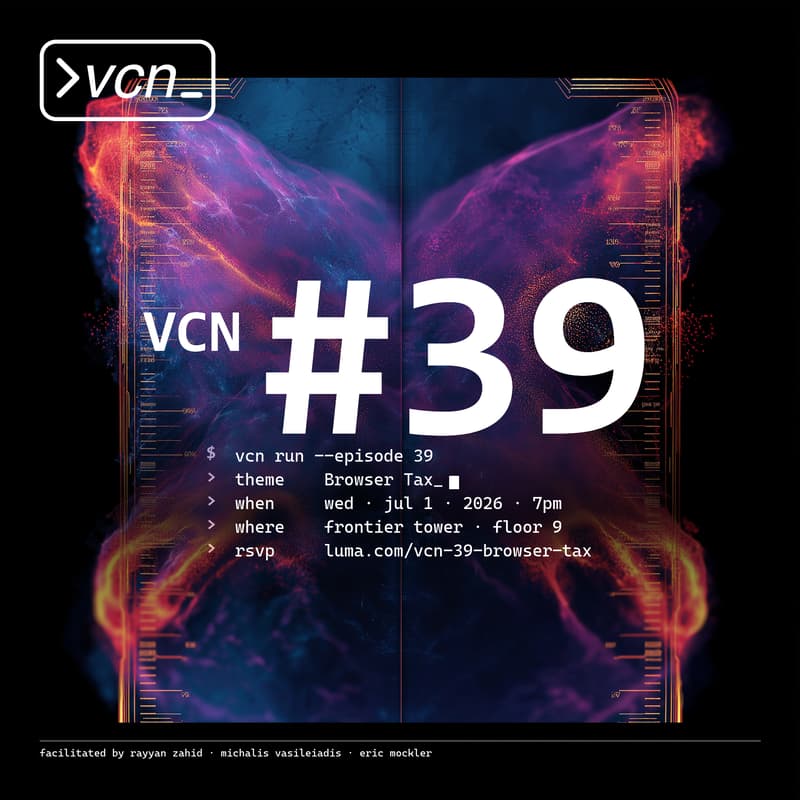

VCN #39: Browser Tax — Instrument Your Site with WebMCP
Instrument your site browser side. The agent finally sees what the human sees.
Agents pay a tax to use the web. They scrape DOM, infer affordances from labels, click <div onClick> buttons that don't surface in the accessibility tree, retry on errors that humans never notice. The tax is paid in latency, hallucination, and unreliability — and you pay it every time an agent touches your product.
WebMCP is the inversion. You instrument the page once. The agent calls navigator.modelContext.registerTool({...}). Same DOM, two callers — humans see a button, agents see a tool. Calls inherit the browser session without separate auth. Chrome 146 Canary shipped early-preview in February 2026. Microsoft's NLWeb is the sibling proposal — NL queries over Schema.org structured data, and every NLWeb instance also acts as an MCP server.
VCN #39: Browser Tax is the builder night where we land it.
Format:
The cart-counter demo. A page with one
<button id="add-to-cart">. Ten-line WebMCP registration. Chrome WebMCP Tool Inspector invokesadd_to_cartfrom outside the page. Counter increments. The most legible "agent did that" moment in modern web.NLWeb on top. Same page, plus a Schema.org markup. NL query mode beside WebMCP tool mode. Both compose.
Bring your product page. Hands-on hour. Three tools instrumented, live, on a page you ship.
The HITL trap.
delete_accountis not a one-shot WebMCP tool. We cover consent gates.
By 10pm your site has three tools an agent can call. Tax paid once. No more scraping.
Builders only. Bring a product page.
Doors 7pm. Talks 7:30. Frontier Tower Floor 9.
Hosted by Vibe Coding Nights: Rayyan Zahid (Immersive Commons), Michalis Vasileiadis (Otto / GSD2.0), Eric Mockler (logistics, F11 Health & Longevity), Devinder Sodhi (Tower Lead, Frontier Tower).
RSVP if you ship a UI and want agents to read it, not scrape it.