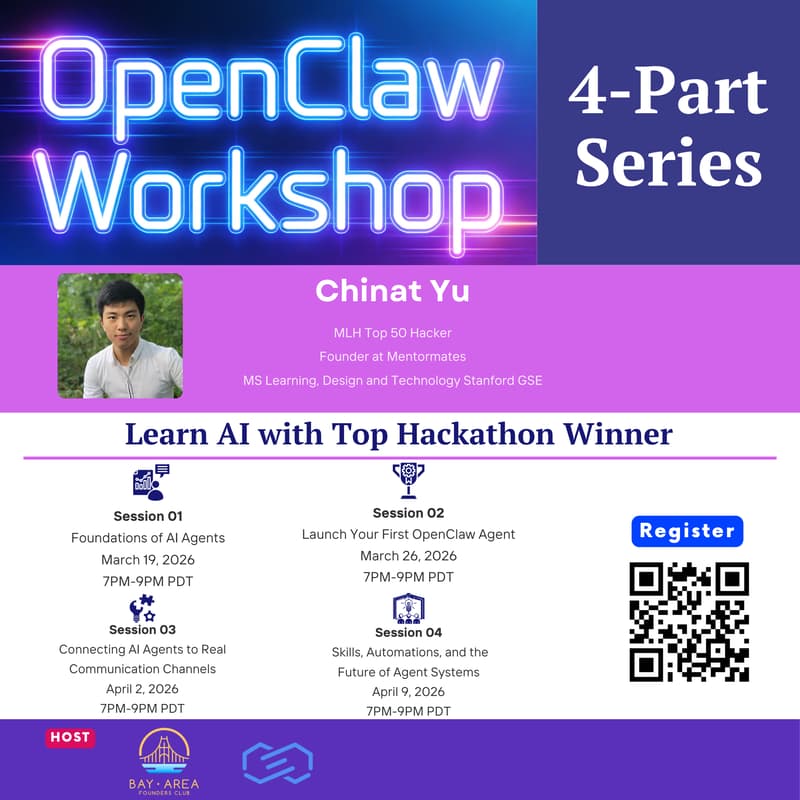

Build Your First OpenClaw AI Agent with a Stanford Mentor - Let AI Work for You 24/7
OpenClaw Workshop Series
Building Cross-Platform AI Agents and the Future of AI Workflows
Join Chinat Yu (Stanford LDT | AI Educator | MLH Top 50) to build your first OpenClaw AI agent—and let AI work for you 24/7.
Overview
Most people still use AI in a fragmented way. They open ChatGPT, ask a few questions, copy results into another tool, then start over again in a new session. These tools are powerful, but they remain isolated, short-lived, and limited to a single interface.
A new paradigm is emerging.
Frameworks like OpenClaw allow you to build persistent AI agents that operate across tools, messaging platforms, and model providers. Instead of using AI in one window, you can create systems where AI works continuously across your digital environment.
OpenClaw makes it possible to connect AI to platforms like Telegram, Slack, Discord, and WhatsApp, switch between models such as OpenAI or Anthropic, maintain long-term memory, and execute workflows that run beyond a single conversation.
This workshop series introduces you to that new layer of AI infrastructure.
Across four sessions, you will move from understanding agent systems to launching your own OpenClaw agents and exploring automation workflows that extend across platforms.
By the end of this series, you will understand how to design and operate AI systems that work for you continuously, not just during a single chat session.
Who This Workshop Is For
This workshop is designed for people who want to move beyond using AI as a simple chat tool and begin building real AI workflows.
It is especially useful for:
Founders and entrepreneurs
who want to automate research, communication, operations, or internal workflows without relying on a single AI vendor.
Creators and knowledge workers
who want an AI assistant that works across tools instead of living inside one chat window.
Developers and technical builders
who are interested in open agent frameworks, modular skills, multi-model orchestration, and persistent AI systems.
Curious professionals and non-technical builders
who want a hands-on introduction to AI agents without needing to build everything from scratch.
Researchers and AI enthusiasts
who want to understand where AI systems are heading, especially around interoperability, memory, and multi-agent networks.
If you feel limited by using ChatGPT or Claude in isolation, this workshop will show you how AI can evolve into a connected system rather than a single tool.
What You Will Learn
During this workshop series, you will learn how modern AI agent systems work and how OpenClaw enables new workflows that traditional chat interfaces cannot support.
You will learn:
How agent systems differ from traditional AI tools
You will understand the difference between an AI model and an AI agent, and why orchestration layers like OpenClaw are becoming important.
How to launch and configure an OpenClaw agent
You will walk through the process of creating an OpenClaw environment, connecting a model provider, and interacting with a working agent.
How to connect AI agents across platforms
You will see how OpenClaw agents can operate through messaging channels like Telegram and communicate beyond the browser.
How AI agents enable automation and productivity systems
You will explore real use cases including research assistants, reminders, summaries, recurring reports, and automated workflows.
How modular skills and workflows work
You will learn how agent capabilities can be structured through modular skills and flexible instruction files such as skill.md.
How memory and observability improve agent systems
You will understand how persistent context and cross-platform logging allow agents to maintain coherent long-term interactions.
Where multi-agent systems are heading
You will explore emerging ideas such as agent-to-agent collaboration, digital twins, and networked AI systems.
Workshop Series Structure
Session 1
Foundations of AI Agents
Date: March 19, 2026
Time: 7PM-9PM PDT
Most people think of AI as a chatbot. This session explains why that model is rapidly evolving.
You will learn:
why chat-based AI tools have structural limitations
the difference between AI models and AI agents
how OpenClaw acts as an orchestration layer
how agents maintain memory and context across sessions
how multiple models can operate inside one agent system
By the end of this session, you will understand the core architecture behind modern AI agent systems.
Session 2
Launch Your First OpenClaw Agent
Date: March 26, 2026
Time: 7PM-9PM PDT
This session focuses on turning theory into a working system.
You will learn how to:
create an OpenClaw environment
configure model providers
launch an agent session
manage prompts and system instructions
observe how the agent operates internally
By the end of this session, you will know how to launch and interact with your own OpenClaw agent.
Session 3
Connecting AI Agents to Real Communication Channels
Date: April 2, 2026
Time: 7PM-9PM PDT
AI agents become far more powerful when they live outside a browser tab.
In this session, you will explore how OpenClaw agents operate across messaging platforms.
You will learn:
how OpenClaw connects to platforms like Telegram
how conversations synchronize across interfaces
how agents maintain state across conversations
what security considerations matter when testing agent systems
By the end of this session, you will understand how AI agents can operate across real communication environments.
Session 4
Skills, Automations, and the Future of Agent Systems
Date: April 9, 2026
Time: 7PM-9PM PDT
The final session explores how AI agents evolve from assistants into automation systems.
You will learn:
how skills enable modular capabilities
how agents execute automation workflows
how persistent memory improves productivity systems
how personal AI assistants can manage recurring tasks
how multi-agent ecosystems may shape the next generation of AI infrastructure
By the end of this session, you will understand how to design AI-powered workflows and begin building your own automation systems.
What You Will Gain From This Series
By the end of the workshop series, you will:
understand how modern AI agent systems are structured
know how to launch and configure an OpenClaw agent
understand how AI agents connect across platforms
learn how skills and workflows extend agent capabilities
gain a framework for building your own AI productivity system
WHAT YOU'LL RECEIVE
Each student will have a chance to complete a project of their own.
Certificates will be awarded upon project completion.
Top projects will receive special recognition and prizes (gift cards).
WHO ARE ATTENDING
The BFC Workshops have now trained 300+ founders, investors, and senior executives across the global innovation ecosystem.
Our participants include:
Partners from leading venture capital firms, including Pear VC
PhDs and postdoctoral researchers from Stanford University
Senior executives from major technology companies, such as Google, Meta, and SAP
Academic leaders, including department chairs from San Francisco State University (SFSU)
These workshops bring together top builders, investors, and operators to learn from one another, exchange cutting-edge insights, and accelerate innovation within the BFC community.
Below is a partial list of our previous participants:
Arash Afrakhteh • Amrut Rajkarne • Anthony H. Lei •Abdulaziz Alrabiah • Alan Louie • Albert Liang • Aleh Manchuliantsau • Amit Nischal • Arzoo Sethi• Bin He Maywah • Bo Long • Brett Bunnell • Claire Kim • Cloris L • Cullen Gray • Emma Wu • Fei Y. • Girish Kulkarni • Ian Darmawan • Ilan Gleiser • Jeanie Fang • Jessie Wu • Jinan Zhou • Jing Dong • John Wu • Zhijiang Li • Justin T. • Leigh Jin • Lesliee Liu • Mala Ramakrishnan • Marisa Erven • Matt Slater • May Spring • Michael Pon • Mingyuan Zhong • Mohinder Sikka • Nadim Sarras • Naoya J Maeda-Nishino, MD , Olivier Pichon • Padmaja Surendranath • Pinaki Aich • Ram Shanmugam • Robert Hsiung • Robin Ren • Rodolfo de Lara Campos • Rumeesa Khalid • Sarthak Chokshi • Shuoyuan He • Sinchana Nama • Sissi Wang • Steve Gu • Syd Porter • Teddy Fang • Tong Shan • Vibhu Narwekar • Will Leung • Xiao A • Yuhao Zhang • Lisa Fei • Cindy Manit 💫 Amy Wilkinson Matthew Cook Chien Jarvis Jingming Li Indy Leonard SangHoon Shin Jaaziel Munoz Vadim Rogovskiy 🇺🇦 Angela K. Fay Christodoulou Dheeraj Goswami Raghav G. Tino Go, Affiliate ASID, Allied AIA Harish Pratapani Julie Candelon Sun Choi Nikhil Racherla Holly Roland Chris Hilton Vinay Mamidi Rodney Cullen Ivana Pignatelli Jeffery Zhou Joshua Silver Phong Nguyen Chris Phelan Mahni Shayganfar, PhD, MBA AyseDeniz Gokcin Nadim Sarras Fay Christodoulou Adeesh Goel Amy Wilkinson Alex Khalin Andre Brandao Gordon Chan Mridula Rahmsdorf Akansha Bansal Gloria DeFelix Jiayi Wang Tianyi Peng Hannah Herzog Boon Chew Alex Maldonado Tatjana Dzambazova Qiwei Li Preeti Anubolu Ann Pierce Weiqi Tian Mekhi Jones Ivan Villa-Renteria Mukesh Kataria, MPH Maddie Bradshaw Vivid N. Savitri Christine Moon Debashish (Deb) Pal sreeprasad Govindankutty Stephen Johnston Michael Stricklen Vibhu Narwekar
ABOUT OUR INSTRUCTOR
Chinat brings elite credentials and practical experience:
Stanford Learning, Design & Technology graduate with expertise in educational innovation
MLH Top 50 honoree recognized for excellence in hackathon organization
Partnerships with Johns Hopkins and Hong Kong PolyU
Check out his previous winning Hackathon projects here
Creator of innovative approaches, making technology accessible to all students and professionals
Award-winning projects: https://devpost.com/cyu60
MLH Top 50 profile: https://top.mlh.io/2023/profiles/chinat-yu
SPACES ARE FILLING FAST! This hands-on workshop is HIGHLY SELECTIVEwith limited enrollment to ensure personalized attention.
About the Host
The Bay Area Founders Club (BFC), founded by Dr. Paul Fang in Silicon Valley in 2022 and managed by a dedicated group of Stanford alumni and students, is a thriving community of over 100,000 members, including more than 5,000 startups and over 1000 venture capital firms. With most startups in our network raising $1-10 million, and some exceeding $20 million, our mission is to empower creators who aspire to make a global impact. We provide the essential resources, support, and connections needed to transform visionary ideas into reality.
Unlock insider access and elevate your founder journey—join BFC Premium NOW.