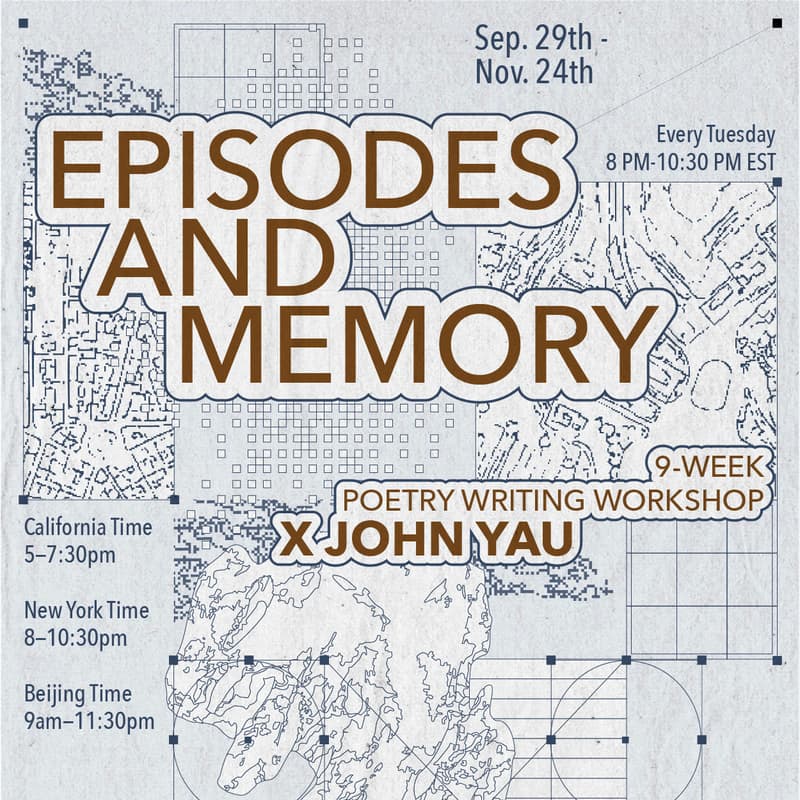

9 Weeks EPISODES AND MEMORY Workshop x John Yau
"Les rats qui construisent le labyrinthe dont ils se sortiront." (Rats who build the labyrinth from which they will escape.)
— Raymond Queneau, founder of OULIPO
Accent Society has invited John Yau, veteran of the American poetry scene and art critic, to teach a 9-week workshop: "Episodes and Memory". "Episode" comes from the Greek epeisodion — the passages in Greek tragedy that exist outside the main narrative, moments that don't constitute plot but constitute atmosphere. We remember things in fragments: the quality of light on a specific afternoon, someone's tone of voice, a smell in the background when something happened. The course departs from Oulipo— the Paris-based group of writers and mathematicians founded in 1960, whose constraint-based methods include writing a 300-page novel without the letter "e" (Perec's La Disparition) or generating one hundred trillion poems from ten sonnets (Queneau's Cent Mille Milliards de Poèmes). But this is not a course only about Oulipo. Where traditional Oulipo practice tends toward objectification — systematizing language, displacing subjectivity — this course asks: what happens when we apply the same formal constraints not to language games, but to memory, identity, personal history and prose poem?
Perec answered this question in W, or the Memory of Childhood, one of the course's core texts: two narrative threads that never directly intersect, yet illuminate each other in the silence between them. Handke answered it in A Sorrow Beyond Dreams, written seven weeks after his mother's suicide, navigating the narrow passage between pure reportage and the danger of letting a real person dissolve into poetic abstraction. Form, in both cases, is ethics.
This class will not hand you a method or help produce a "better poem", but will help you stay open. Every session ends with a question, not an answer. By the end of the six weeks, students will have completed a manuscript ready for submission and publication — a container, finally, for the fragments you have been carrying a long time.
Course Description
The class will explore the changing relationship of word order, sentence, narrative, and paragraph. Conventional writing follows rules, as in the noun (as the subject) precedes the verb (action) precedes the object (The young girl sat on the sofa). What would happen if we substitute different sets of rules for the conventional ones we follow when writing sentences. What if we do not do what is expected without resorting to what academia calls surrealism? Can we surprises ourselves?
This course is rooted in the work of writers who belong to a group known as OULIPO, which was founded in 1960 by Raymond Queneau and François Le Lionnais. Georges Perec wrote a novel, W, or the Memory of Childhood, which alternated between two seemingly disconnected narratives, one of which had to do with being Jewish in France in World War II.
The Oulipo group (an abbreviation of Ouvroir de littérature potentielle, which roughly translates to “workshop of potential literature”) sought to create works using constrained writing techniques instead of the stream of consciousness approach. Queneau defined writers of this group as “rats who construct the labyrinth from which they plan to escape.” Together they devised and documented a series of literary methods constraints, with an emphasis on the playful spirit of the exercise. The purpose of these constraints was to stimulate inspiration and lead them to ideas that would have otherwise eluded them.
Students will use the Oulipo method as a jumping-off point to create manuscripts, which will consist of either one long-form piece or a selection of shorter works. This workshop offers an alternative to the highly saturated market of raw, “stream-of-consciousness” memoirs, and instead reveal how form and constraint exist as equally useful tools toward self expression.
Upon completion of the course, students will have assembled a manuscript that is ready to be sent out for publication. Students will, through this course, become familiar with a lesser known method of writing and gain the tools to implement it long-term in their writing practice.
The first goal: To write in a way that you never have before.
The second goal: To assemble a manuscript of related pieces.
The third goal: To send work out for publication.
What will you accomplish?
By the end of the class, students will have completed a manuscript that is ready to be submitted for publication.
Workshop Time
September 29th - December 1st
Every Tuesday
California Time
5—7:30pm
New York Time
8—10:30pm
Beijing Time
9am—11:30pm
Course space limited to 6-20 people. 3 early bird seats available.
Who is this class for?
This class is aimed for students...
Seeking the support of a veteran writer (and peers) to guide them through preparing their first manuscript for publication.
Eager to push the boundaries of their writing style and experiment with new approaches through constraint-based techniques (the Oulipo method).
Searching for a community of peers to read, write, and explore the literary unconventional alongside.
Non-writers who are looking for an eccentric beginners guide to the writing process.
Workshop Course Outline
This workshop requires students to work on their manuscript as the weekly assignment. Students will share their writing at least two times during the course and receive feedback from John Yau and their peers.
All writing will be uploaded to a central Google Drive for circulation and review prior to class time. Students sharing their writing should upload their materials the day before class.
For the first week, students will discuss their individual projects and outline their goals for the class.
Each student will share a short sample of their writing (no more than 500 words).
Students will decide on a rotational sharing schedule for workshop that will be followed for the duration of the nine weeks.
About the Instructor
Poet, art critic, and curator John Yau has published over 50 books of poetry, fiction, and art criticism. Born in Lynn, Massachusetts in 1950 to Chinese emigrants, Yau attended Bard College and earned an MFA from Brooklyn College in 1978. His first book of poetry, Crossing Canal Street, was published in 1976. Since then, he has won acclaim for his poetry’s attentiveness to visual culture and linguistic surface. In poems that frequently pun, trope, and play with the English language, Yau offers complicated, sometimes competing versions of the legacy of his dual heritages—as Chinese, American, poet, and artist. A contributor for Contemporary Poets wrote: “Yau’s poems [are] often as much a product of his visual sense of the world, as his awareness of his double heritage from both Oriental and Occidental cultures.” Yau’s many collections of poetry include Corpse and Mirror (1983), selected by John Ashbery for the National Poetry Series, Edificio Sayonara (1992), Forbidden Entries (1996), Borrowed Love Poems (2002), Ing Grish (2005), Paradiso Diaspora (2006), Exhibits (2010), and Further Adventures in Monochrome (2012). Yau’s work frequently explores, and exploits, the boundaries between poetry and prose, and his collections of stories and prose poetry include Hawaiian Cowboys (1994), My Symptoms (1998), and Forbidden Entries (1996).
A noted art critic and curator, Yau has also published many works of art criticism and artists’ books. Reviewing Yau’s The United States of Jasper Johns (1996) a Publishers Weekly writer commented: “If you already have a weighty, profusely illustrated book on artist Jasper Johns but are still a little bemused, this is the book to buy.” Yau covers the career of the controversial neo-Dadaist painter, from his 1955 Flag to the 1993 After Holbein, deriving much of his text from interviews conducted with the reclusive Johns over a period of fifteen years. “In graceful, accessible prose,” the Publishers Weekly reviewer noted, “Yau deciphers the many art-historical sources within Johns’s art …[and] is capable of crafting the single phrase, such as ‘visual echo,’ that describes the activity within Johns’s work.” In addition to Johns, who he also wrote about in A Thing Among Things: The Art of Jasper Johns (2008), Yau has written on artists such as Andy Warhol, Joe Coleman, James Castle, and Kay Walkingstick. He has also collaborated with artists Archie Rand, Thomas Nozkowski, and Leiko Ikemura in poetry and art books like Hundred More Jokes from the Book of the Dead (2001), Ing Grish (2005), and Andalusia (2006). Calling Yau a “genius,” Robert Creeley described Ing Grish as a “brilliant train of wildly divergent thought.”
Yau has received many honors and awards for his work including a New York Foundation for the Arts Award, the Jerome Shestack Award, and the Lavan Award from the Academy of American Poets. He has received fellowships from the National Endowment for the Arts, the Ingram-Merrill Foundation, and the Guggenheim Foundation, and was named a Chevalier in the Order of Arts and Letters by France. Yau has taught at many institutions, including Pratt, the Maryland Institute College of Art and School of Visual Arts, Brown University, and the University of California-Berkeley. Since 2004 he has been the Arts editor of the Brooklyn Rail. He teaches at the Mason Gross School of the Arts and Rutgers University, and lives in New York City.
Reading Materials
A Sorrow Beyond Dreams
Peter Handke
One of the most beautiful novels by Nobel laureate Peter Handke, A Sorrow Beyond Dreams, was written seven weeks after his mother's suicide. The translator and author of the foreword, Dr. Amalija Maček, said about the novel: "Due to the lack of love and the possibility of being more than just a housewife and mother in the extremely poor patriarchal environment of Carinthia, Peter Handke's mother took her own life at the age of barely fifty.”
The small, yet brilliant and painfully empathetic narrative book is an attempt at a literary adaptation of this event and at the same time one of the central works of the author's extensive prose, drama and film oeuvre, and a key work of world literature. The focus is not on Peter Handke himself, but rather, rather than death, he talks about the life of his mother, who comes to life before the reader's eyes with all her youthful dreams, singing, dancing, but also with all her stubbornness and inflexibility, with all the suffering in an environment and time that did not allow women personal freedom, let alone romance.
Quotes:
“Horror is something perfectly natural: the mind’s emptiness. A thought is taking shape, then suddenly it notices that there is nothing more to think. Whereupon it crashes to the ground like a figure in a comic strip who suddenly realises that he has been walking on air.”
“I can only move myself into the distance; my mother can never become for me, as I can for myself, a winged art object flying serenely through the air. She refuses to be isolated and remains unfathomable; my sentences crash in the darkness and lie scattered on the paper.”
The Girl Who Fell to Earth
Sophia Al Maria
When Sophia Al-Maria's mother sends her away from rainy Washington State to stay with her husband's desert-dwelling Bedouin family in Qatar, she intends it to be a sort of teenage cultural boot camp. What her mother doesn't know is that there are some things about growing up that are universal. In Qatar, Sophia is faced with a new world she'd only imagined as a child. She sets out to find her freedom, even in the most unlikely of places.
Both family saga and coming-of-age story, The Girl Who Fell to Earth takes readers from the green valleys of the Pacific Northwest to the dunes of the Arabian Gulf and on to the sprawling chaos of Cairo. Struggling to adapt to her nomadic lifestyle, Sophia is haunted by the feeling that she is perpetually in exile: hovering somewhere between two families, two cultures, and two worlds. She must make a place for herself—a complex journey that includes finding young love in the Arabian Gulf, rebellion in Cairo, and, finally, self-discovery in the mountains of Sinai.
The Girl Who Fell to Earth heralds the arrival of an electric new talent and takes us on the most personal of quests: the voyage home.
Quotes:
“Love in the context of youth culture in Qatar was far more complex than anything I had ever seen on MTV. Because segregation between the sexes is so enforced , when a love affair does gain any kind of traction [...] it has to fly below radar.”
““The experience made me realize that the only way to become the person I wanted to be was to remove myself from the people who thought they knew me.”
The Edge of Europe: A Kinetic Image
Pentti Saarikoski
In this late poem-novel-memoir, Saarikoski explores life in the “buffer zones” of language, genre, geography and consciousness. This Finnish poet of the Generation of '68 "shocked his elders in much the same way that William S. Burroughs and Allen Ginsberg jolted the establishment in the United States. Anselm Hollo's translation makes this fluid novel read as though it were written by one of the finest poets in English, not just Finnish, telling a story in a language that surprises not just line by line, but often from the start of one sentence to its end, as it effortlessly sweeps across literature, architecture, rusted cars, trees, nations, beer, history, jogging—life—until it finally, in the finest sense of Ulysses, brings us home again.
Pull-Quote:
Pentti Saarikoski’s The Edge of Europe is one of those novels often imagined but rarely realized: a novel that is as moving as it is funny, a book that is as thoughtful as it is kinetic, as timeless as it is specific to the narrator’s apartment with its entrance hall in Dublin, its living room in Paris, its bedroom in Rome, its office in Budapest, its kitchen in Athens, its sauna in Kerimäki . Anselm Hollo’s translation makes this fluid novel read as though it were written by one of the finest poets in English, not just Finnish, telling a story in language that surprises not just line by line, but often from the start of one sentence to its end, as it effortlessly sweeps across literature, architecture, rusted cars, trees, nations, beer, history, jogging-life-until it finally, in the finest sense of Ulysses, brings us home again.
– Steve Tomasula, author of The Book of Portraiture
W, or the Memory of Childhood
Georges Perec
W or The Memory of Childhood is a narrative that reflects a great writer’s effort to come to terms with his childhood during the Nazi occupation of France.
Perec tells two parallel stories. The first is autobiographical, describing his wartime boyhood. The second tale, denser, more disturbing, more horrifying, is the allegorical story of W, a mythical island off Tierra del Fuego governed by the thrall of the Olympic “ideal,” where losers are tortured and winners held in temporary idolatry. As the reader soon discovers, W is a place where “it is more important to be lucky than to be deserving,” and “you have to fight to live...no recourse, no mercy, no salvation, not even any hope that time will sort things out.”
Perec’s memory of the Holocaust and vision about its meaning has resulted in an astonishing achievement that stands with the best of his work.
Quotes:
“I write: I write because we lived together, because I was one of them—a shadow among their shadows, a body close to their bodies; I write because they left their indelible mark upon me, and writing is the trace of that mark: their memory has died into writing; writing is the memory of their death and the affirmation of my life.”
“But childhood is neither nostalgia, nor terror, nor a lost paradise, nor a Golden Fleece; it is perhaps a horizon, a starting point, the coordinates from which the axes of my life might find their meaning. Even though I have nothing to substantiate my improbable memories but the aid of yellowed photographs, rare accounts, and meager documents, I have no choice but to evoke what for too long I called the irrevocable—what was, what came to a halt, what was brought to a close: what existed, only to cease being today, yet what also existed so that I might still be.”
Diary of Small Discontents
New & Selected Poems
John Yau
This collection brings together work from half a century of writing by John Yau. Preoccupied with forms and musical structures, Yau’s work includes sestinas, sonnets, pantoums, and lists, as well as invented forms. Employing both strict and open-ended frameworks, Yau creates multi-faceted poems that can shift abruptly from humor to outrage and consider topics including Chinese American identity, school shootings, invented countries, and haunted memories. Some poems are grounded in an autobiographical voice, while others take on the voices of other characters, including contemporary artists and a fictional Chinese private eye.
John Yau on Writing
“One of the ways I write is—say with the “O Pinyin Sonnets”—I’d write in pursuit of something until I couldn’t stand it any more. So once it’s done I don’t want to go back to it. This means I end up with lots of different kinds of poems and uses of language. I always think it’s interesting to reach the end of something where you don’t know what the next thing will be. I like making up a language that you can imagine is being used. That’s really something I think poems can do. It’s like reading Shakespeare or detective novels: they have a kind of slang in them. I’m interested in street language/vernacular that people use. Jean-Michel Basquiat was interested in this. There’s an imagined vernacular—the langue de tribe—that helps show how things are.” — Literary Hub
“I try to turn what I read and hear into music. I wanted to inhabit that language as well as shape it. I wanted to get to the creepy intimacy they evoke because the speakers of these poems know someone is in agreement with them. They have an audience.” — Literary Hub
‘We live in different registers of sound. Being Chinese-American in America doesn’t mean you can only write poems about being the child of immigrants. How many different ways do you exist in the world and in your imagination? How many different voices, intonations and expressions do you hear? Can you listen to them all? In poetry, there’s this thing called voice: it’s about being sincere or transparency. I’m not interested in that. Whitman embraces multitudes. Shouldn’t it include their voices, not just his superimposed over them all? Can we listen to what they are saying?” — Literary Hub
“An artist’s job is to be open to experimenting and trying everything — trying new mediums, new materials. I admire artists that don’t have a style. That was a big influence from the art world — that I didn’t want to have a style…” — LA Review of Books Interview
SAMPLE POEMS:
Ing Grish
“You need to speak Singlish to express a Singaporean feeling.”
- Catherine Liu
I never learned Singlish.
I cannot speak Taglish, but I have registered
the tonal shifts of Dumglish, Bumglish, and Scumglish.
I do not know Ing Grish, but I will study it down to its
black and broken bones.
I do not know Ing Gwish, but I speak dung and dungaree,
satrap and claptrap.
Today I speak barbecue and canoe.
Today I speak running dog and yellow dog.
I do not know Spin Gloss, but I hear humdrum and humdinger,
bugaboo and jigaboo.
I do not know Ang Grish, but I can tell you that my last name
consists of three letters, and that technically all of them are vowels.
I do not know Um Glish, but I do know how to eat with two sticks.
Oh but I do know English because my father’s mother was English
and because my father was born in New York in 1921
and was able to return to America in 1949
and become a citizen.
I no speak Chinee, Chanel, or Cheyenne.
I do know English because I am able to tell others
that I am not who they think I am.
I do not know Chinese because my mother said that I refused to learn it
from the moment I was born, and that my refusal
was one of the greatest sorrows of her life,
the other being the birth of my brother.
I do know Chinese because I understood what my mother’s friend told her
one Sunday morning, shortly after she sat down for tea:
“I hope you don’t that I parked my helicopter on your roof.”
Because I do not know Chinese I have been told that means
I am not Chinese by a man who translates from the Spanish.
He said that he had studied Chinese and was therefore closer
To being Chinese than I could ever be. No one publicly disagreed with him,
Which, according to the rules of English, means he is right.
I do know English and I know that knowing it means
that I don’t always believe it.
The fact that I disagree with the man who translates from the Spanish
is further proof that I am not Chinese because all the Chinese
living in America are hardworking and earnest
and would never disagree with someone who is right.
This proves I even know how to behave in English.
I do not know English because I got divorced and therefore
I must have misunderstood the vows I made at City Hall.
I do know English because the second time I made amarriage vow
I had to repeat it in Hebrew.
I do know English because I know what “fortune cookie” means
when it is said of a Chinese woman.
The authority on poetry announced that I discovered that I was Chinese
When it was to my advantage to do so.
My father was afraid that if I did not speak English properly
I would be condemned to work as a waiter in a Chinese restaurant.
My mother, however, said that this was impossible because
I didn’t speak Cantonese, because the only language
waiters in Chinese restaurants know how to speak was Cantonese.
I do not either Cantonese or English, Ang Glish or Ing Grish.
Anguish is a language everyone can speak, but no one listens to it.
I do know English because my father’s mother was Ivy Hillier.
She was born and died in Liverpool, after living in America and China,
and claimed to be a descendants of the Huguenots.
I do know English because I misheard my grandmother and thought
she said that I was a descendant of the Argonauts.
I do know English because I remember what “Made in Japan” meant
when I was a child.
I learn over and over again that I do not know Chinese.
Yesterday a man asked me how to write my last name in Chinese,
because he was sure that I had been mispronouncing it
and that if this was how my father pronounced it,
then the poor man had been wrong all his life.
I do not know Chinese even though my parents conversed in it every day.
I do know English because I had to ask the nurses not to put my mother
in a straitjacket, and reassure them that I would be willing to stay with her
until the doctor came the next morning.
I do know English because I left the room when the doctor told me
I had no business being there.
I do not know Chinese because during the Vietnam War
I was called a gook instead of a chink and realized
that I had managed to change my spots without meaning to.
I do not know English because when father said that he would
like to see me dead, I was never sure quite what he meant.
I do not know Chinese because I never slept with a woman
whose vagina slanted like my mother’s eyes.
I do not know either English or Chinese and, because of that,
I did not put a gravestone at the head of my parents’ graves
as I felt no language mirrored the ones they spoke.
Chinese Villanelle
I have been with you, and I have thought of you
Once the air was dry and drenched with light
I was like a lute filling the room with description
We watched glum clouds reject their shape
We dawdled near a fountain, and listened
I have been with you, and I have thought of you
Like a river worthy of its gown
And like a mountain worthy of its insolence. . .
Why am I like a lute left with only description
How does one cut an axe handle with an axe
What shall I do to tell you all my thoughts
When I have been with you, and thought of you
A pelican sits on a dam, while a duck
Folds its wings again; the song does not melt
I remember you looking at me without description
Perhaps a king's business is never finished,
Though "perhaps" implies a different beginning
I have been with you, and I have thought of you
Now I am a lute filled with this wandering description
O Pin Yin Sonnet 15
We’re not talking about Asians; we’re talking about China
It is smart business to name a restaurant chain after a cuddly bear
Who happens to be a vegetarian, but it is another thing
To go big-game hunting in the African savanna
I would just as soon turn a panda into a huggy coat or hat.
Importing kudu horns or making a zebra into a rug—
This is real and different. For one thing, it’s permanent,
Not just a bowl of green weeds and brown meat scrape
Gobbled, wolved, or slurped up or jammed down with sticks
Standing beside a dead giraffe that you shot on a hot day
Proves something about the depth of your character
I respect a man or woman that displays big-game trophies
We had Teddy Roosevelt, his Big Stick policy and Rough Riders
What does China have: old men with canes and fallen zippers