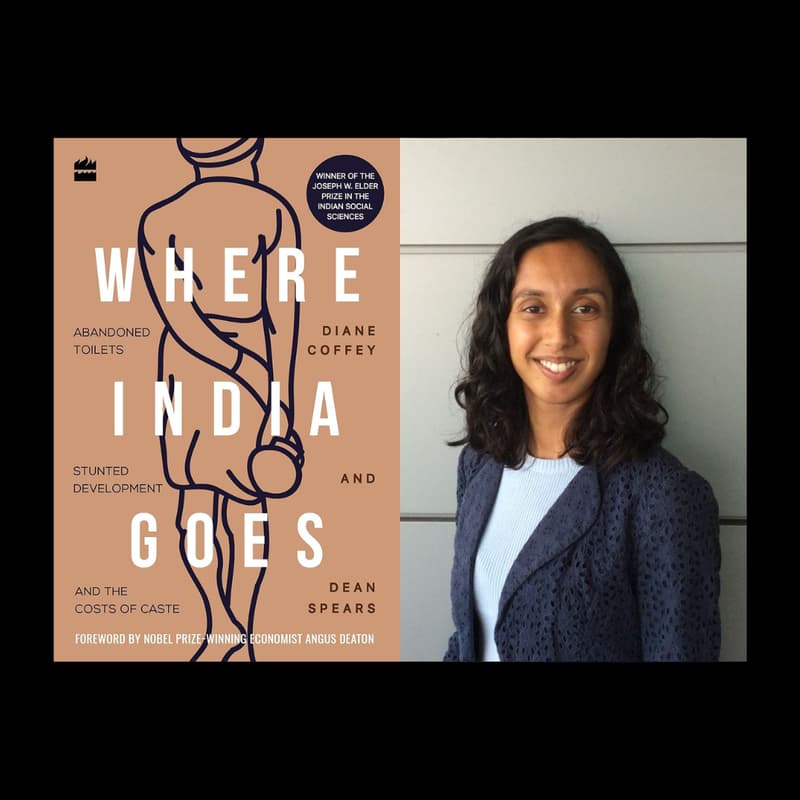
Reading Group: "Where India Goes" with Dr. Sangita Vyas
Join us to discuss "Where India Goes: Abandoned Toilers, Stunted Development, and the Costs of Caste" with Dr. Sangita Vyas.
Around the world, people live longer, better lives than in centuries past, in part because of the rapid adoption of latrines and toilets that keep faecal germs away from growing children. India is an exception. Compared to the rest of the world, latrine and toilet adoption in India has been very slow and open defecation remains far too common. This is one reason why infants in India are more likely to die than in neighboring poorer countries like Bangladesh and Nepal, and are more likely to be stunted than children in sub-Saharan Africa. Because early-life conditions have life-long consequences, when children cannot develop to their potential, economic development is stunted, too. "Where India Goes" demonstrates that India's exceptional open defecation is not the result of poverty. It is an enduring consequence of the caste system, untouchability, and ritual purity. Dr. Diane Coffey, along with her co-author Dr. Dean Spears tells an unsanitized story of an unsanitary subject, with characters spanning the worlds of rural development policy --- from mothers and babies living in villages to local government implementers, senior government policy-makers and international development professionals
Sangita Vyas is a development economist and demographer. She is an Assistant Professor in Economics at CUNY Hunter College. Her research focuses on the interrelationships among health, the environment, and social inequality in India. In 2013, she started working with r.i.c.e., a non-profit research organization which aims to inform child health policy in India. Here, she designed and implemented multiple quantitative and qualitative field research projects in rural north India, including the SQUAT Survey, which forms the evidence base for the book.