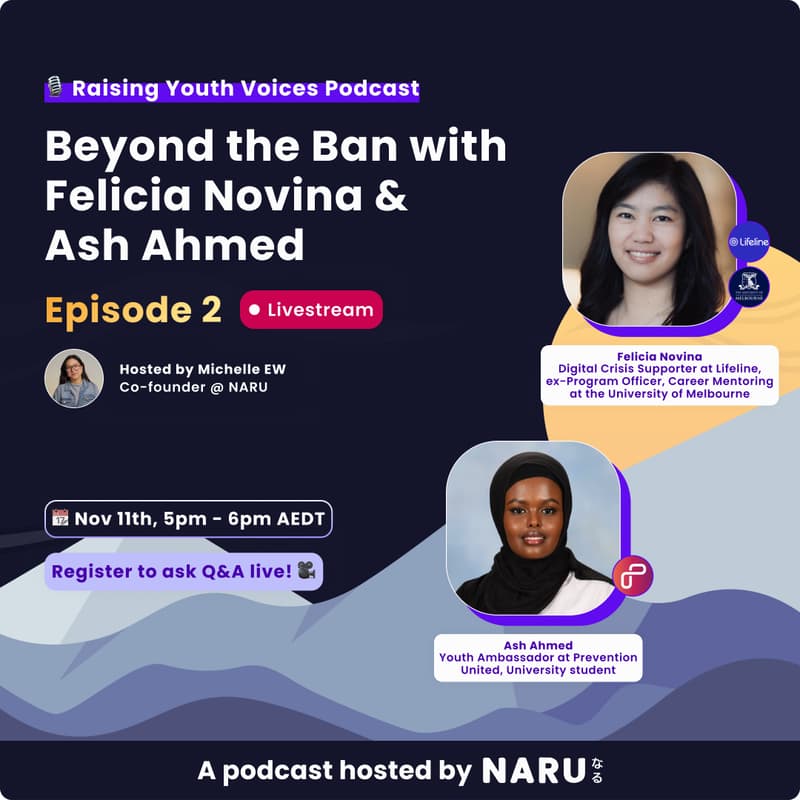

Beyond the Ban - Episode 2 with Felicia Novina & Ash Ahmed
Register to receive a link to the podcast recording after the session. 🎥
Beyond the Ban: Are We Cutting Off Digital Lifelines for Youth?
Not every young person has someone to turn to at home, at school or down the street.
For some, the first place they found a mentor, a community that felt like theirs, or the courage to ask for help was online.
Australia’s under-16 social media restrictions are designed to protect young people. That goal deserves to be taken seriously.
But protection has a cost to weigh. So what happens to the young person who found their people online and has to start again?
Meet the Guests
Felicia Novina is a Digital Crisis Supporter at Lifeline and former Program Officer, Career Mentoring at the University of Melbourne.
She arrived in Melbourne from Indonesia as an international student in 2015 and had to build her support network from scratch. She was in her early 20s and despite it being her lifelong dream to study abroad, loneliness was still a big part of her journey.
Her lived experience as an international student motivated her to give back and she’s been supporting students through various mentoring programs at the university since 2018. She also volunteers as a Digital Crisis Supporter with Lifeline, responding to people in distress through online chat and text.
Both roles have shown her how people reach out for help in digital spaces and why.
We will be joined by our youth guest, Ash Ahmed, an emerging young leader, Youth Ambassador at Prevention United and undergraduate university student.
She has 6 years of volunteering experience working with young peers in grass-root communities, facilitation and co-design for youth causes. Her commitment is fuelled by her passion for the community, youth rights, bridging the gap of prevention in youth issues, and promoting civic dialogue in a dynamic environment.
Together, we’ll uncover how the ban has really changed young people’s lives.
What we'll explore
Where do young people turn when they can’t tell a parent or teacher?
Explore digital crisis support, anonymity, and whether a peer or mentor feels easier to approach than another adult.What does belonging look like for a 14-year-old?
Ask how everyday online interactions sustain friendships and how online communities relate to friendships at school.Who might lose an important route to connection?
Consider neurodiverse young people, those with disabilities, and young people in rural or regional, LGBTQ+ and culturally diverse communities, without assuming they are affected in the same way.Are the remaining spaces enough?
Where can young people now find support and community (online, at school, or through clubs and local groups) and which needs remain unmet?What should adults do differently?
How can parents, educators and policymakers listen to young people’s experiences and involve them in decisions without assuming they already know what young people need?What should be built next?
Explore how young people could help design safe, accessible ways to find connection and mental health support.
Who should attend?
This conversation is for people who work with, care about or design for young people:
Parents and carers
Educators and school leaders
Youth organisations and youth workers
Community builders
Researchers and policymakers
People working in youth wellbeing and digital safety
Anyone trying to understand how young people will build connection in a changing digital world
You don't need to work in technology to join the conversation.
If young people are part of your work, this conversation is for you.
About NARU
NARU is exploring what safe digital community can look like for young people in a world where the way they connect online is changing.
We believe young people still need places to build friendships, find belonging, learn from their peers and participate in communities.
The question is what those spaces should look like.
That means listening to the people closest to the issue, young people, parents, educators, youth organisations, researchers and community leaders.
This conversation is part of that work.