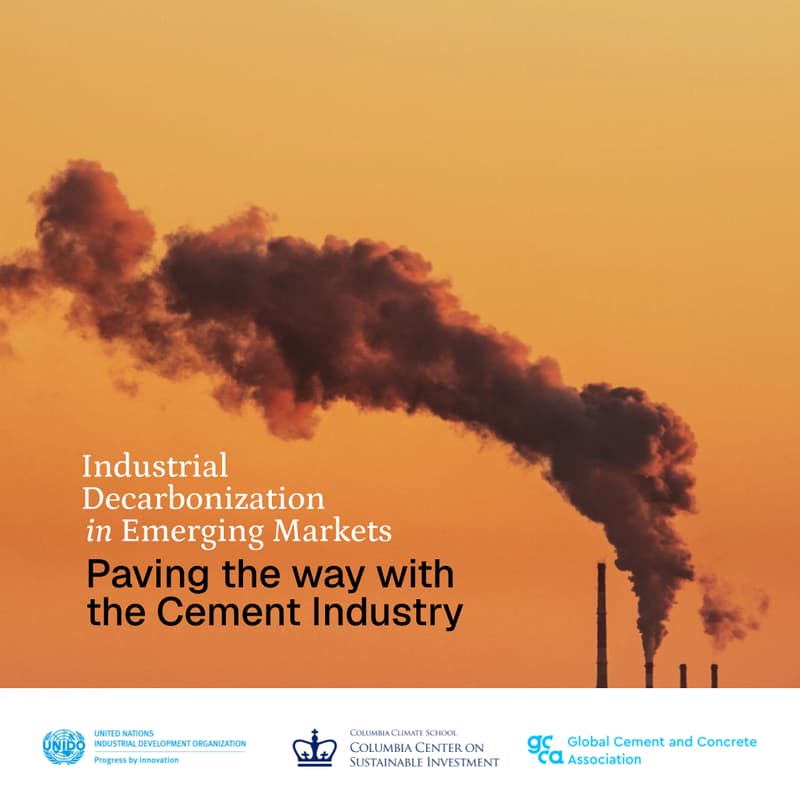

Financing Industrial Decarbonization at Scale, Starting with Cement: The Investment Case
Hosted by
United Nations Industrial Development Organization (UNIDO), the Columbia Center on Sustainable Investment (CCSI), and the Global Cement and Concrete Association (GCCA).
About this event
An invitation-only, moderated roundtable convening cement-sector leaders, financiers, and governments to examine the policy, financing, data, and risk-pricing requirements for decarbonizing hard-to-abate industry, with cement as a proof point for assessing project bankability.
Industrial decarbonization in emerging markets and developing economies (EMDEs) will be critical to achieving global emissions-reduction goals. Yet financing the transition remains challenging for a range of reasons. This event will examine those barriers and explore how they can be addressed, including through better system-level policy, financing mechanisms, plant-level data, and accurate pricing of risk.
The so-called "hard-to-abate" industries are material contributors to global CO₂ emissions; cement production alone accounts for roughly 7% of the total, making cement and concrete an important part of the decarbonization strategy. Cement is a key starting point: decision-making in the sector is relatively concentrated compared with more fragmented sectors, and the Global Cement and Concrete Association (GCCA) brings together major cement and concrete producers to drive innovation and collaboration around the technologies and approaches needed to decarbonize the sector. First-generation decarbonization measures, from waste-heat recovery to alternative fuels and clinker substitutes like LC3, are already commercially viable and deployed in various markets.
The open question is how to scale cement decarbonization across EMDEs at the speed climate science requires. High perceived risk usually translates into a higher cost of capital, and barriers remain across plant- and sector-level data, including economics, infrastructure access, system-level policy, financing mechanisms, risk-sharing instruments, and impact monitoring.
This roundtable will use cement decarbonization as a proof point for how industrial transition can be financed at scale in EMDEs. We are convening a curated group of 30–40 participants – EMDE government representatives, chief officers from GCCA member companies, banks and asset managers active in transition finance, multilateral and development finance institutions, equity investors and strategists, climate philanthropy, and research and data experts – for a focused working session, so that the participants' collective experience can contribute to the path forward.
After the event, a networking session will be held.