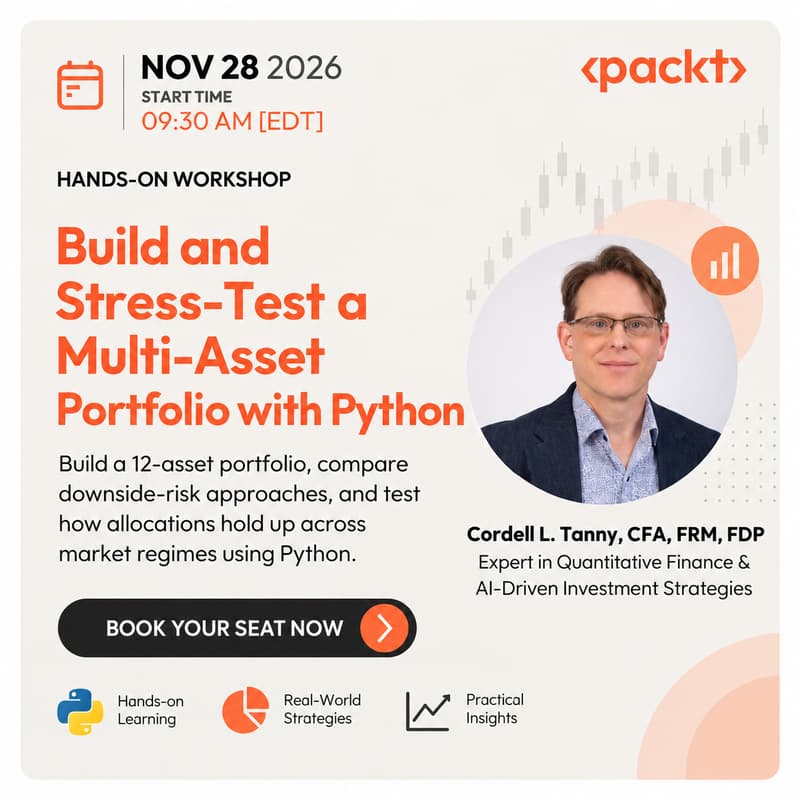

Build and Stress-Test a multi-asset portfolio with Python
Build and stress-test a multi-asset portfolio using Python in this practical, hands-on workshop designed for finance and investment people
Hands-on with Cordell Tanny: build and stress-test a multi-asset portfolio with Python using institutional portfolio construction and risk management techniques.
Join Cordell Tanny, CFA, FRM, FDP, for a hands-on workshop focused on how institutional allocators construct and evaluate portfolios at the asset-class level. Working with a real 12-asset universe covering global equities, government bonds, credit, inflation protection, real assets, and cash, you will build and assess your own portfolio in Python.
The workshop goes beyond standard mean-variance optimization. You will use simulation and block bootstrapping to develop portfolio inputs, compare traditional optimization with CVaR and downside-target approaches, examine how diversification changes during stressed markets, and evaluate allocations across different market regimes. You will also explore sequence-of-returns risk, risk contribution, and the effect of stale pricing on illiquid assets. The session closes with a practical AI-assisted exercise that turns portfolio risk output into a clear investment risk memo.
The workshop runs for approximately four hours and includes two short breaks. Attendees receive the complete 12-asset case study, reusable Python notebooks, supporting code, a factor model reference notebook, and templates you can adapt to other portfolios.
By the end of this workshop, you’ll have:
Analyzed the return, volatility, skew, kurtosis, correlation, and diversification characteristics of major asset classes.
Built portfolio inputs using parametric simulation and block bootstrapping rather than relying on a single historical estimate.
Measured drawdowns, recovery periods, sequence-of-returns risk, and downside performance using Sortino, Calmar, and Omega ratios.
Constructed an efficient frontier and compared mean-variance portfolios with CVaR and downside-target allocations.
Decomposed portfolio risk by asset class and examined how correlations and portfolio behaviour change across market regimes.
Explored how stale pricing can understate the volatility and correlation of illiquid assets.
Used an LLM to turn stress-test and risk-contribution results into a plain-English portfolio risk memo.
Walked away with reusable Python notebooks, case study data and code, a factor model reference notebook, and portfolio templates.
This workshop is ideal for:
Portfolio managers and investment analysts who want to strengthen their quantitative asset allocation process.
Asset allocators and investment consultants responsible for constructing or reviewing multi-asset portfolios.
Quantitative analysts and researchers interested in portfolio optimization, risk measurement, and stress testing.
Risk professionals who want to examine downside risk, tail dependence, risk contribution, and regime behaviour.
Python developers and data scientists looking to apply their skills to portfolio construction and investment management.
Finance students and professionals seeking practical experience with institutional portfolio analysis in Python.
Prerequisites
Technical: A laptop with a stable internet connection and access to a Python notebook environment. Setup instructions and workshop materials will be shared in advance.
Libraries: The required open-source Python libraries will be specified in the workshop repository. Attendees should complete the environment check before the session.
Data: The 12-asset case study data and supporting code will be provided. No brokerage account is required.
Optional: Access to an LLM will be useful for following the AI-assisted risk memo exercise. The recommended platform and access requirements will be confirmed before the workshop.
Experience: Attendees should be comfortable with basic Python and working with tabular data. Familiarity with portfolio concepts such as returns, volatility, correlation, diversification, and the Sharpe ratio will be helpful. Advanced optimization, machine learning, or institutional portfolio management experience is not required.