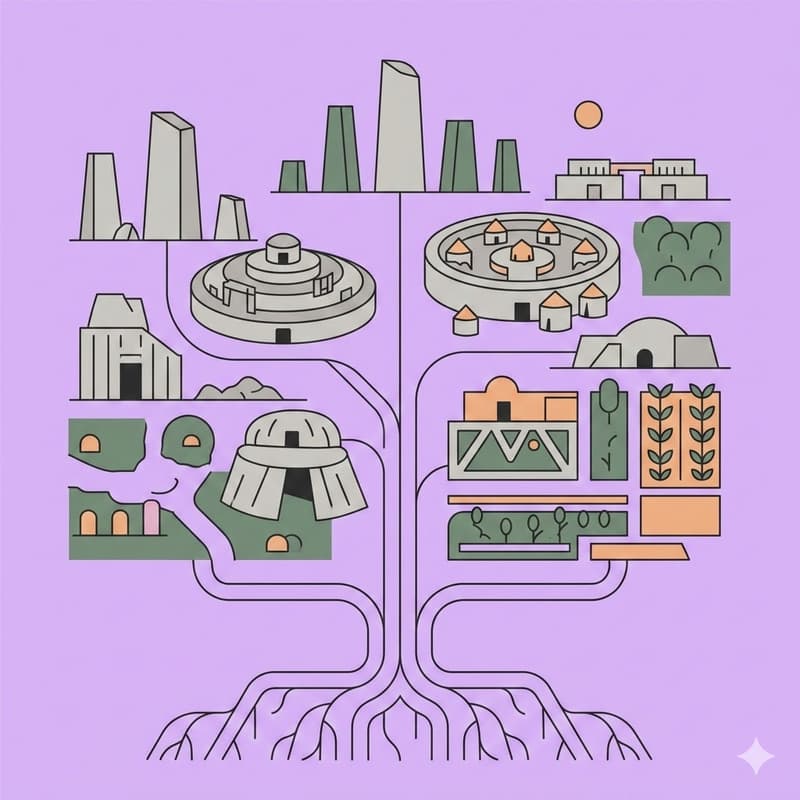

Decentralization Is Humanity's Default Mode by David Wengrow
The standard account of early human history is familiar: small egalitarian bands gave way to agriculture; agriculture produced surplus; surplus produced hierarchy; hierarchy culminated in the state. Inequality, in this telling, is the price of scale and complexity.
This narrative is elegant. It is also misleading.
Drawing on archaeological research from Africa, the Americas, Eurasia, and the Pacific — and on the arguments developed in The Dawn of Everything — this seminar reconsiders the foundational assumptions about how cities, property, governance, and social stratification emerged.
The historical record reveals something far less linear and far more interesting:
Agricultural societies that resisted permanent hierarchy
Cities organized without centralized sovereign authority
Seasonal alternations between authoritarian and egalitarian structures
Political experimentation over millennia rather than a single “revolution”
The question is not simply when inequality began. It is why we remain committed to a story that treats it as inevitable.
This course revisits deep history not as nostalgia or utopian speculation, but as institutional inquiry. If early societies repeatedly constructed — and dismantled — different forms of power, then the range of possible political arrangements today may be wider than commonly assumed.
Format
Five-week live seminar
90 minutes per session
Lecture + moderated discussion
Closed cohort
Weekly Outline
Day 1 — The Myth of Linear Progress
How Enlightenment debates shaped modern assumptions about “primitive” and “civilized” societies. Why the question of “the origins of inequality” may be incorrectly framed.
Day 2 — Indigenous Political Thought and the Critique of Europe
How non-European political traditions challenged European ideas of hierarchy, property, and freedom — and helped shape modern political discourse.
Day 3 — Agriculture Without Destiny
Why farming did not mechanically produce private property or centralized states. Evidence of gradual adoption, rejection, and institutional reversibility.
Day 4 — Cities Without Kings
Archaeological evidence of large-scale urban organization without entrenched ruling classes. Rethinking the relationship between complexity and domination.
Day 5 — The State as Contingency
Disaggregating sovereignty, bureaucracy, and charismatic authority. Why political centralization was neither uniform nor inevitable — and what that implies for contemporary institutional design.
Who This Seminar Is For
Institutional designers and governance researchers
Historians, anthropologists, political theorists
Technologists working on coordination systems
Builders exploring non-centralized forms of organization
No prior background in archaeology required.
Why It Still Matters
How we narrate the past shapes what we consider possible in the present.
If hierarchy is not a natural endpoint of human development — if centralized authority is not the unavoidable result of scale — then contemporary debates about governance, decentralization, and collective decision-making look different.
Re-examining early civilization is not an antiquarian exercise. It is a reassessment of the conceptual limits we have placed on ourselves.