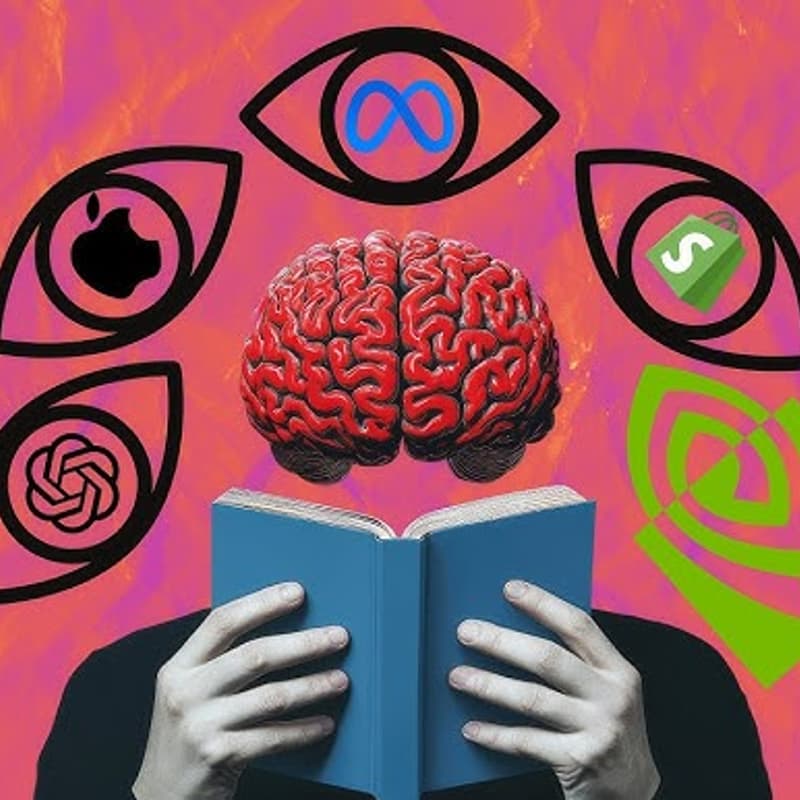

Recipe for Cognitive Currencies
Why do people behave irrationally or altruistically? The advent of behavioral economics in the 1970s challenged the standard assumption that people act as rational, self-interested calculators, showing instead that our decisions are systematically shaped by cognitive biases and mental shortcuts. Decades earlier, the Cognitive Revolution of the 1950s had already cracked open the mind, proving that internal states like memory, perception, and problem-solving could be modeled directly rather than inferred from behavior alone. Now, as an "attention economy" competes to hijack our dopamine circuitry and an "intention economy" races to anticipate our desires before we act, computational science and personalized algorithms are raising the possibility of pricing and paying with attention, judgment, identity, and other cognitive currencies. Join us to figure out what this means for human capital.
SCHEDULE
We will open with a special advance screening of Adam Smith: The Currency of Thought, a documentary on the 18th-century Scottish economist Adam Smith who many credit with some of the root ideas of behavioral economics.
From there, we'll do a groupthink on the kinds of cognitive economies that can be produced by emerging tech. Then we will eat dessert in silence.
We'll close with a reflection session, augmented by a new tool from the Experiments in Reflection team at Stanford d.school.
By registering for this event, you are confirming you will be able to attend for the entire duration of the event.
Cohosted with Pace Capital