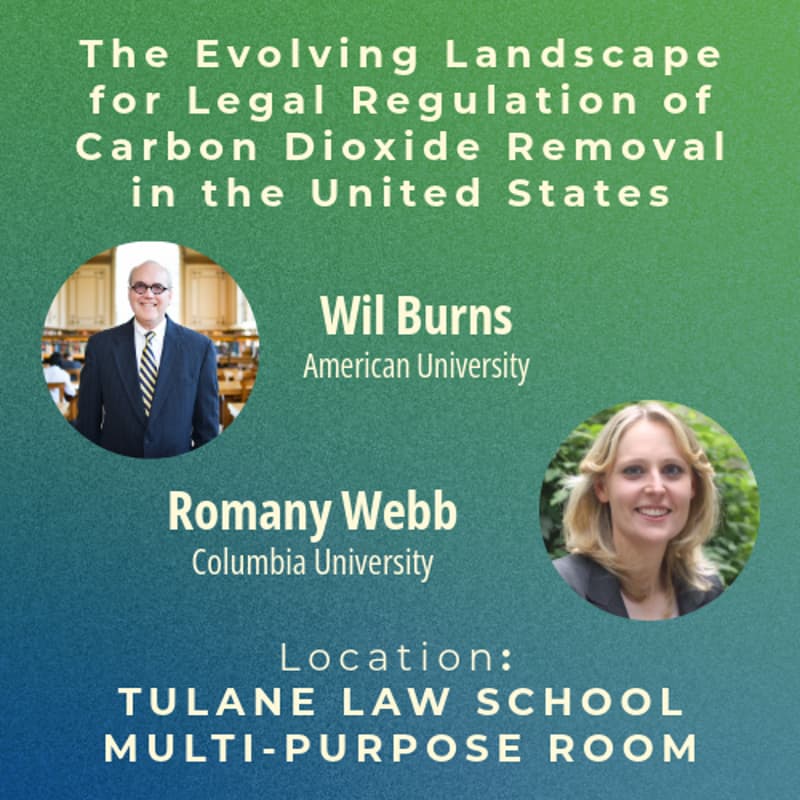

The Evolving Landscape for Legal Regulation of Carbon Dioxide Removal in the United States
PANEL DESCRIPTION
As carbon dioxide removal (CDR) technologies are presented as environmental solutions, they are raising complex and unresolved legal questions across multiple areas of U.S. environmental and natural resources law. This panel will examine the developing legal framework governing CDR and implementing CDR, with a particular focus on the challenges of siting terrestrial and marine CDR technologies and the emerging domestic efforts to regulate these approaches. Panelists will explore how existing statutes, coastal and ocean management laws, and property law are being applied or adapted to CDR and the implications for permitting, property use, environmental reviews, and community engagement. The discussion will also address regulatory gaps, prospects for future regulatory legislation or agency guidance, and nonlegislative solutions as the United States navigates the governance of CDR at scale.
Moderated by Preston Carley.
WIL BURNS, AMERICAN UNIVERSITY
Wil Burns is the Founding Co-Director of the Institute for Responsible Carbon Removal at American University’s School of International Service (SIS) in Washington, DC and a Professor in the School of International Service. He is the former Associate Director of the Environmental Policy and Culture Program at Northwestern University. He has taught at a number of other universities, including John Hopkins University, where he served as the Director of the Energy Policy & Climate Program, the University of Chicago, Stanford University, and the University of California-Berkeley. He has taught in professional, graduate and undergraduate programs, as well as at law schools.
Prior to becoming an academic, he served as Assistant Secretary of State for Public Affairs for the State of Wisconsin and worked in the non-governmental sector for twenty years, including as Executive Director of the Pacific Center for International Studies, a think-tank that focused on implementation of international wildlife treaty regimes, with a focus on the International Convention for the Regulation of Whaling.
He is also the former President of the Association for Environmental Studies & Sciences, (and recipient of the organization’s Lifetime Achievement Award for his academic and service contributions in the field), as well as the former Co-Chair of the International Environmental Law interest group of the American Society of International Law and Chair of the International Wildlife Law Interest group. He also served as a Senior Research Fellow for the Centre for International Governance Innovation (CIGI), and Co-Chair of the International Environmental Law Committee of the American Branch of the International Law Association. He also served as founder and Editor-in-Chief of the Journal of International Wildlife Law & Policy, as well as Case Studies in the Environment.
He holds a Ph.D. in International Environmental Law from the University of Wales-Cardiff School of Law, where he completed his thesis on the Agreement on the Conservation of Cetaceans of the Black Sea, Mediterranean Sea and Contiguous Atlantic Area (ACCOBAMS). He has published over 80 articles and chapters in law, science, and policy journals and books, and has co-edited four books.
ROMANY WEBB, COLUMBIA UNIVERSITY
Romany Webb is Deputy Director of the Sabin Center for Climate Change Law. Romany also holds appointments as a Research Scholar at Columbia Law School, Adjunct Associate Professor of Climate at the Columbia Climate School, and Senior Advisor on Climate Science at the Columbia Graduate School of Journalism. Romany’s research focuses on two primary areas: (1) energy and (2) negative emissions technologies. Romany’s energy-related research explores how legal and policy tools can be used to minimize the climate impacts of energy development as well the impacts of climate change on energy infrastructure. Romany also researches legal issues associated with the development and deployment of negative emissions technologies on land and in the ocean.
Between 2020 and 2023, Romany served as a vice chair and then co-chair of the Climate Change, Sustainable Development, and Ecosystems Committee of the American Bar Association’s Section of Environment, Energy, and Resources. Romany also served on the National Academy of Sciences, Engineering, and Medicine Committee on Ocean Carbon Dioxide Removal and Sequestration from 2020 to 2022. In 2024, she was appointed to the Pool of Experts of the United Nations Regular Process for Global Reporting and Assessment of the State of the Marine Environment, and invited to be a contributing author of the Third UN World Ocean Assessment. She also serves on a number of other advisory boards, councils, and committees.
Prior to joining the Sabin Center, Romany worked at the University of California Berkeley Energy and Climate Institute, researching executive authority to combat climate change. Romany also completed a fellowship with the Kay Bailey Hutchison Center for Energy, Law, and Business at the University of Texas at Austin, where she researched energy policy. The fellowship followed several years working in private practice in Sydney, Australia.
Romany received an LL.M., with a certificate of specialization in environmental law, from the University of California, Berkeley in 2013. She also holds an LL.B., awarded with first class honors, from the University of New South Wales (Australia).