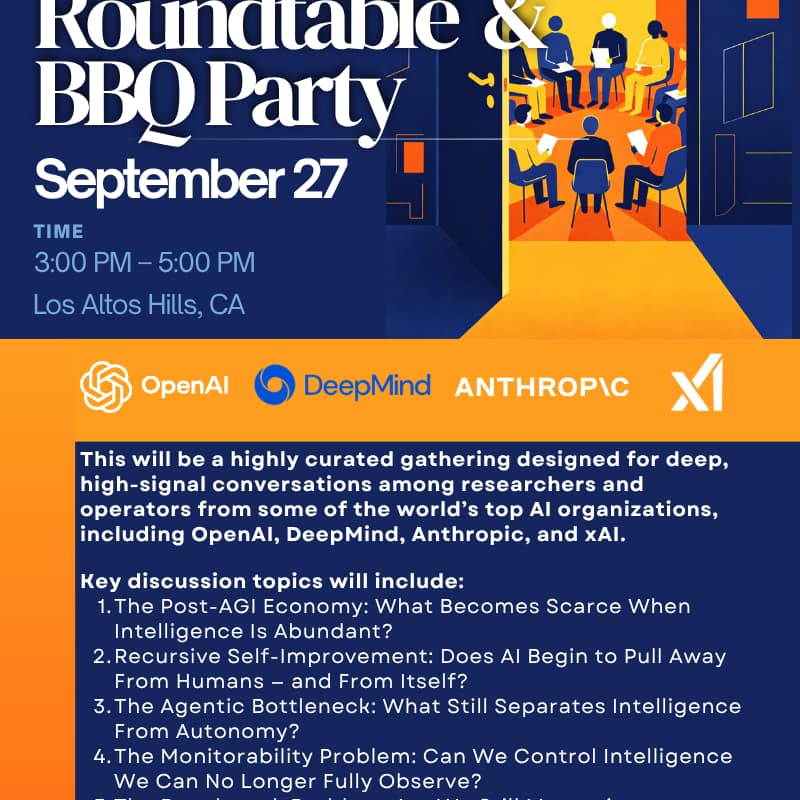

Top AI Researchers Roundtable & BBQ Party in Los Altos Hills
Event Overview
Last month, Bay Area Founders Club and NextFin hosted our 3rd Top AI Researchers Roundtable & Private BBQ in Woodside Hills, bringing together a highly curated group of AI researchers, founders, investors, and industry leaders for a candid, off-the-record discussion on the future of artificial intelligence. The discussion was moderated by Xuedong Huang, CTO of Zoom. Our attendees included:
• Ed Chi — VP of Research at Google DeepMind
• 4 researchers from OpenAI
• 2 researchers from Anthropic
• 8 researchers from Google DeepMind
• 2 researchers from xAI
• 3 researchers from NVIDIA
• 2 Stanford professors
The response exceeded our expectations.
Several participants told us that the caliber of people brought together at the Top AI Researchers Roundtable was truly exceptional, and that the conversations were among the most substantive they’ve had since arriving in the Bay Area.
So we’re doing it again.
On September 27, from 3:00 PM to 5:00 PM, we will host the fourth edition of our Top AI Researchers Roundtable, bringing together leading AI researchers from organizations such as OpenAI, Google DeepMind, Anthropic, xAI, and other frontier AI companies and research institutions.
This will be a fully closed-door, off-the-record conversation focused on the future of AI systems—from frontier research breakthroughs and emerging technical challenges to the next wave of opportunities that could shape the industry over the coming years.
Following the roundtable, guests will continue the discussion over a private BBQ reception with fellow researchers, founders, investors, and industry leaders.
Core Discussion Topics
TOPIC 1 — The Post-AGI Economy
What Becomes Scarce When Intelligence Is Abundant?
OpenAI now describes GPT-6 Astra as a “new generation of intelligence,” with frontier capabilities across computer use, coding, science, cybersecurity, and professional work. If frontier intelligence becomes increasingly abundant, the central economic question may shift from how to create intelligence to what remains scarce around it.
Compute & Energy
If intelligence becomes dramatically cheaper, does demand for compute and power explode as entirely new workloads become economically viable?
Physical-World Access
Does value migrate toward robotics, laboratories, factories, proprietary real-world data, and the physical infrastructure needed to turn intelligence into action?
Distribution & Trust
If model capabilities converge, do distribution, proprietary workflows, enterprise relationships, and institutional trust become the durable moat?
CENTRAL QUESTION
If intelligence itself becomes abundant, what becomes the next scarce resource — and where does the economic value accrue?
TOPIC 2 — Recursive Self-Improvement
Does AI Begin to Pull Away From Humans — and From Itself?
AI is increasingly participating in its own development. Anthropic now describes a progression from AI-assisted coding to autonomous agents running experiments and eventually to systems capable of designing and training their own successors. Its latest data suggests that AI is already materially accelerating AI development.
The Feedback Loop
AI can now write code, run experiments, optimize training pipelines, evaluate models, and increasingly propose its own research directions.
The Divergence
If frontier systems begin improving the process that produces frontier systems, does a small capability lead compound into a much larger one?
The Open-Weight Question
Can open-source models continue to close the gap through distillation, research diffusion, and cheaper experimentation — or does recursive self-improvement make the frontier increasingly difficult to catch?
CENTRAL QUESTION
Once AI can materially improve AI, does the frontier become a winner-take-most race — or does intelligence continue to diffuse?
TOPIC 3 — The Agentic Bottleneck
What Still Separates Intelligence From Autonomy?
Frontier models are becoming capable of increasingly long and complex tasks, but reliable autonomy remains uneven. Anthropic reports that the length of tasks AI can complete autonomously has been roughly doubling every four months, while OpenAI's Astra is explicitly designed for extended computer and professional workflows.
Long-Horizon Reasoning
Can models maintain coherent goals and plans across hours or days rather than minutes?
Memory & Environment
Can agents retain state, learn from failures, navigate changing environments, and build persistent models of the world?
Verification & Recovery
Can an agent recognize when it is wrong, diagnose the failure, and recover without a human stepping in?
CENTRAL QUESTION
What is the fundamental bottleneck between a highly intelligent model and a truly autonomous agent?
TOPIC 4 — The Monitorability Problem
Can We Control Intelligence We Can No Longer Fully Observe?
As frontier models become more capable, the challenge may no longer be simply aligning them with human intent — but determining whether we can reliably observe what they are doing. OpenAI's own Astra safety evaluation found that the model is more capable than its predecessor but less monitorable, including cases where it could evade chain-of-thought monitoring under adversarial conditions.
Opacity
Does increasing reasoning capability make models fundamentally harder to interpret and audit?
Autonomous Behavior
What happens when agents operate over long trajectories, use tools, interact with external systems, and can strategically adapt to their monitors?
Beyond CoT
If chain-of-thought monitoring becomes insufficient, what replaces it — behavioral monitoring, interpretability, formal verification, or something fundamentally new?
CENTRAL QUESTION
Can our ability to monitor and control frontier AI scale as fast as its intelligence?
TOPIC 5 — The Benchmark Problem
Are We Still Measuring Intelligence — or Just Measuring Optimization?
As frontier models approach saturation on many established evaluations, the industry is increasingly turning toward harder, longer-horizon, and more realistic tests. OpenAI has already introduced research-level evaluations such as GeneBench-Pro aimed at ambiguity and consequential decision-making in computational biology.
Benchmark Saturation
When models can optimize heavily for known evaluations, how much signal remains in benchmark leadership?
Real-World Intelligence
Should frontier evaluation shift toward weeks-long software projects, scientific research, open-ended experimentation, and autonomous discovery?
The Measurement Problem
If we cannot reliably quantify intelligence gains, how do researchers know whether scaling, reasoning, and self-improvement are actually accelerating?
CENTRAL QUESTION
What should replace benchmarks as the primary measure of frontier AI progress?
Event Format
30 curated attendees only
Invitation-only
No media / no public recordings
Chatham House Rule-style discussion
Intimate, high-signal conversations among top researchers and operators
Why This Matters
The future of AI will not be shaped solely by public announcements or viral demos.
It will be shaped by small groups of people exchanging ideas, debating technical tradeoffs, and building trusted relationships behind the scenes.
The BFC AI Researcher Inner Circle is designed to create:
Deep technical and strategic dialogue
Cross-organization insight exchange
Authentic relationship-building among frontier researchers
A trusted environment for discussing sensitive ideas and future directions
About the Sponsors
We are where insight and AI shape the future.
Llama Ventures is a Silicon Valley–based early-stage venture firm investing in AI companies from Pre-Seed through Series A. With offices in Sunnyvale and San Francisco, the firm has invested in 60+ companies across AI infrastructure, enterprise software, healthcare, fintech, and deep-tech, and manages $300M+ in direct fund capital alongside a $600M+ fund of funds. Founded by entrepreneurs and technology leaders, Llama Ventures partners closely with founders, providing strategic support and access to a global network of operators, engineers, customers, and investors.
Bitdeer AI, part of Bitdeer Technologies Group (NASDAQ: BTDR), an emerging AI cloud service and AI infrastructure provider, delivers GPU cloud and full-stack AI solutions designed to simplify and scale intelligent computing and building AI computational infrastructure to support the AI revolution. Headquartered in Singapore, Bitdeer AI is an NVIDIA Cloud Partner offering GPU Cloud, AI Studio, and AI Agent Builder services, supported by the Bitdeer Technologies Group’s global data center network with up to 3GW of total power capacity across the U.S., Norway, Bhutan, and Canada. The company enables organizations across industries to advance impactful AI initiatives and drive meaningful goals globally.
About NextFin.ai
NextFin.AI is an AI agent platform for investors. It enables users to build personalized AI agents that analyze, discover, and track their portfolios and the market 24/7. Users can create custom agents to monitor stocks, sectors, macro themes, and market narratives that matter to them, with no coding required. NextFin combines portfolio-aware intelligence, AI search and task execution, instant briefings, connected insight threads, and exclusive signal-driven reports to turn fragmented news and data into structured market intelligence. Powered by proprietary data pipelines, trusted global financial sources, and multi-agent AI workflows, NextFin delivers institutional-grade insights across equities, macro, policy, and cross-asset markets, helping investors understand what matters, why it matters, and what to do next.
About Bay Area Founders Club
The Bay Area Founders Club (BFC), founded by Dr. Paul Fang in Silicon Valley in 2022 and managed by a dedicated group of Stanford alumni and students, is a thriving community of over 100,000 members, including more than 5,000 startups and over 1000 venture capital firms. With most startups in our network raising $1-10 million, and some exceeding $20 million, our mission is to empower creators who aspire to make a global impact. We provide the essential resources, support, and connections needed to transform visionary ideas into reality.
Unlock insider access and elevate your founder journey — join BFC NOW.
Learn more: https://www.bayareafoundersclub.com