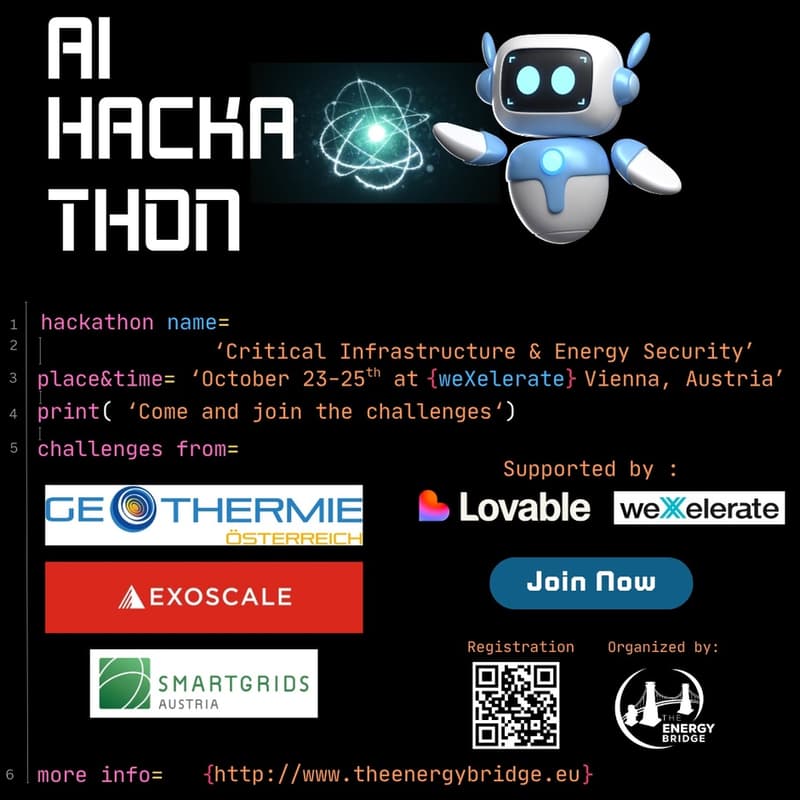
TEB AI Hackathon: Critical Infrastructure & Energy Security
TEB AI Hackathon: Critical Infrastructure & Energy Security
Friday, October 23, 2026, 16:00 – Sunday, October 25, 2026, 19:00
weXelerate, Vienna
Building Cyber Resilience Into the Energy Transition with AI:
The energy transition is making our critical infrastructure more connected, digital, and dependent on communication networks — creating new opportunities, but also new vulnerabilities.
Power grids, pipelines, industrial control systems, energy markets, and communication networks are increasingly exposed to cyberattacks, physical disruption, ransomware, system failures, and coordinated threats. A vulnerability in one part of the system can quickly become a problem across an entire region.
The TEB AI Hackathon brings together cybersecurity specialists, engineers, grid and utility experts, energy innovators, startups, and policy-minded technologists to tackle these challenges hands-on.
Over one intensive weekend, participants will form interdisciplinary teams, work on real-world security and resilience challenges, build prototypes, and pitch their solutions to a jury of experts.
Challenge Tracks
1. AI for Energy Security
Protect energy supply and demand-side systems against disruption, manipulation, and emerging threats.
2. Cyber-Physical Security
Explore how AI can protect the intersection of digital and physical infrastructure, including OT, ICS, and SCADA systems, by detecting unusual behaviour, identifying attacks, and supporting faster response.
3. AI for Pipeline Integrity
Develop AI solutions for detecting, preventing, and responding to physical and cyber threats targeting pipeline infrastructure.
4. Power Grid Cyber Resilience
Design intelligent systems that can detect attacks, isolate compromised components, maintain essential services, and recover quickly from cyber or physical disruption.
5. Blackout Communications
Develop resilient communication systems that keep critical coordination and emergency response functioning when conventional networks go offline.
6. 5th Generation District Heating & Cooling (5GDHC)
Develop a focused and viable business model for a low-temperature energy network based on a concrete use case.
Additional challenge tracks may be added as the programme develops.
Agenda
Friday, October 23
16:00 — Doors Open
17:00 — Welcome & Introduction
17:30 — Keynote & Cybersecurity / Energy Security Expert Talks
18:30 — Challenge Tracks Presented
19:00 — Networking & Team Formation
20:00 — Hacking Begins
Saturday, October 24
08:00 — Doors Open
08:30 — Breakfast & Hacking Continues
12:00 — Cybersecurity & Critical Infrastructure Expert Sessions
13:00 — Lunch
14:00 — Hacking Continues
18:00 — Progress Check with Mentors
19:00 — Dinner
20:00 — Overnight Build Sprint
Sunday, October 25
08:00 — Doors Open
08:30 — Breakfast & Final Hacking
12:00 — End of Hacking & Submission
12:00 — Lunch Break
13:00 — Demo Day & Pitches
The detailed programme, speakers, mentors, and challenge prompts will be announced closer to the event.
Who Should Join?
We are looking for people who want to work at the intersection of energy, technology, and cybersecurity:
Cybersecurity Specialists · Ethical Hackers · OT/ICS Security Experts · Engineers · Grid & Utility Technologists · Energy Startups · Software Developers · AI & Data Specialists · Incident Response Experts · Policy & Regulation Experts · TU Wien Students
No single discipline can solve critical infrastructure security alone. Teams will be encouraged to combine cybersecurity expertise with energy-system knowledge to develop solutions that work in the real world.
What Will You Build?
From detecting attacks on industrial control systems to protecting grid infrastructure, securing operational technology, maintaining communications during a blackout, or designing systems that can recover from a cyber incident — the challenges are designed around the real-world security of the energy system.
The goal is not just to identify vulnerabilities.
The goal is to build resilience.
Why Join?
Work alongside experts from the energy and cybersecurity ecosystem, gain hands-on experience with critical infrastructure challenges, meet future collaborators, and turn an idea into a working prototype in just one weekend.
Whether you are an experienced cybersecurity professional, an energy engineer, a developer, a researcher, a startup founder, or a student — bring your skills and help build the systems that cannot afford to fail.
From individual effort to collective action — building cyber resilience into the energy transition.
About The Energy Bridge
The Energy Bridge (TEB) is a collaboration platform connecting academia, industry, policymakers, innovators, and investors to accelerate the energy transition.
TEB combines forums, expert networks, a centralised data and knowledge repository, and collaborative platforms to connect knowledge, technology, and people with practical implementation.
The Hackathon is part of TEB’s broader programme focused on bringing together the expertise, technologies, and communities needed to build a more secure, resilient, and future-ready energy system.
Vienna · October 23–25, 2026 · weXelerate