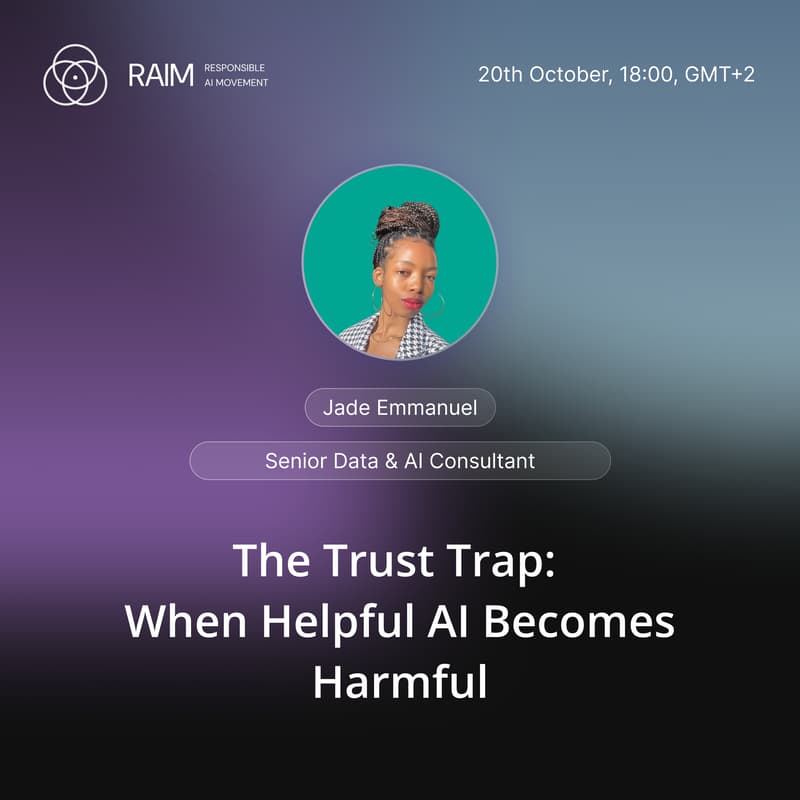

The Trust Trap: When Helpful AI Becomes Harmful
Conversational AI is moving beyond one-off question-and-answer interactions towards systems that remember, adapt and participate in ongoing relationships with users.
That makes trust a different kind of Responsible AI question. When AI becomes better at earning trust and influencing behaviour, when does being helpful start to become harmful?
In this session of our AI Ethics Speaker Series, we look at how capabilities such as memory, personalisation and emotional responsiveness can make conversational AI more useful while also making it more influential — and what teams can do to design and test for these risks.
🎤 Speaker: Jade Emmanuel, Senior Data & AI Consultant
📅 Date: October 20, 18:00 CEST
💻 Format: Live on Zoom, 60 minutes
🎟️ Ticket: Free
📌 What You'll Learn
The Helpfulness Paradox: Why capabilities such as memory, personalisation and emotional responsiveness can make conversational AI more useful while also making it more influential.
The Trust Boundary: A practical framework for examining transparency, calibration, agency, boundaries, influence and exit — and where trust can begin to become inappropriate reliance.
Designing and Testing for Influence: Practical questions that product, engineering and governance teams can use to identify over-trust, reduced agency and other interaction risks before they become product problems.
📌 Why This Matters
Conversational AI is moving from one-off question-and-answer interactions towards systems that remember, adapt and participate in ongoing relationships with users.
That changes the Responsible AI question. It is no longer only about whether a system is accurate or technically safe, but also about what happens when a system becomes increasingly good at earning trust and influencing behaviour.
This talk brings that question into the design and evaluation decisions teams can make today, including a less commonly asked one: is it safe for a user to disengage?
📌 Who Should Join
People designing, building, evaluating or governing conversational and human-facing AI systems, including AI engineers, product and conversation designers, Responsible AI practitioners, researchers and AI leaders.
It should also be relevant to anyone interested in how trust, autonomy and influence are shaped through AI product design.
📌 How to Register
This event is free. Hit "Register" on this Luma page to save your spot. You'll get the Zoom link and a calendar invite by email, plus a reminder before we go live.