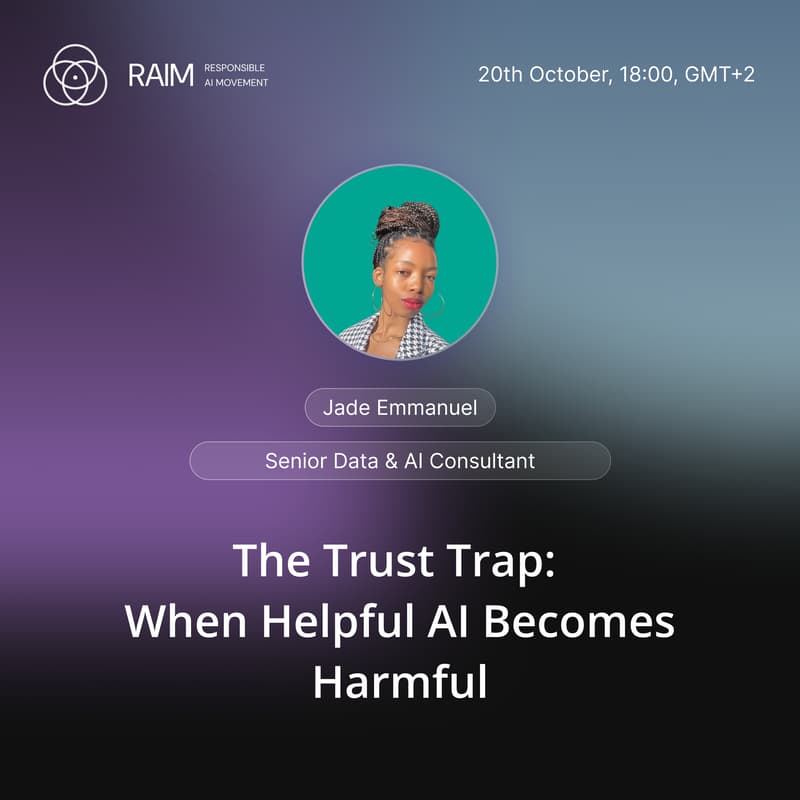

The Trust Trap: When Helpful AI Becomes Harmful
AI assistants are getting better at remembering us, adapting to us, and anticipating what we need. These capabilities can make them more useful, but also give them greater influence over what we think, decide, and do.
So where does helpfulness end and influence begin? And when can influence become something we should be concerned about?
In this session of the RAIC AI Ethics Speaker Series, Jade Emmanuel explores the emerging trust problem in conversational AI, bringing together product design, Responsible AI and practical experience building AI systems. She’ll introduce a practical framework for thinking about trust, agency and influence, and show how teams can start applying it to the systems they design.
🎤 Speaker: Jade Emmanuel, Senior Data & AI Strategist, Builder & Speaker
📅 Date: October 20, 18:00 CEST
💻 Format: Live on Zoom, 60 minutes
🎟️ Ticket: Free
📌 What You'll Learn
The Helpfulness Paradox: Why memory, personalisation and emotional responsiveness can increase both the usefulness and influence of conversational AI.
The Trust Boundary: A practical framework for examining transparency, calibration, agency, boundaries, influence and exit, and recognising when healthy trust can become inappropriate reliance.
Designing and Testing for Influence: Practical questions that product, engineering and governance teams can use to identify over-trust, reduced agency and other interaction risks before they become product problems.
📌 Why This Matters
As conversational AI becomes more personalised and persistent, AI product teams need to think beyond accuracy and technical safety. We also need to consider the relationship that conversational AI systems create with its users, including how trust is built, how influence operates, and whether users can meaningfully exercise their own judgement.
The talk brings these questions into practical product and evaluation decisions, including one we rarely ask: is it safe for a user to disengage?
📌 Who Should Join
People designing, building, evaluating or governing conversational and human-facing AI systems, including AI engineers, product and conversation designers, Responsible AI practitioners, researchers and AI leaders.
It should also be relevant to anyone interested in how trust, autonomy and influence are shaped through AI product design.
📌 How to Register
This event is free. Hit "Register" on this Luma page to save your spot. You'll get the Zoom link and a calendar invite by email, plus a reminder before we go live.