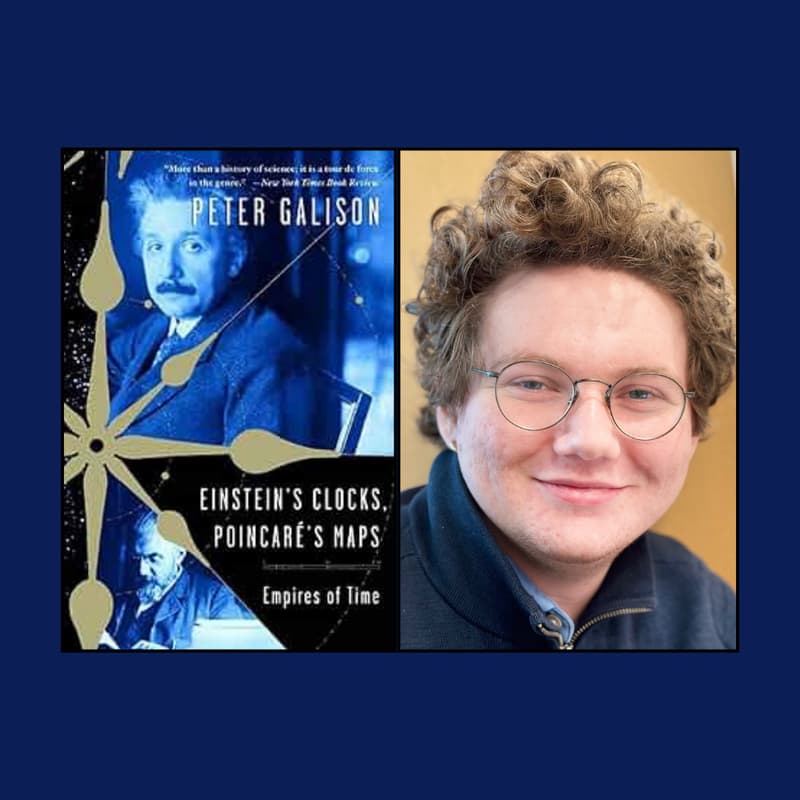

Einstein's Clocks, Poincaré's Maps: Empires of Time with Aiden Sagerman
Join us (along with Aiden Sagerman!) to discuss Peter Galison's Einstein's Clocks, Poincaré's Maps: Empires of Time.
Relativity is usually told as a story about a lone thinker and a thought experiment. Galison's book puts it back into the world of railway timetables, undersea telegraph cables, patent applications, and the Bureau des Longitudes (the vast nineteenth-century machinery for making distant clocks agree).
"Einstein, therefore, was not only surrounded by the technology of coordinated clocks, he was also in one of the great centers for the invention, production, and patenting of this burgeoning technology. Were any other major scientists whose concern was with basic physical laws of electromagnetism and the nature of philosophical time also in the midst of this vast effort to synchronize clocks? There certainly was at least one. Some seven years before the twenty-six-year-old patent officer redefined simultaneity in his 1905 relativity paper, Henri Poincaré had advanced strikingly similar ideas. A cultured intellectual, Poincaré was widely acclaimed as one of the greatest of nineteenth-century mathematicians for his invention of a great part of topology, his celestial mechanics, his enormous contributions to the electrodynamics of moving bodies. Engineers lauded his writings on wireless telegraphy. The wider public devoured his best-selling books on the philosophy of conventionalism, science and values, and his defense of “science for science.””
About our discussant:
Aiden Sagerman is a PhD student in the History of Science at Harvard (and is advised by the author of the book), where he works on the histories of mathematics, quantification, and eugenics. His research has covered the use of diagrams in twentieth-century algebraic topology and the ideals of mathematical modernism, transnational collaboration in interwar eugenics, and the recent rise of pronatalism in the United States. He holds a BA in Mathematics and Comparative Literature and Society from Columbia and an MPhil in History and Philosophy of Science and Medicine from Cambridge, where he was a Gates Cambridge scholar.
See you there!