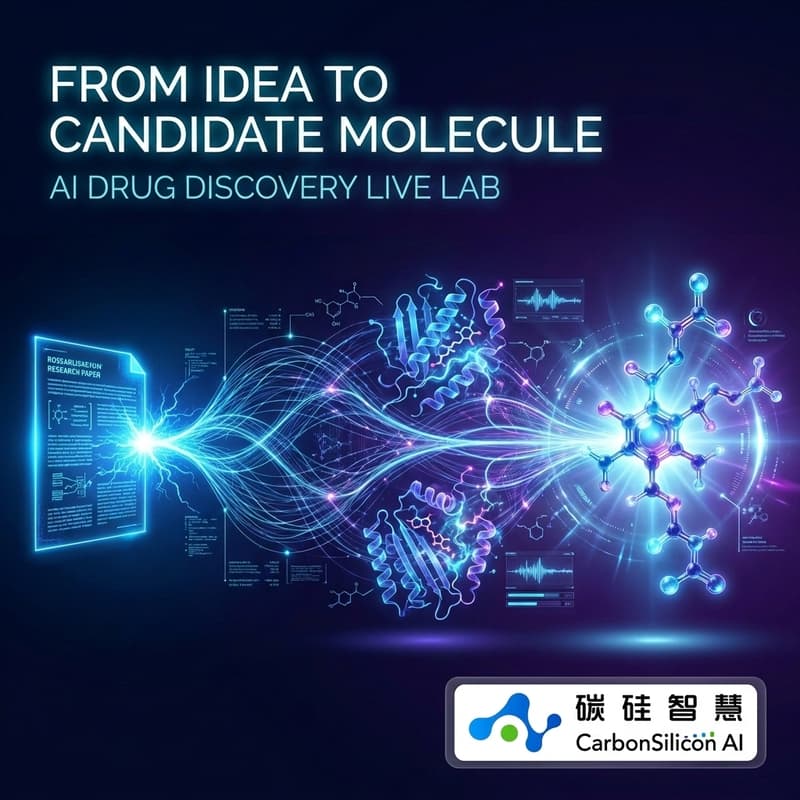

【Official】90 分钟,从一个想法到候选分子 From Idea to Molecule in 90 Minutes (muShanghai Pass Required)
90 分钟,从一个想法到候选分子
一场真正会“跑起来”的 AI 药物发现现场实验:我们打开一篇公开论文,把里面的分子结构图自动抽出来,丢进蛋白口袋里做对接、打分、ADMET 过筛,再让模型生成几个还不存在的新分子。全程使用公开数据,没有 PPT 催眠——而且就算你听到 docking 只想到划船,也完全可以跟得下来。
如果说过去的研发更像“先懂很多,再慢慢试”,AI 制造则让一个明确的想法更快变成可验证的原型:先定义目标,再调用已有模型、算法和工具,把论文里的线索转化为可筛选、可优化、可迭代的候选分子。这场活动想展示的,不是一个完整药物如何诞生,而是一个想法如何借助 AI 制造能力,快速走到“可以被看见、被评估、被继续推进”的下一步。
关于专业名词的友好声明
这场不是考试,是低门槛的第一排。屏幕上会全程挂一份“人话翻译”,把 docking、ADMET、骨架跃迁、从头设计 这些词都讲清楚。听到陌生词请直接举手,我们随时停下来解释。重要的不是你已经懂这些名词,而是看见它们怎么串成一条完整的流水线。
📖术语小词典
AIDD(AI 药物发现) — 用人工智能来设计、筛选潜在药物,把过去靠经验试错的流程换成“先在电脑里跑一遍”。
分子对接(Docking) — 把一个小分子虚拟地塞进蛋白的“口袋”里,看它们贴不贴合。像拿一串钥匙试一把锁,只是用的是物理 + 机器学习。
ADMET — 吸收 分布 / 代谢 / 排泄 毒性。一句话翻译:“这玩意儿真被人吃下去会发生什么?”
虚拟筛选(Virtual Screening) — 在海量化合物库里先用电脑过一遍,挑出少数值得进一步验证的候选。
骨架跃迁 从头设计(Scaffold-hopping / De novo Design) — 让模型要么把已知分子的“骨架”换一种结构,要么干脆从零生成一个全新的分子。 <aside>
碳硅智慧是谁
碳硅智慧(CarbonSilicon AI,杭州,2021 年成立)是国内 AIDD 圈相当扎实的一家公司,团队脱胎自浙江大学侯廷军教授的 CADD 课题组。公司已经上线 DrugFlow、BioFlow、Inno-FEP、SciGPT 等平台;核心算法与模型包括 FragGPT、Delete、RapiDock、CarsiDock、KarmaDock、RTMScore、BioScore、ADMET 等,背后都有同行评审论文支撑,不是只能做 demo 的那种。
为什么这场会好玩
Speedrun 模式。 我们会现场跑一个简化版流程,让你看到候选分子如何从公开论文一路进入筛选漏斗。
造一个还不存在的分子。 分子工厂支持 R-group Linker / 骨架跃迁 全新生成,模型真的会当场“画”出新分子。
像化学家一样读论文。 Structure Extraction 几秒钟就能把 PDF 里的化学结构图变成可编辑、可对接的分子(包括那些画得有点歪的)。
整条 AIDD 流水线一气呵成。 Inno-Docking(CarsiDock KarmaDock RTMScore)→ Inno-ADMET → 分子工厂,环环相扣。
顺便瞄一眼 Agent 层。 Agent 会把研究问题拆成子任务、调用合适的工具、自己跑起来,出错了还能自己救回来。
适合谁来
做工程的、做科研的、读书的、做产品的、对 AI 好奇的——不管你是 PyMOL 老玩家,还是连 RDKit 都没装过。“AI for biology” 既好玩又有点劝退?这场就是给你准备的低门槛第一排。不需要化学背景,带着好奇心就够了。
重点平台
DrugFlow — 完整小分子流水线。模块包括 Inno-Docking、Inno-ADMET、分子工厂、虚拟筛选、结构提取。
BioFlow — 大分子设计平台,覆盖多肽、抗体、蛋白互作等方向,包含 Inno-PepDocking、Inno-ProtDocking、Inno-StructGen 等能力。
Inno-FEP — 高性能自由能计算平台,帮助快速完成 FEP 计算流程。
SciGPT — 生医药研发副驾驶,跑在知识图谱、临床、监管与专利数据之上。
现场会发生什么
开场。 碳硅智慧是谁,以及为什么 AIDD 最近又突然“上头”了。
平台轮廓。 DrugFlow BioFlow / Inno-FEP SciGPT 各自是干嘛的,讲清楚。
现场 speedrun。 从一篇公开论文到候选分子排序:结构提取 → Inno-Docking → Inno-ADMET → 分子工厂,每一步都讲解。
自由问答与交流。 带着你的问题、半成形的想法,以及“这真的能跑吗”的怀疑都来。
主持人
谢昌谕 — 碳硅智慧 CTO,浙大求是工程教授
施慧 — 碳硅智慧联合创始人兼 COO
贾皓文 — 碳硅智慧 AI 工程化负责人
王志远 — 碳硅智慧产品经理
参与说明
这次活动的报名主要是为了收集大家的邮箱,以便后续有更新信息时能及时通知到大家。本活动对所有持有日票或月票的朋友开放。
希望大家带上电脑,方便现场跟着 demo 看窗口、记笔记,或在合适环节同步操作。
全程只使用公开数据。我们不会使用、上传或处理任何私人数据、未公开靶点、未公开结构或未公开化合物。
如果你有自己的研究问题,欢迎带来讨论;但请不要在现场提交任何敏感或未公开材料。
From Idea to Molecule in 90 Minutes
A real AI drug-discovery stack, running live in front of you. We open a public research paper, pull the molecules out of its figures, dock them into a protein, score them, filter for drug-likeness, and ask the model to invent new molecules that do not exist yet. Public data only, no PowerPoint coma — and yes, you can absolutely follow along even if docking still sounds like something boats do.
AI manufacturing changes the shape of early R&D: a clear idea can move much faster toward a testable prototype. Define the target, call the right models, algorithms, and tools, then turn signals from a paper into candidate molecules that can be screened, optimized, and iterated on. This session is not about claiming that a full drug appears in one afternoon — it is about showing how an idea can use AI manufacturing capabilities to reach the next visible, evaluable step.
A friendly note on jargon
This is meant to be a low-stakes front row, not a final exam. We’ll keep a running plain-English gloss on screen for terms like docking, ADMET, scaffold-hopping, and de novo design. If a word makes you twitch, raise your hand — we’ll pause and explain. The fun is in seeing how the pieces snap together, not in already knowing them.
📖Quick glossary
AIDD (AI Drug Discovery) — using AI to design and screen potential drugs, instead of (or alongside) trial-and-error in the wet lab.
Docking (分子对接) — virtually fitting a small molecule into a protein’s binding pocket to predict whether they stick. Like trying keys in a lock, but with physics and ML.
ADMET — Absorption, Distribution, Metabolism, Excretion, Toxicity. In one sentence: if a human actually swallowed this, what would happen?
Virtual screening (虚拟筛选) — searching large candidate libraries in silico to find the few worth investigating further.
Scaffold-hopping De novo design (骨架跃迁 / 从头设计) — asking the model to either swap out the “skeleton” of a known molecule, or invent a brand-new one from scratch. <aside>
Who is CarbonSilicon AI?
CarbonSilicon AI (碳硅智慧, founded in Hangzhou in 2021) is one of the more substantive AI-for-drug-discovery teams in China, spun out of Prof. Tingjun Hou’s CADD lab at Zhejiang University. The team has shipped platforms including DrugFlow, BioFlow, Inno-FEP, and SciGPT, with core methods such as FragGPT, Delete, RapiDock, CarsiDock, KarmaDock, RTMScore, BioScore, and ADMET backed by peer-reviewed papers.
Why this will be fun
Speedrun mode. We’ll run a simplified live workflow so you can watch a candidate set move through the screening funnel.
Generate molecules that do not exist yet. The Molecular Factory supports R-group edits, linker design, scaffold-hopping, and full de novo generation — the model literally draws new chemistry in front of you.
Read a paper like a chemist. Structure Extraction turns the molecule pictures inside a PDF into editable, dockable structures in seconds, including the ones drawn a little crooked.
One continuous AIDD pipeline. Inno-Docking (CarsiDock KarmaDock RTMScore) → Inno-ADMET → Molecular Factory, each step feeding the next.
A peek at the agent layer. The agent decomposes a research question into subtasks, calls the right tool for each, reviews its own work, and recovers when a step fails.
Who this is for
Builders, researchers, students, founders, and the AI-curious — whether you live in PyMOL or you have never opened RDKit. If “AI for biology” sounds equally fascinating and intimidating, this is your low-friction front row. No prior chemistry required; curiosity is the only prerequisite.
Featured platforms
DrugFlow — full small-molecule pipeline, including Inno-Docking, Inno-ADMET, Molecular Factory, Virtual Screening, and Structure Extraction.
BioFlow — large-molecule design for peptides, antibodies, and protein–protein interactions, with capabilities such as Inno-PepDocking, Inno-ProtDocking, and Inno-StructGen.
Inno-FEP — high-performance free-energy calculation platform for faster FEP workflows.
SciGPT — biomedical R&D copilot built over knowledge graphs, clinical-trial, regulatory, and patent data.
What will happen live
Opening. Who CarbonSilicon AI is, and why AIDD has gotten suddenly, almost suspiciously good.
Platform tour. A grounded sketch of DrugFlow BioFlow / Inno-FEP SciGPT — what each one is actually for.
Live speedrun. From a public paper to a ranked candidate set: Structure Extraction → Inno-Docking → Inno-ADMET → Molecular Factory, narrated every step of the way.
Open Q&A and hangout. Bring your questions, half-formed ideas, and “wait, is this real?” skepticism.
Hosts
Xie Changyu — CTO, CarbonSilicon AI; Qiushi Engineering Professor, Zhejiang University
Shi Hui — Co-founder & COO, CarbonSilicon AI
Jia Haowen — Head of AI Engineering, CarbonSilicon AI
Wang Zhiyuan — Product Manager, CarbonSilicon AI
Participation notes
Registration is mainly to collect email addresses so we can notify everyone promptly if there are follow-up updates. This event is open to all day-pass and month-pass holders.
Please bring a laptop so you can follow the demo windows, take notes, or participate hands-on where appropriate.
We will use public data only. We will not use, upload, or process any private data, unpublished targets, unpublished structures, or unpublished compounds.
If you have your own research questions, feel free to bring them for discussion — just please do not submit sensitive or unpublished materials during the session.