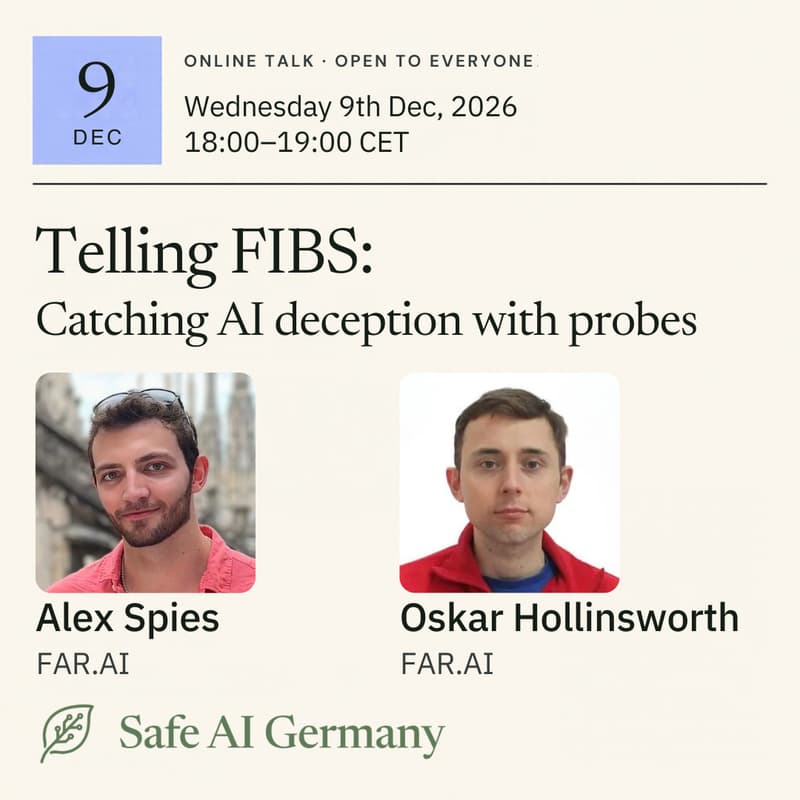

Telling FIBS: catching AI deception with probes
Summary
Recent incidents have highlighted the challenge of monitoring LLM agents and the danger of models deceiving people.
Researchers at FAR.AI trained probes, which are classifiers that read a model’s internal activations instead of its outputs. Their probes surpassed monitors that only see the agent’s actions, in catching sabotage in agentic coding tasks. They also detected deception that couldn’t be identified from the transcript.
Paper: https://arxiv.org/abs/2610.12445
Their training dataset, dubbed FIBS, is released to help drive frontier deployment of effective probes, and encourage the community to expand upon it with further examples of deception and sabotage.
What will be covered
what probes are, and why looking inside a model can catch what its outputs hide
how FIBS, the largest deception dataset for training probes to date, was built
how the community can extend FIBS
results on sabotage in agentic coding tasks, on hidden goals models don’t verbalise, and on open-weight models lying about politically sensitive topics under pressure
what this means for monitoring frontier AI systems
Format
📅 Wednesday, 9 December, 18:00 - 19:00 CET
Online talk, followed by Q&A via Slido
Speaker bios
Oskar Hollinsworth is a Research Engineer at FAR.AI, where he has worked on mitigating deception in LLMs, post-training infrastructure and scaling laws for adversarial robustness. Previously, he studied how sentiment is represented in language models under Neel Nanda. Oskar had a first career as an algorithmic trader at Susquehanna International Group, Dublin.
Alex Spies is a Research Scientist at FAR.AI. He works on mitigating deceptive behavior in frontier models, with a particular interest in applied interpretability and scalable oversight. He received his PhD in Interpretable Representations in Neural Networks from Imperial College London, advised by Alessandra Russo and Murray Shanahan, and has published on mechanistic interpretability, causal world models in transformers, and object-centric relational reasoning. He also held a JSPS Doctoral Fellowship under Katsumi Inoue at Japan's National Institute of Informatics during his PhD. Alongside research, Alex led research on two AI Safety Camp projects and served as a Technical Advisor for the Pivotal Fellowship; he welcomes inquiries from researchers seeking to contribute to technical alignment.