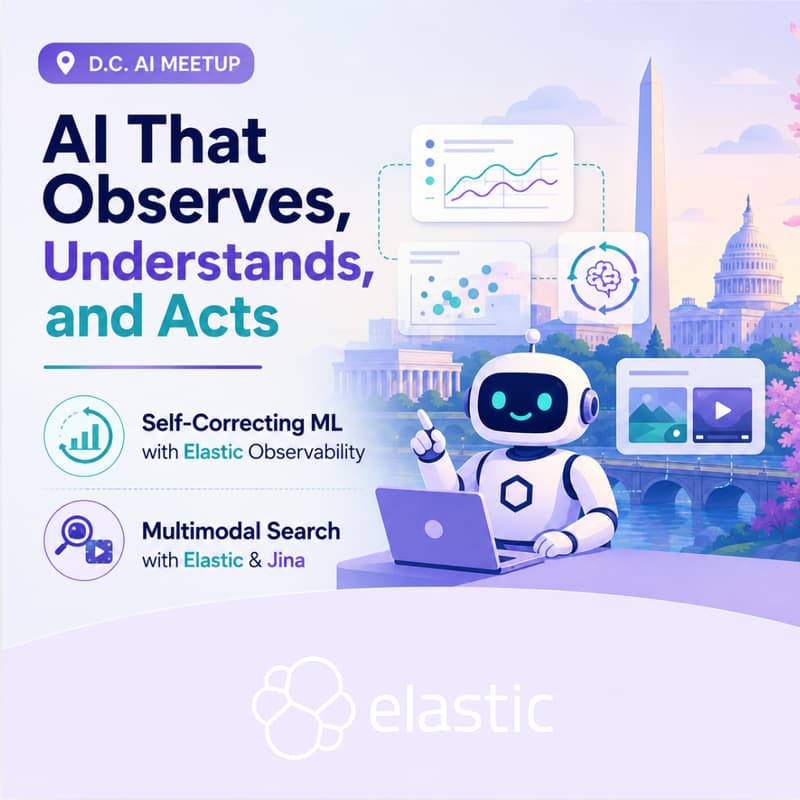

Self-Correcting ML + Multimodal Search with Elastic
Join the Elastic Washington, D.C. User Group on Wednesday, September 16th for an exciting meetup.
We’ll feature a presentation from Kritika Berry and Josh Phifer, followed by networking, refreshments, and pizza with the DC tech and Elastic community.
Date and Time:
Wednesday, September 16th, from 5:30-7:30 pm EDT
Location:
Elastic Arlington Office - 4100 Fairfax Drive, Ste 500, Arlington, VA 22203
Parking:
The building’s parking garage is operated by Joyce Parking and is located off N. Randolph Street
Book a spot on SpotHero
A Metro Station is located across the street
Agenda:
5:30 pm: Doors open; say hi, grab a seat, and eat some food.
6:00 pm: Dashboards to Decisions: A Self-Correcting ML Loop with Elastic Observability - Kritika Berry
6:40 pm: Building Multimodal Search with Elastic and Jina - Josh Phifer, Principal Solutions Architect at Elastic
7:20-7:30 pm: Networking & refreshments
Talk Abstracts:
Dashboards to Decisions: A Self-Correcting ML Loop with Elastic Observability - Kritika Berry (Software Engineer)
Most ML pipelines face a drop in accuracy or a spike in latency as it gradually trains which goes unnoticed until someone downstream complains. In this talk I’ll show how I wired Elastic Observability into my ML workflow so the pipeline watches itself: logs, metrics, and traces feed back into the system to catch drift and errors, then trigger corrective action automatically. This session delivers a practical pattern for turning observability data from something you just look at into something that actually fixes your models.
Building Multimodal Search with Elastic and Jina Josh Phifer, Principal Solutions Architect at Elastic
We’ll walk through two demos using Elastic and Jina to power multimodal search.
The first is an artwork search experience where users can search with text, images, or a combination of both. From there, an agent can help narrow the results, compare pieces, and explore similarities across style, subject matter, color, and other visual details.
The second demo applies the same concepts to video. Videos are divided into searchable segments, making it possible to find specific scenes, objects, actions, or topics with a simple question. The agent can search across clips, follow related results, and take users directly to the moments that matter.
We’ll wrap up with a look at how both applications were built, what worked well, and some of the implementation details and tradeoffs behind each approach.