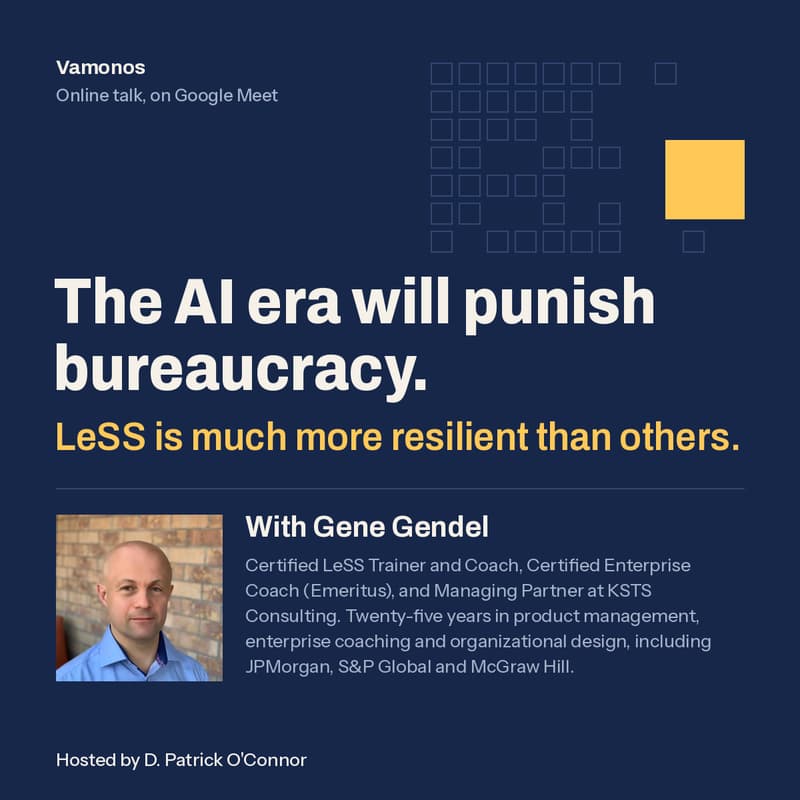

The AI Era Will Punish Bureaucracy: LeSS Is Much More Resilient Than Others
AI is changing more than technology. It is changing the economics of knowledge work, the speed of competition, and the expectations placed on every organization. The advantage will increasingly belong not to companies with the most elaborate operating structures, but to those that can learn faster, decide closer to the customer, simplify relentlessly, and turn insight into value without organizational friction.
Large-Scale Scrum (LeSS) offers a powerful response to this new reality.
LeSS scales product development by scaling the principles of simplicity, empiricism, customer focus, and self-management—not by scaling bureaucracy. Its design is deliberately lean: real, long-lived, cross-functional feature teams; one product direction; one Product Backlog; one Product Owner; one shared Definition of Done; and one integrated product increment. Coordination is pushed toward teams themselves, favoring decentralized communication and direct collaboration rather than adding layers of centralized orchestration.
This matters enormously in the world of AI.
When technology and customer expectations can shift in weeks rather than years, organizations cannot afford operating models dominated by long planning horizons, governance machinery, dependency management, reporting structures, and layers of coordination. Such structures increase organizational drag precisely when rapid experimentation and decentralized learning are becoming competitive necessities.
LeSS points in the opposite direction: reduce complexity rather than manage more of it. Bring teams closer to customers. Broaden product ownership. Build teams capable of delivering end-to-end value. Replace conformance with experiments. Replace organizational handoffs with shared responsibility. Replace assumptions with frequent inspection and adaptation. Its underlying empirical model is designed to expose reality early and turn what is learned into action.
For companies, the potential outcome is profound: faster learning, shorter feedback loops, stronger product focus, fewer organizational dependencies, greater adaptability, and more energy directed toward customer value instead of internal machinery.
For leaders and practitioners who learn LeSS, the opportunity is equally significant. They learn not simply another collection of practices, but a different way to think about organizations: see the whole system, challenge unnecessary complexity, create conditions for people to self-manage, and continuously improve the organization’s capability to deliver value.
In the AI era, that capability may become one of the defining advantages of the modern enterprise.
The future does not need more machinery for managing work. It needs organizations designed to learn. LeSS offers a path toward building them.
Gene Gendel is a Certified Large-Scale Scrum (LeSS) Trainer-Coach, Certified Enterprise Coach (Emeritus), and Managing Partner of KSTS Consulting - https://www.keystepstosuccess.com, where he helps organizations replace surface-level Agile adoption with real organizational design and product-centric ways of working. His 25-plus years span product management and enterprise coaching at firms including JPMorgan, Standard & Poor's and McGraw Hill, alongside building global Lean and Agile communities of close to 10,000 practitioners. Connect with Gene on LinkedIn - https://www.linkedin.com/in/ggnyc/