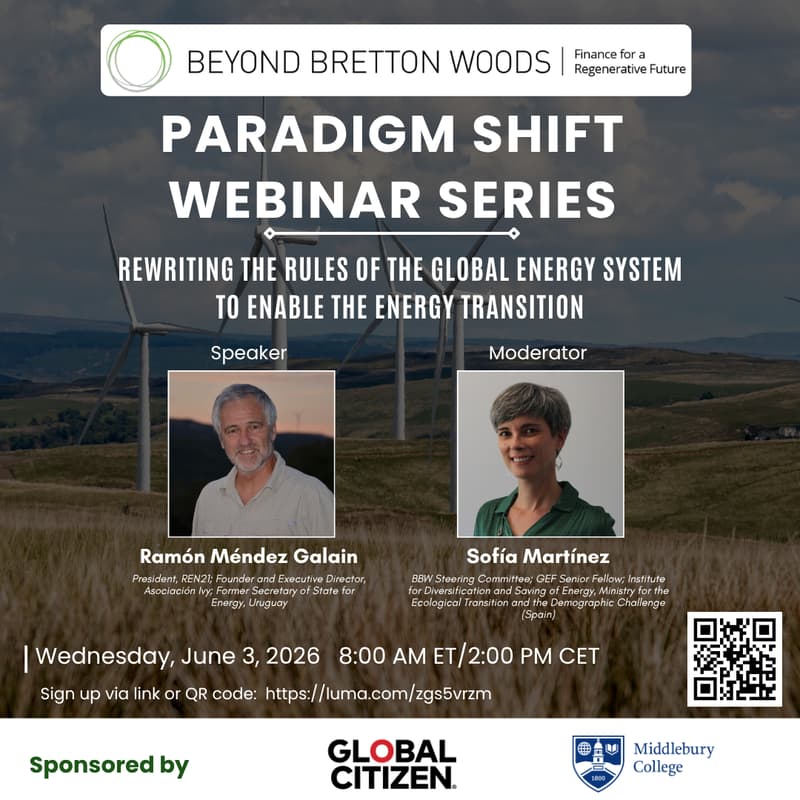
Rewriting the Rules of the Global Energy System to Enable the Energy Transition
Event Overview
The global energy system is undergoing not a transition, but a profound structural transformation. Global energy demand is rising while millions of people still lack reliable access to electricity or clean cooking.
Although clean energy is expanding at record pace, the system remains misaligned with global climate and development objectives. IRENA’s Renewable Capacity Statistics 2025 found that a record 585 GW of renewable capacity was added globally in 2024, though the pace remains deeply uneven, dominated by China, the US and the EU, while Africa accounted for just 0.7% of new installed capacity.
Beneath these investment flows lies a structural distortion that the debate rarely names clearly enough: the global energy system was built around fossil fuels for more than a century. Regulations, grid codes, planning frameworks, financial instruments and risk models evolved to serve an economy powered by oil, gas and coal. Renewables are not competing on a level playing field but against a system that remains deliberately designed in fossil fuels’ favor.
The geopolitical moment adds further urgency. The weaponization of fossil fuel resources and supply chains has redefined renewables and energy efficiency from environmental instruments to levers of economic resilience, national security and geopolitical influence.
The countries most vulnerable to fuel price volatility, dollar-denominated debt, and geopolitical price shocks are also those where fossil fuel systems are hardest to dismantle. Uruguay’s experience is instructive precisely here: by redesigning its energy system from first principles, new laws, new institutions, new financial models, and new market rules, it eliminated its exposure to global fuel price volatility, halved its electricity costs, and created 50,000 jobs without large public subsidies.
This webinar puts Ramón Méndez Galain’s experience as a system redesigner, policymaker and network leader at the centre of a sharper question: why does a system built for fossil fuels continue to hold back renewable energy, and what does rewriting those rules look like in practice? His insights speak directly to the governance, financial and institutional reforms required to dismantle the structural advantages of fossil fuels to make the clean energy transformation possible at scale.
Sign up to receive the webinar link
The Panel
Ramón Méndez Galain is a physicist by training who served as Uruguay’s Secretary of State for Energy from 2008 to 2015. Under his direction, Uruguay transformed its electricity system from one heavily reliant on oil and weather-dependent hydro into one of the cleanest in the world. According to latest data, in 2025 approximately 99% of Uruguay’s electricity generation comes from renewable sources — wind, hydro, solar and biomass. Electricity generation costs fell by roughly 50% over the period of the transformation; some 50,000 jobs were created; and household electrification reached near-universal coverage. Critically, this was achieved without large public subsidies, through transparent competitive auctions, broad political consensus and a risk-sharing framework that crowded in private capital at scale.
He has founded Asociación Ivy to replicate the model across Latin America and the Caribbean. In April 2025 he was elected President of REN21 (the Renewable Energy Policy Network for the 21st Century), representing 119 member institutions and over 4,000 actors worldwide, and received the Climate Breakthrough Award 2025. He is not an advocate but a practitioner. He has governed an energy transformation, not merely designed one, and has since spent a decade proving it can be done elsewhere.
Sofía Martínez is a member of the BBW Steering Committee and a GEF Senior Fellow. She is a senior expert in energy, climate, resilience, sustainable finance and international cooperation, with more than 20 years of experience in policy-making and technical assistance across public institutions, international organisations and civil society. She currently serves as Senior Manager of International Relations at IDAE, the Spanish Energy Agency operating under the Ministry for the Ecological Transition and the Demographic Challenge. Previously, she worked at the European Commission (DG INTPA), the Spanish Office for Climate Change, in international consultancy, as Policy Director at the Green Economy Coalition, or as Senior Expert for UNIDO.
She holds master’s degrees in Chemical Engineering and Environmental Technology.
Hosted by Beyond Bretton Woods (BBW), a think tank that challenges the current international financial architecture and proposes a radical paradigm shift to ensure a world with equitable, eco-centric, and regenerative systems that serve the interests of humanity and nature.
Sponsors
Sponsored by Global Citizen and Middlebury College