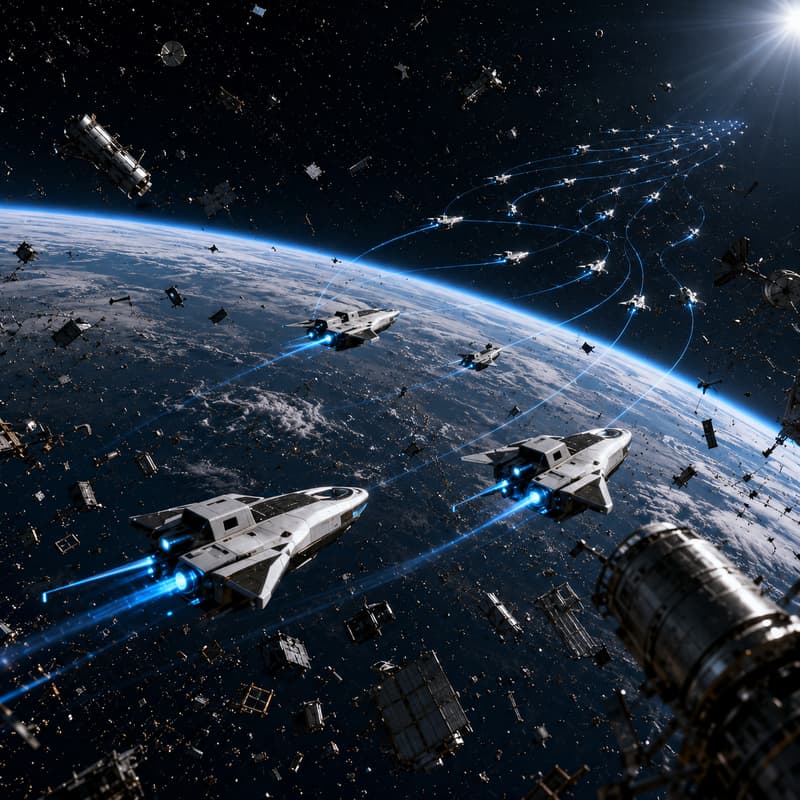

Navigating Spacecraft Swarms Through Hazard-Filled Orbits
As Earth’s orbits become more crowded, future spacecraft swarms will need to navigate around debris and one another without repeatedly solving enormous trajectory-optimization problems.
Join us for a live research talk on a new approach to collision-aware planning for spacecraft swarms. We developed a physics-grounded neural operator that maps spacecraft, targets, and debris directly to trajectories for an entire swarm, then refines those trajectories to satisfy exact orbital dynamics.
Trained on swarms of no more than 10 spacecraft, the system generalizes to 1,000 spacecraft navigating among more than 11,000 catalogued objects, while maintaining accurate transfers and low rates of hazardous close approaches.
We will cover:
why conventional path planning struggles at swarm scale
how the model represents spacecraft and debris as distributions
how self-supervised physics objectives replace optimal-trajectory labels
how adversarial debris teaches the system to evade dangerous encounters
how learning and numerical refinement combine to produce physically valid trajectories
what scalable planning could enable for autonomous swarms in crowded and contested orbits
The talk will be followed by an open Q&A and discussion.
Read the preprint: https://arxiv.org/abs/2608.00320
Explore opportunities at Manifold: https://www.manifoldrg.com/opportunities/
Join the Advancement Network: https://www.manifoldrg.com/advancement-network/
Subscribe to our Luma calendar for future talks: https://luma.com/manifold