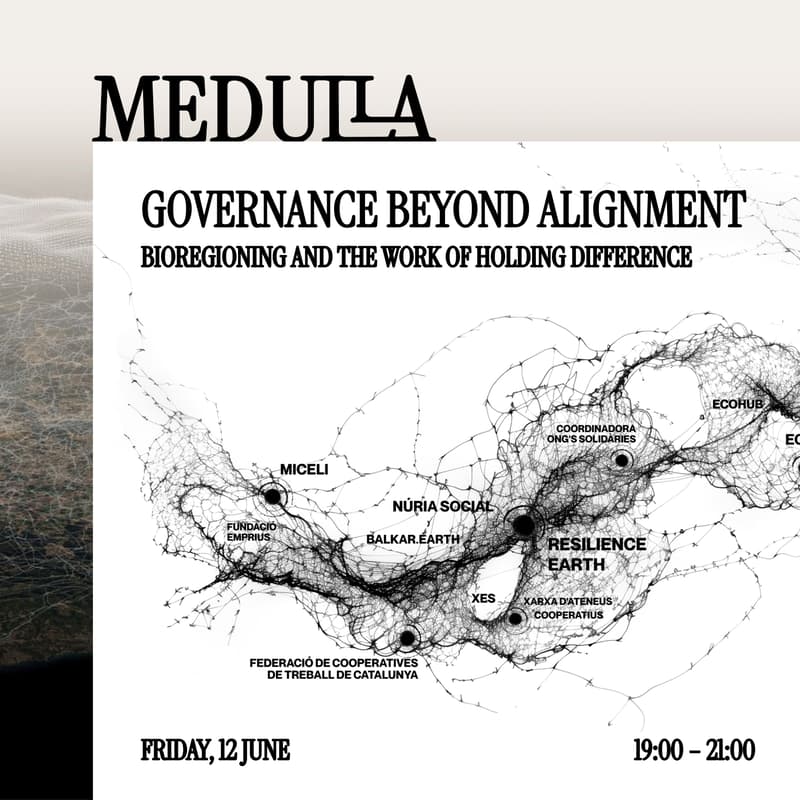

Governance Beyond Alignment: Bioregioning and the Work of Holding Difference
How can institutions, communities, and living systems coordinate without one logic dominating the others?
As climate adaptation, ecological degradation, democratic fatigue, and social fragmentation intensify, public systems are being asked to work across differences they were not designed to hold: departments, territories, communities, legal mandates, political cycles, infrastructures, and living systems.
During Creative Bureaucracy Festival week, we have the special opportunity to host Resilience Earth in Berlin for an evening of conceptual sharing, storytelling, and co-creation with practitioners working on governance, place, ecology, and shared responsibility.
Resilience Earth brings deep experience from Catalonia, working with rural communities, municipalities, cooperatives, and vulnerable territories on regenerative and democratic governance. Their work explores what becomes possible when governance is organised around the relationships between people, place, institutions, and the wider web of life – including rivers, watersheds, territories, communities, and the living systems that sustain them.
Together, we will explore the synergies between bioregioning, fielding, and the work of holding difference. Fielding points to an organising approach that asks how different actors, mandates, infrastructures, and ecosystems can remain coordinated without being forced into one logic. Bioregioning brings this question into concrete territories, where ecological realities, institutional responsibilities, and community life meet.
This evening is part of Medulla Ecotones, a recurring format for work that happens at the edges: between institutions and communities, policy and ecology, stability and disruption. Each edition invites practitioners to sense what is emerging in these transition zones and to develop working hypotheses for future practice.
With this signature format, we open a focused learning space for people already working with difficult governance questions in practice:
How can living systems inform public decisions without being reduced to data or metaphor?
What makes governance experiments durable beyond projects, funding cycles, and individual champions?
How can public institutions, communities, and territories build the relational capacity needed for long-term stewardship?
And how can we hold difference productively, without turning coordination into control?
The evening is designed for people working across public administration, climate adaptation, urban and regional transformation, civic tech, commons infrastructure, regenerative finance, democratic innovation, cooperative governance, and social-ecological transformation.
What to expect
Arrival, drinks and informal welcome
Storytelling from Resilience Earth’s practice
Shared mapping and practice-based conversations
Co-creation of a first working hypothesis on where these approaches are useful, where they may become risky, and what it would take to make them durable
A lively, embodied, and possibly disruptive exploration
Practical notes
Doors open: 18:30, Program begins: 19:00
Language: English
Places are limited to allow for a focused professional exchange
Tickets
We kindly ask for a contribution of 15 – 25 € to help support the space and encourage your commitment to attending. If this is not possible for you, please write to Medulla with a few words on why you would like to attend. We will try to make your participation possible.
About Resilience Earth
Resilience Earth is a Catalan cooperative of regenerative governance practitioners and consultants. They work with communities, municipalities, cooperatives, and territories to cultivate the capacities needed for places and living systems to thrive. Through a decolonial and intersectional lens, they accompany the co-design of governance processes that strengthen relationships between people, place, and the wider web of life. Their work supports territories in developing their unique potential, stewarding commons, and creating the conditions for long-term social and ecological vitality.