Self-Supervised Reinforcement Learning and Patterns in Time
Abstract
In the same way that computer vision models find structures and patterns in images, how might reinforcement learning models find structures and patterns in solutions to control problems? This talk will focus on learning temporal representations, which map high-dimensional observations to compact representations where distances reflect shortest paths. Once learned, these temporal representations encode the value function for certain tasks – learning temporal representations is itself an RL algorithm. In both robotics and reasoning problems, such representations capture temporal patterns. Temporal representations also facilitate a form of (temporal) generalization: navigating between pairs of states that are more distant than those seen during training. I will show evidence that agents trained via temporal representations exhibit surprising exploration strategies, in both single-agent and multi-agent settings.
About the Speaker
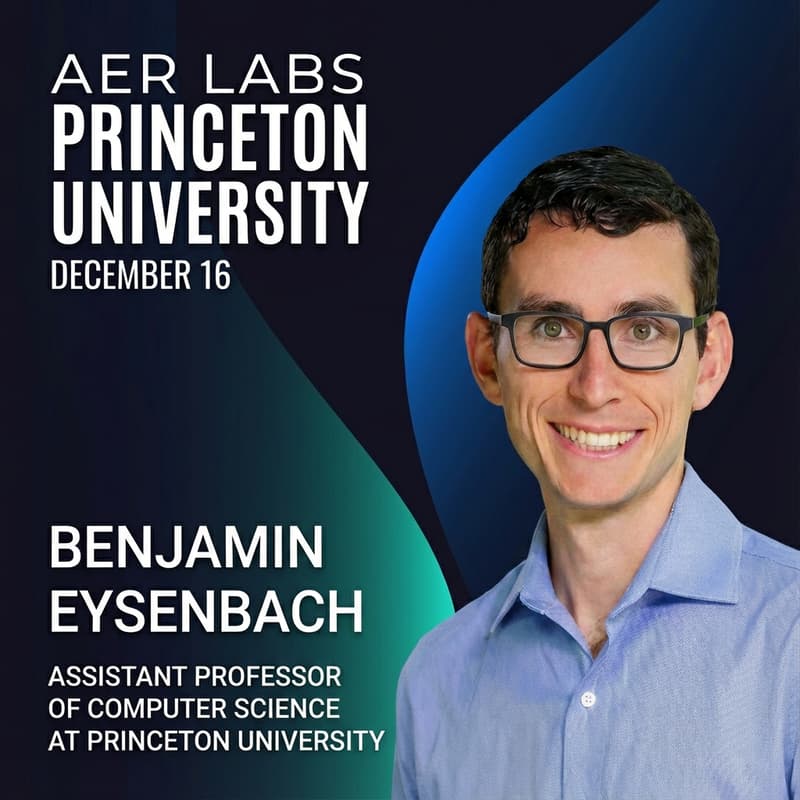
Benjamin Eysenbach
Assistant Professor of Computer Science at Princeton University
Website
Benjamin Eysenbach designs reinforcement learning (RL) algorithms—AI methods that learn intelligent decisions from trial and error. He is specifically focused on self-supervised methods that enable agents to learn behaviors without labels or human supervision. He leads the Princeton Reinforcement Learning Lab, which has developed leading algorithms and analysis for self-supervised RL.
Affiliations
Princeton Program in Cognitive Science
Princeton Language Initiative
Natural and Artificial Minds
Background
Before joining Princeton, Benjamin completed his PhD in machine learning at CMU under Ruslan Salakhutdinov and Sergey Levine. He spent several years at Google Brain/Research and completed his undergraduate studies in math at MIT. His work has been recognized by an NSF CAREER Award, a Hertz Fellowship, an NSF GRFP Fellowship, and the Alfred Rheinstein Faculty Award.