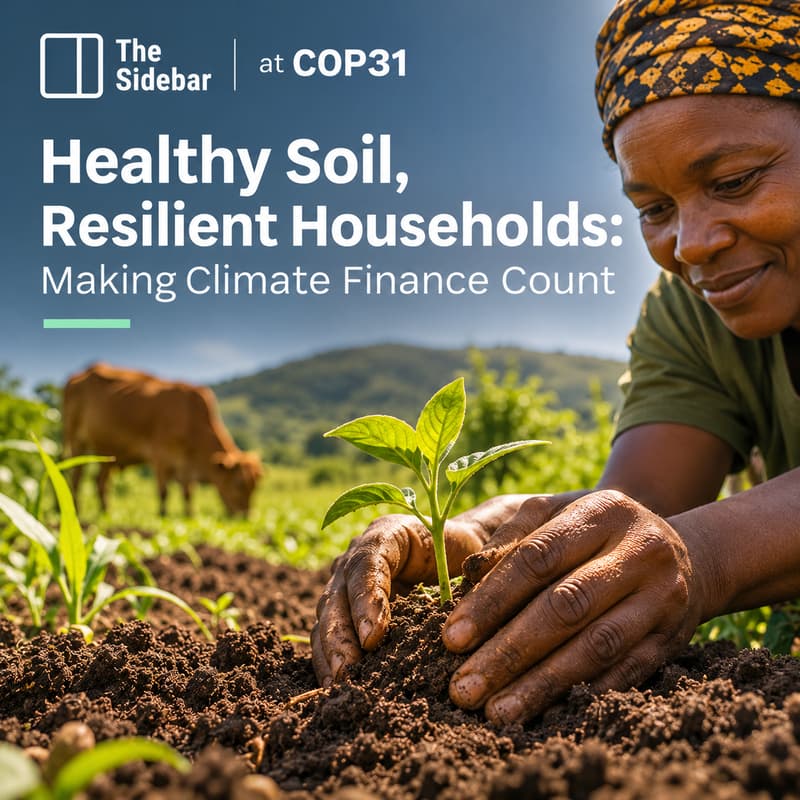

Healthy Soil, Resilient Households: Making Climate Finance Count
Event Description
Agriculture sits at the intersection of climate change, nature restoration, food security and rural livelihoods. Yet investment in agricultural transformation is too often measured by capital mobilised, projects launched or farmers trained, rather than by whether soils are healthier, food systems are more resilient and households are better able to withstand climate shocks.
This discussion will explore how climate finance can accelerate the transition towards regenerative, resilient and equitable agri-food systems while delivering measurable benefits for communities. Participants will examine the potential of soil health and land restoration as investment opportunities, including approaches that recognise the long-term economic and ecological value of healthy soils. From agroecology and nature-based solutions to rotational grazing and holistic livestock management, the conversation will consider how agricultural practices can restore degraded rangelands, improve productivity and strengthen resilience to drought and changing seasons.
A central question will be how food security, hunger eradication and food sovereignty can become core priorities within climate governance, rather than being treated primarily as humanitarian concerns. The discussion will also consider the connections between animal welfare, livestock health, food safety and human health through a One Health perspective.
Crucially, participants will examine what successful agricultural climate investment should look like at household and community level. How can funders and policymakers assess improvements in livelihoods, nutrition, soil fertility and local food security, rather than relying on financial commitments and activity-based indicators?
The conversation will bring together agricultural practitioners, investors, food-system advocates and community leaders to explore how climate finance can deliver healthier landscapes, stronger rural economies and more secure food systems.
Featuring
Karen Namonje is Technical Lead at Triharmony Climate Network (TCN), advancing youth climate literacy, sustainable agriculture, food security, and climate finance accountability through community-led initiatives in Zambia and Malawi.
Nonsi Nkomo is Business Development Manager at Solidaridad Southern Africa, mobilizing funding and strategic partnerships to scale sustainable development solutions that strengthen livelihoods and climate resilience across Africa.
Discussion Questions
How can climate finance and innovative investment structures support regenerative agriculture, soil restoration and resilient agri-food systems, particularly in communities facing drought, land degradation and food insecurity?
What role can agroecology, rotational grazing, holistic livestock management and other nature-based approaches play in restoring degraded landscapes while improving agricultural productivity and rural livelihoods?
How can hunger eradication, food sovereignty and the right to food become central priorities in climate governance, while integrating animal health, food safety and One Health considerations?
How should investors, governments and practitioners measure the real-world impact of agricultural climate investments on soil health, household resilience, livelihoods and food security, beyond money spent, partnerships formed or people trained?"