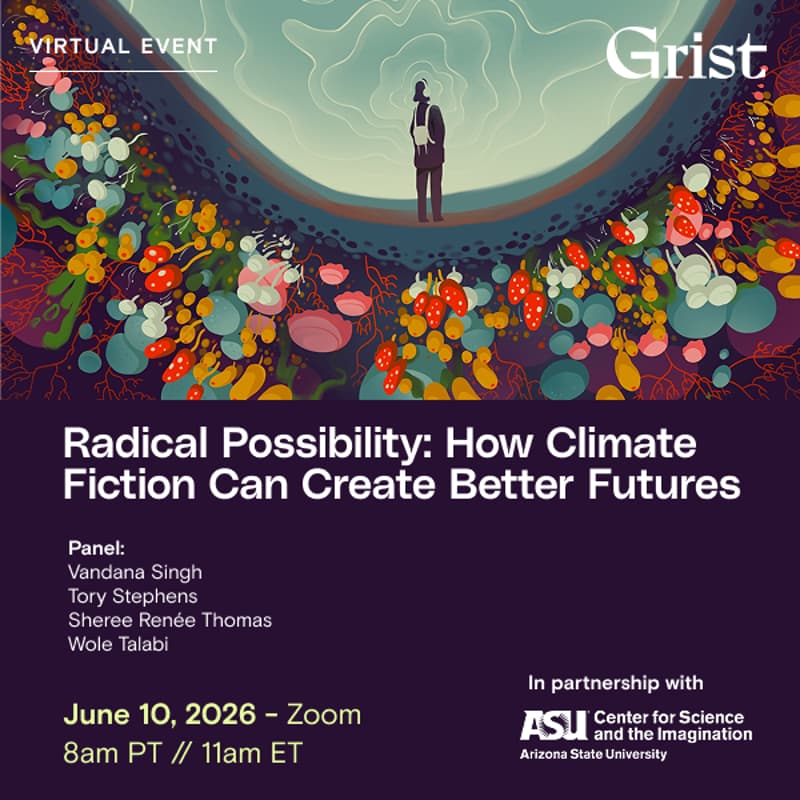
Radical Possibility: How Climate Fiction Can Create Better Futures
In an era defined by democratic backsliding, climate crisis, disinformation, fear-mongering, and the normalization of cruelty, speculative climate fiction plays an active and necessary role in countering narratives that divide. Where authoritarianism thrives on inevitability, fear, and historical amnesia, climate fiction can insist on adaptability, memory, and possibility.
Join Grist’s Tory Stephens, founder of Imagine 2200: Climate Fiction for Future Ancestors, for a deep conversation with renowned world-builder and author Sheree Renée Thomas, author and professor of physics Vandana Singh, and author and engineer Wole Talabi. This conversation will explore how climate fiction and speculative storytelling can:
Disrupt narratives of “there is no alternative”
Protect and transmit cultural memory under threat
Model collective action, care, and solidarity at scale
Offer moral clarity when institutions fail
Create emotional and imaginative refuge without retreating from reality
Rather than predicting the future, we can use fiction to practice freedom by imagining just systems, climate solutions in action, resilient communities, and forms of power rooted in care rather than domination.
Presented in partnership with the Center for Science and the Imagination at Arizona State University.
Speaker information
Sheree Renée Thomas is a New York Times bestselling, two-time World Fantasy Award-winning author and editor. A 2023 Octavia E. Butler Award honoree and a 2022 Hugo Award Finalist, she is the author of Nine Bar Blues: Stories from an Ancient Future, a Locus, Ignyte, and World Fantasy Finalist, Marvel’s Black Panther: Panther’s Rage novel, and she collaborated with Janelle Monáe on “Timebox Altar(ed)” in The Memory Librarian and Other Stories of Dirty Computer. She co-edited Africa Risen: A New Era of Speculative Fiction, a NAACP Image Award Nominee, and is the Editor of The Magazine of Fantasy & Science Fiction. Sheree lives in her hometown, Memphis, Tennessee, near a mighty river and a pyramid.
Wole Talabi is an engineer, writer, and editor from Nigeria. He is the author of the acclaimed fantasy novel SHIGIDI AND THE BRASS HEAD OF OBALUFON, which was nominated for the Nebula, Locus, and World Fantasy awards. His next novel is the forthcoming sci-fi thriller THE FIST OF MEMORY, set in a climate-impacted Africa. His short fiction has appeared in places like Asimov’s, Clarkesworld, and The Africa Risen anthology and is collected in CONVERGENCE PROBLEMS and INCOMPLETE SOLUTIONS. He has been a finalist for the Hugo, Nommo, BSFA, Sidewise, Ignyte and Crawford awards, as well as the Caine Prize for African Writing. He has edited five anthologies. He likes scuba diving, elegant equations, and oddly shaped things. He currently lives in Perth, Australia. Find him at wtalabi. com and at @wtalabi online.
Vandana Singh was born and raised in India and currently lives in the Boston area, where she is a professor of physics at Framingham State University, and a science fiction writer. Vandana’s short fiction has been widely published to critical acclaim, and many of her stories have been reprinted in Year’s Best collections. Her North American debut is a second short story collection, Ambiguity Machines and Other Stories (Small Beer Press) that was No. 1 on Publisher’s Weekly’s Top Ten in Science Fiction when it came out in February 2018, and earned praise from Wired, the Washington Post, and the Seattle Times, among others. Locus Magazine’s Gary K. Wolfe refers to her as “one of the most compelling and original voices in recent SF.”
Tory Stephens is a climate storyteller, narrative strategist, and creative manager at Grist, where he co-founded and leads Imagine 2200: Climate Fiction for Future Ancestors. He oversees two acclaimed anthologies, builds partnerships across media, film, and academia, and develops collaborations that bring climate storytelling into conversation with new audiences and communities. He thinks about climate through culture — and believes the stories we tell about the future shape the futures we're able to build.