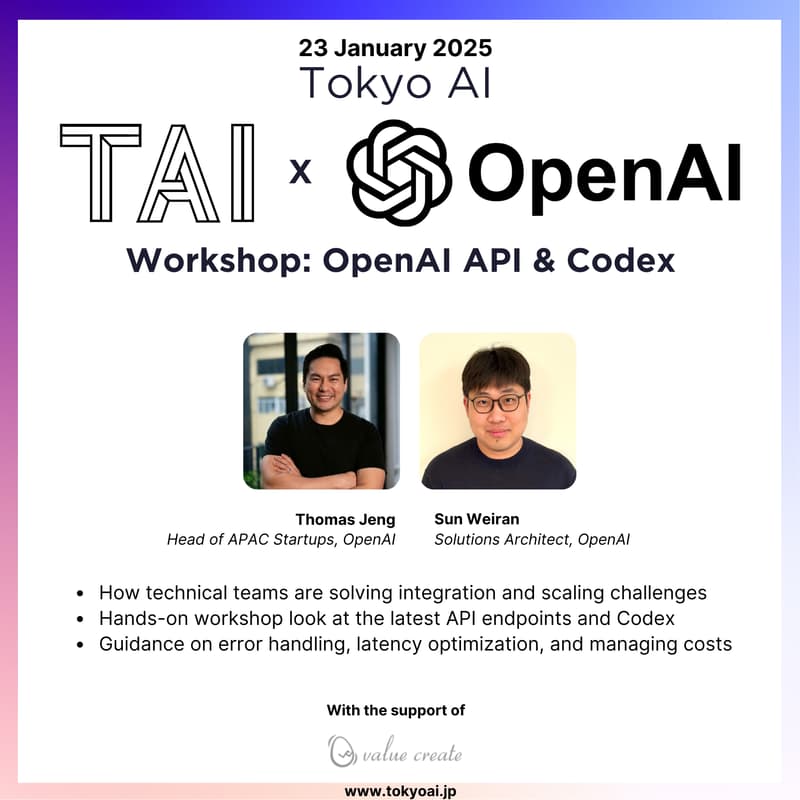


TAI Explorations: OpenAI API & Codex Workshop
Summary
Welcome to AI Explorations. We designed this series with a simple mandate: less sales, more product and tech. We invite companies from Japan and abroad to showcase their solutions, keeping the marketing pitch brief to prioritize live demos and technical features. Our goal is to help you cut through the noise, understand how these tools actually work, and have fun adopting new technology for your stack.
TAI Explorations: OpenAI API & Codex Workshop
For this session, we are hosting the OpenAI APAC team to look at the current state of their developer ecosystem. Thomas Jeng (Head of APAC Startups) will move beyond the general hype to discuss how startups are actually architecting products on top of OpenAI’s models today.
The Session:
Implementation Patterns: Thomas will break down specific use cases from the region, focusing on how technical teams are solving integration challenges and scaling with the technology.
Technical Workshop (Codex & APIs): A hands-on look at the latest API endpoints and Codex capabilities. We will examine the request/response structures, parameter tuning, and integration methods.
Best Practices: Guidance on error handling, latency optimization, and managing API costs during production scaling.
Q&A: Open floor for technical questions with the OpenAI team.
Who is this for? Engineers, Technical PMs, and builders actively working with LLMs or evaluating OpenAI’s platform for their production stack.
Schedule
18:00 Doors open
18:15 - 18:30 Intro by Thomas Jeng (OpenAI Head of Startups APAC)
18:30 - 19:00 Lightning Talks from TAI's Community
19:00 - 20:30 Codex Workshop
20:30 - 21:00 Networking
21:00 Event ends
Lightning Talks
LT#01 - Codex CLI in Practice: Daily Workflow (Prashant Anand)
This demo walks through how I actually use Codex CLI day-to-day when building products. I will showcase the following three things:
First, using speech-to-text (gpt-4o-transcribe model) for prompting. Coding agents work better with detailed context, but typing out thorough instructions repeatedly gets tedious. I'll show how voice input changes this and compare the kinds of prompts I give when speaking versus typing.
Second, local issue tracking is designed for agents. Instead of scattered markdown files for plans and todos, I use a local tracker where agents can create tickets, define dependencies, and pick up work across sessions. I'll demo an actual implementation task with pre-planned tickets.
Third, post-implementation workflows. For code review, formatting, linting, cleanup, and the commit/PR cycle, I use custom commands that run after the main work is done.
Together, these three pieces give me a repeatable loop for shipping changes quickly without doing anything fancy.
LT#02 - How I Use Codex: Parallel Sessions and Learning from Failures (Eunsu Jang)
In this demo, I'll share two workflows that have become part of my daily routine since I started using Codex as my main coding agent last September, both at work and for personal projects:
Running parallel sessions to compare different approaches and pick the best result
Asking Codex to analyze a failed session and generate a better prompt for a fresh start
LT#03 - Bringing OpenAI to the Robot Operating System (Tomoya Fujita)
ros2ai extends the ROS 2 command line with LLM capabilities powered by the OpenAI API. Instead of memorizing dozens of ros2cli commands, developers can simply ask questions in natural language—and let the AI execute the right commands automatically. This lightning talk demonstrates how the OpenAI API can lower the barrier to entry for robotics development, with a couple of demos of querying system state, executing commands, and multi-language support. I'll share implementation insights, including domain-specific tooling and API integration patterns.
Organizers
Ilya Kulyatin: Fintech and AI entrepreneur with work and academic experience in the US, Netherlands, Singapore, UK, and Japan, with an MSc in Machine Learning from UCL.
Thomas Jeng: Head of APAC OpenAI for Startups.
Supporters
Tokyo AI (TAI) is the biggest AI community in Japan, with 3,000+ members mainly based in Tokyo (engineers, researchers, investors, product managers, and corporate innovation managers).
Value Create is a management advisory and corporate value design firm offering services such as business consulting, education, corporate communications, and investment support to help companies and individuals unlock their full potential and drive sustainable growth.
Privacy Policy
We will process your email address for the purposes of event-related communications and ongoing newsletter communications. You may unsubscribe from the newsletter at any time. Further details on how we process personal data are available in our Privacy Policy.