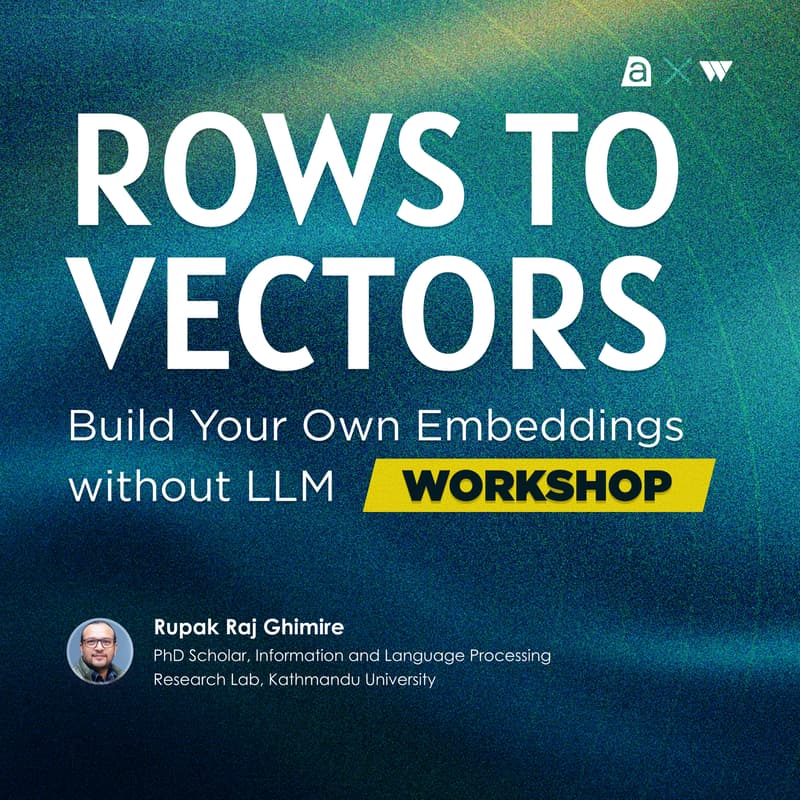

TKK #39 From Rows to Vectors: Build Your Own Embeddings without LLM (Workshop)
A database can answer "satisfaction_score < 5 AND industry = 'Healthcare'". It can't answer "unhappy healthcare customers", "customers like this one", or "who does this new lead resemble?" when you only know only a few fields. But AI models can. In this workshop we explore how we can build our own AI model. We will see how to turn each record (database row) into a short vector of numbers that captures what the whole record means.
We will learn the basics: what an embedding is, why a vector can serve as a summary, and how a model learns one without labels. Then we build one from scratch on a 3,000-row CRM dataset. We'll encode mixed data (categories, skewed numbers, dates, free text, missing values) into model-ready arrays. Then we'll train a small encoder-decoder in PyTorch with two simple training tasks: fill in the blanks (a denoising autoencoder) and match the description (contrastive learning on synthetic queries).
You'll leave with a working system that searches customers in plain English, finds look-alikes, handles brand-new customers with no retraining, and beats keyword search, all without a LLM.
Prerequisites
Basic: Python, Pandas, Some PyTorch helps but isn't needed
What to bring
Bring a laptop
Should have Google Account
Own internet powered by Mobile Data (we will use Google Colab, sharing same wifi will be problematic sometime due to rate limiting)
------------
Rupak Raj Ghimire (Google Scholar)
PhD Scholar, Information and Language Processing Research Lab (ILPRL), Kathmandu University
Rupak Raj Ghimire is a PhD scholar at ILPRL, Kathmandu University, researching Nepali Automatic Speech Recognition. He has over 15 years of experience in software engineering, working with C#, Python, and PostgreSQL. His research includes work on ASR fine-tuning, corpus development, and speech recognition systems for low-resource languages such as Nepali.