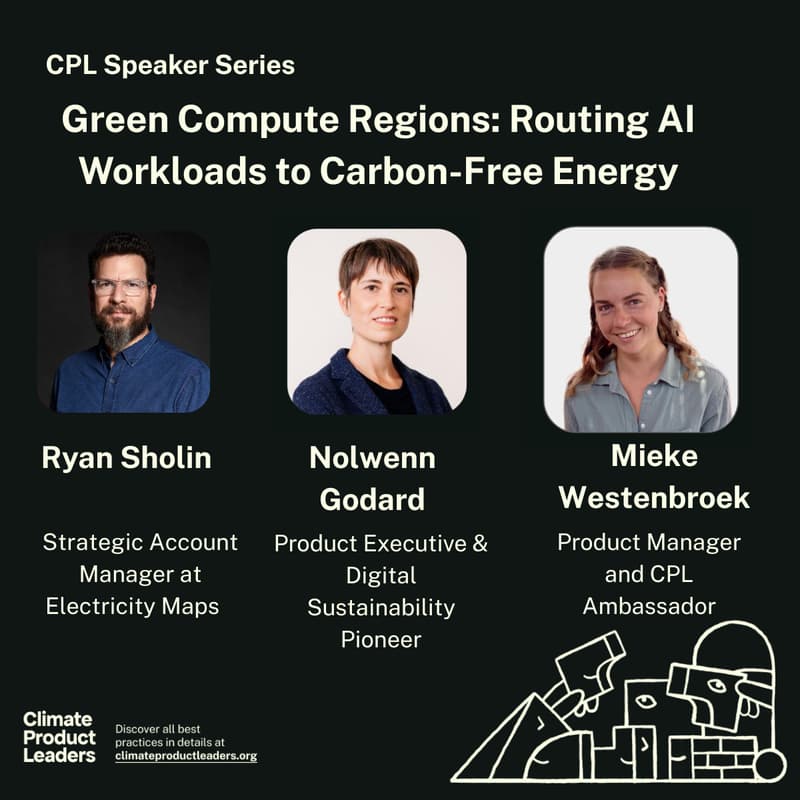
Green Compute Regions: Routing AI Workloads to Carbon-Free Energy 🌿
Where your AI runs matters as much as how it runs.
Two AI jobs. Same model. Same compute time. One runs in a data center powered by coal. The other in a region running on wind and hydro. The carbon footprint difference? Dramatic, and entirely preventable.
This is carbon-aware computing. And most product and engineering teams have never heard of it.
Climate Product Leaders (CPL) is back for the second session of our event series, and this time we're going deep on two practices from the CPL Playbook that sit at the infrastructure layer of every AI product:
Don't forget to check out the chapter in the CPL playbook, climateproductleaders.org/playbook
We wil be covering:
Practice 34: Choose sustainable providers: How to evaluate cloud and hosting vendors based on their actual energy mix, not just their marketing
Practice 37: Optimize for clean energy: How to route AI workloads to regions powered by 24/7 carbon-free energy grids, and what stands in your way when you try
Speakers
🎙 Ryan Sholin: Strategic Account Manager at Electricity Maps, the world's most comprehensive real-time carbon intensity data platform. Ryan works with hyperscalers to translate carbon data into operational decisions, helping companies like Google shift compute workloads to the cleanest hours and regions available on the grid.
🎙 Co-hosted by Nolwenn Godard (CPL co-author) & Mieke (CPL ambassador)
What we'll cover
This are some of the topics we will cover:
What carbon-aware computing actually is: and how it works in practice
How to read and use electricity maps to understand the carbon intensity of your infrastructure choices
What the CPL Playbook recommends for selecting sustainable providers and clean energy regions
How Ryan applies this with real customers, including the challenges of public cloud constraints and how to navigate them
What product managers can do, even without full control over infrastructure
Who is this for?
Product managers, engineers, data scientists, and technical leads who make, or influence, decisions about where AI workloads run. If you use any public cloud to train or serve models, this session will change how you think about those choices.