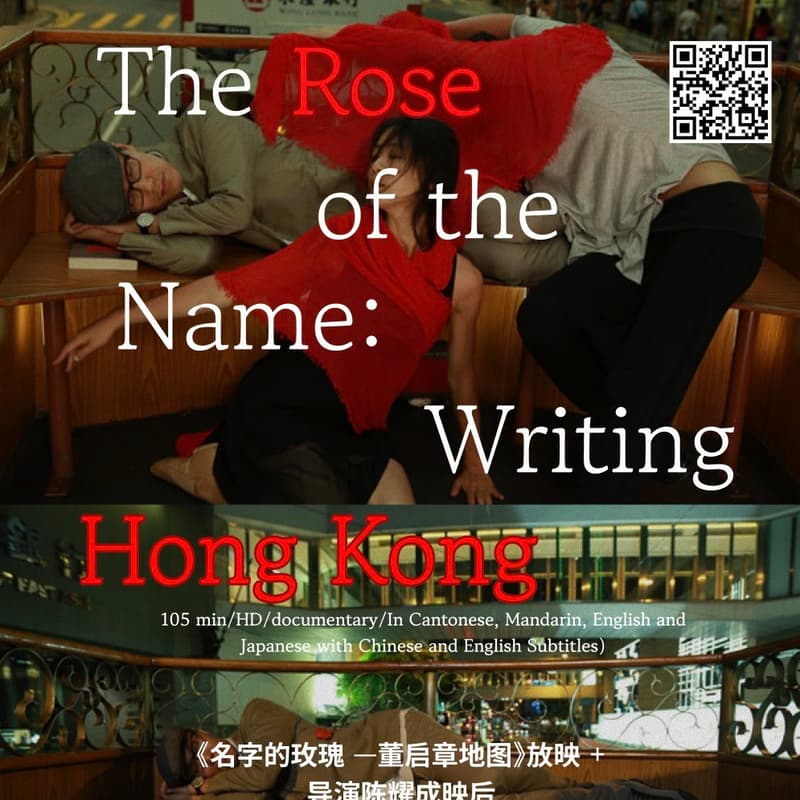

《名字的玫瑰 —董启章地图》放映+导演陈耀成映后 The Rose of the Name: Writing Hong Kong (with director Evans Chan in attendance)
本次放映为《联合文学:文学的四十年回声》展览后续活动
105 min/HD/documentary/In Cantonese, Mandarin, English and Japanese with Chinese and English Subtitles
影片简介:
于1967 年香港的暴动期间出生,而在2014的骚动不安之年成为香港书展年度作家的小说家董启章,已经成为香港进军国际文坛的重要声音。他的生命及创作历程见证了香港社会的重大转变。导演陈耀成透过董家三代横切了一页香港社会史,并追溯香港社运史,香港文学史。影片揉合访问及表演艺术以探索香港社会面临的重大危机,文艺创作的心路历程。贯彻片中的是置于电车上层的摄影机,如同在一个流动的舞台上, 既拍摄改编为舞台剧的董启章短篇小说,复眺览时代、文艺与生命的严峻挑战。
导演简介:
陈耀成 Evans Chan(导演)
台湾著名电影学者焦雄屏形容陈耀成是「华语电影真正的知识份子,他有诗人的情怀,敏锐的洞察力,原创性的创作形式,还有当代华语导演中难得有的历史观。」美国《后现代文化》学报形容他的作品「同时是香港与美国主流之外的另类声音,但却朝向一个崭新的文化领域。」美国学者白睿文 (Michael Berry) 称赞陈为「过去15年, 华文文化界最具创意和多样化的要角之一」陈耀成生于广东南海, 成长于澳门及香港,在纽约社会研究新院大学 (New School for Social Research) 得哲学硕士,论文是「欲的变貌:周梦蝶的《还魂草》」。后在美国西北大学 (Northwestern University) 得博士学位 。曾导演剧情片《浮世恋曲》(1991)、《错爱》(1994)、《情色地图》(2001) 及《紫荆》(2002) ;记录片:《北征》(1999) 、《澳门二千》(2000)、《吴仲贤的故事》(2003)、《灵琴新韵》(2004)及《独行琴》(2007) 等,曾在柏林,伦敦,鹿特丹,莫斯科和台湾金马奖等多个国际电影节展出及得奖。他的记录剧情片《大同:康有为在瑞典》获「南方都市报」颁发的首届人文生活(2011)年度电影大奖。(颁奖词形容「电影…是整个社会渴望人文复兴的呐喊———把完整的记忆还给当代,为思想史补上缺失。」) 同年的香港 Time Out 杂志把《浮世恋曲》列入「最伟大的一百部香港电影」名单。他为 2015 年香港艺术节撰写文本的歌剧《大同》被 Bachtrack 乐评杂志誉为「独特,充满想像力的...重要的新歌剧」。英文《南华早报 South china Morning Post》则赞扬曲辞「流丽...文彩丰富」。
电影之外,陈耀成同时以中英文发表评论。他的评论集《最后之中国人》得2000年香港文学双年展的评论组最佳书奖。他为台湾麦田出版社编译的两本苏珊·桑塔格 (Susan Sontag)文集:《文选》及《旁观他人的痛苦》连续获台湾《联合报》列为全年十大非小说好书之列。南伊利诺州大学教授 Tony Williams 编辑的讨论陈耀成电影的文集《后殖民主义、散居、另类历史》(Post-Colonialism, Diaspora, and Alternative Histories: The Cinema of Evans Chan) 于2015年由香港大学出版社 (HKU Press)出版。
Synopsis:
The Rose of the Name: Writing Hong Kong is about novelist Dung Kai-cheung, Hong Kong's emerging voice in world literature. Film essayist Evans Chan offers an illuminating portrait of Dung, his literary lineage, as well as the social and political history of an Asian metropolis where waves of intrepid mass protests in recent decades have embroiled the city’s passage from being a British colony to a post-colonial “Special Administrative Region” in the People’s Republic of China. This “informative” and “engrossing” film (Tony Rayns) explores not only the challenge faced by a writer working in a so-called "cultural desert," but also a ethnic and cultural minority people’s search for its voice -- in novels or the Umbrella Movement -- in Greater China and the world.
About Evans Chan (Director)
Film scholar Michael Berry has called Evans Chan 陳耀成 (www.evanschan.com) “one of the most singularly innovative and diverse figures in the Chinese cultural world in the last 15 years.” A New York-based critic, playwright, and one of Hong Kong’s leading independent filmmakers, Chan has made four narrative features and seven documentaries, including Crossings, The Map of Sex and Love, Journey to Beijing, Adeus Macau, and The Life and Times of Wu Zhongxian. Time Out Hong Kong (March, 2012) has named Chan’s directorial debut, To Liv(e), one of the 100 Greatest Hong Kong Films. His docu-drama about Kang Youwei, Datong: The Great Society, received the 2011 Chinese-language Movie of the Year Award, presented by Southern Metropolitan Daily, for “returning fuller memories and humanity to Chinese history.” The Hong Kong Arts Festival engaged him as a librettist to adapt his Datong film as an opera. Upon its premiere in 2015, Datong: The Chinese Utopia was hailed as a “witty…unique and imaginative…major new opera” (Bachtrack), featuring a “stellar line-up” of “awesome” talents (China Daily) and an “eloquent” libretto that is a “rich literary text.” (South China Morning Post).
Evans Chan’s documentary Sorceress of the New Piano (2004), about the John Cage’s foremost keyboard advocate, Margaret Leng Tan, was named “The Best Contemporary Music Film” by the Compact Disc magazine in Spain.
His writings have appeared in Critique, Asian Cinema, Film International, Postmodern Culture, Cinemaya, and various anthologies. He is also the editor/translator into Chinese of three books by Susan Sontag. Postcolonalism, Diaspora, and Alternative Histories: The Cinema of Evans Chan, a critical anthology about Chan’s works, edited by Tony Williams, is forthcoming from the Hong Kong University Press. Chan obtained his PhD in Screen Culture at Northwestern University.