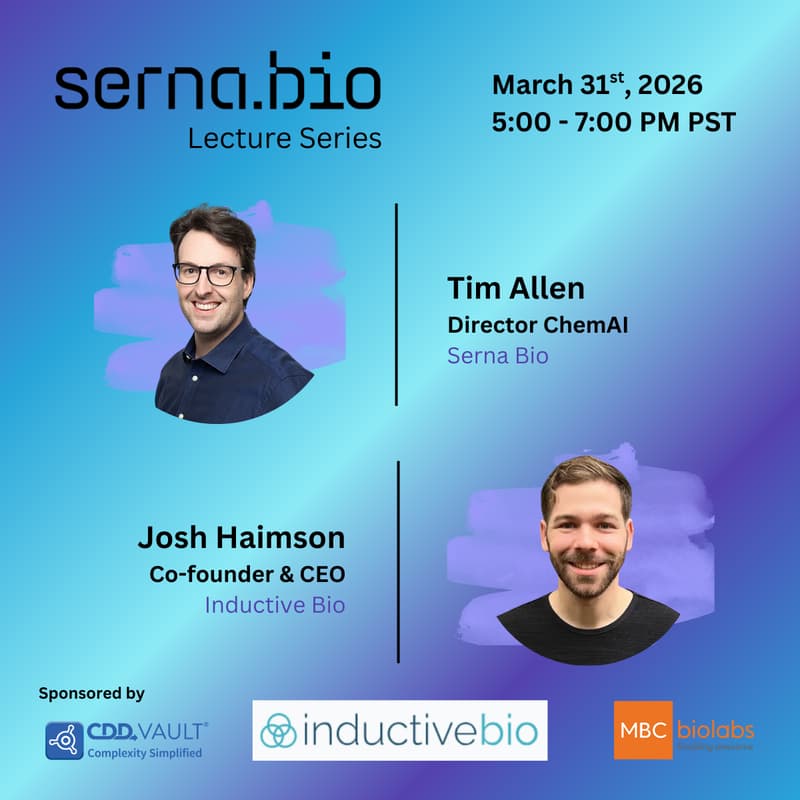

Real World Applications of AI for Chemical Design - Serna Bio and Inductive Bio.
AI is rapidly evolving and has impacted drug discovery & continues to do so. We have set up the the Serna Bio lecture series to feature visionary founders and industry leaders, who have a history of operating at the intersection of AI and drug discovery. Beyond the hype, this series explores real - life examples of how AI is transforming drug discovery.
This event features Josh Haimson, CEO and co-founder, Inductive Bio & Tim Allen, Director of ChemAI at Serna Bio. The talks will feature how AI has enabled rapid chemical optimisation with Inductive's ADMET predictive platform & Serna Bio GenAI platform that designs small molecules to target RNA.
Josh co-founded Inductive Bio, which provides virtual lab software and AI-enabled discovery services to biopharma organizations. Inductive was recently awarded 1st place out of 370+ competitors, including Merck and EMD Serono, in the OpenADMET blind challenge. Prior to Inductive, Josh led the machine learning & data curation teams at Flatiron Health through their acquisition by Roche, helping biopharma companies understand real-world efficacy and safety of oncology treatments.
Tim is a machine learning chemist, cheminformatician, and computational toxicologist working to discover novel RNA-targeting small molecule therapeutics and designing machines capable of optimizing them for the clinic at Serna Bio. He previous worked as a post-doctoral research associate at the University of Cambridge and Medical Research Council Toxicology Unit working in collaboration with Unilever to build computational models for toxicity prediction.
This event is in-person only, no virtual option.
The Serna Bio Discovery Platform integrates target discovery, generative chemical design, and in-cell screening to identify and optimize selective RNA-binding molecules.
This technology has enabled the creation of an entirely new class of small molecules—translational enhancers—that modulate RNA to restore or increase protein expression, offering novel therapeutic paths in neurodegeneration and cardiometabolic disease.