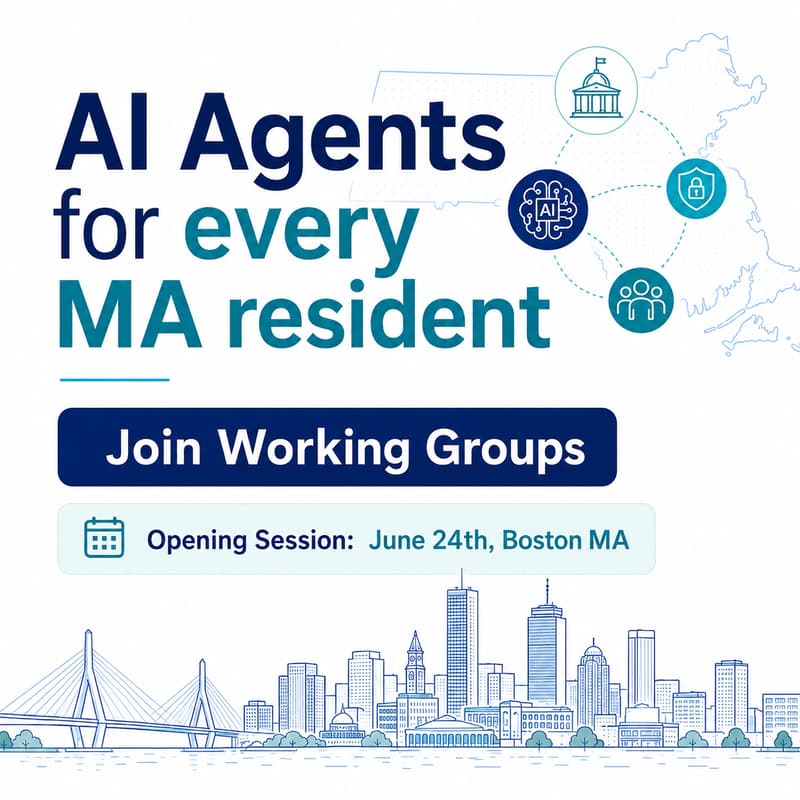

Wedn Jun 24th: AI Agent for Every Resident, Boston and MA
Please add to this RFC document: http://tiny.cc/agents4ma and sign up to join the working group
AI agents present a unique opportunity to simplify the experience of people interacting with complex organizations. Finding information, initiating requests, scheduling, following up - across multiple systems, departments, etc. Agentic systems could save time and frustration, especially for people who already suffer from challenges accessing resources they need to thrive. We need new types of infrastructure that enable the accessibility that comes with agentic systems, without compromising on privacy and individual liberty.
This paper does not claim to have built this infrastructure. It argues that the need for it is urgent, that the building blocks already exist in Massachusetts, and that this Commonwealth, and the City of Boston, home to the first public library, the first subway, the first phone call - is the right place to build it first. We propose not a government-run agent for every citizen, but a public infrastructure layer that guarantees every resident the ability to access their civic life through an AI agent without corporate capture of their most intimate data.
APPLY to join the working group
Working Group 1 — Identity and Authentication: What does the schema for a civic agent identity look like? Should agents have independent identities or delegated access? How does Boston Home federate with my.mass.gov? What attributes — preferred language, service scope, delegated permissions — should be portable across providers?
Working Group 2 — Civic Services Interface: What services should be exposed through MCP in Phase 2 (submission, not just read)? What are the security and liability requirements for each service category? How do we handle non-determinism and cascading failures when agents interact with deterministic government systems?
Working Group 3 — Equity, Privacy, and Digital Access: How does the Commonwealth use its procurement power to buy privacy for residents who cannot afford it? What is the public option for AI access — and what should it cover? How does the workforce development living guide stay current as AI transforms the labor market?
Working Group 4 — Governance and Policy: What body governs the civic agent protocol stack? What is KYA (Know Your Agent) certification, who issues it, and what does it require? How do we handle adversarial agents, fraudulent impersonation, and the deepfake threat to civic services?
Santiago Garcés is the Chief Information Officer for the City of Boston. He focuses on deploying generative AI in city operations, writing some of the first municipal AI guidelines in the U.S.
Gabriela Torres is the Director of AI Innovation Ecosystem Development at Mass Tech, a role under the Massachusetts Tech Collaborative, where she helps integrate the state's AI innovation ecosystem.
Ashish Bhatia is a Product Manager with 23 years of experience in Product and AI Solutions at Microsoft and Amazon.
Ramesh Raskar is an Associate Professor at MIT and the founding architect of ProjectNANDA.org , pioneering research at the intersection of machine learning and agentic web infrastructure.
More details at this LinkedIn post: https://www.linkedin.com/feed/update/urn:li:activity:7473382165406216192/