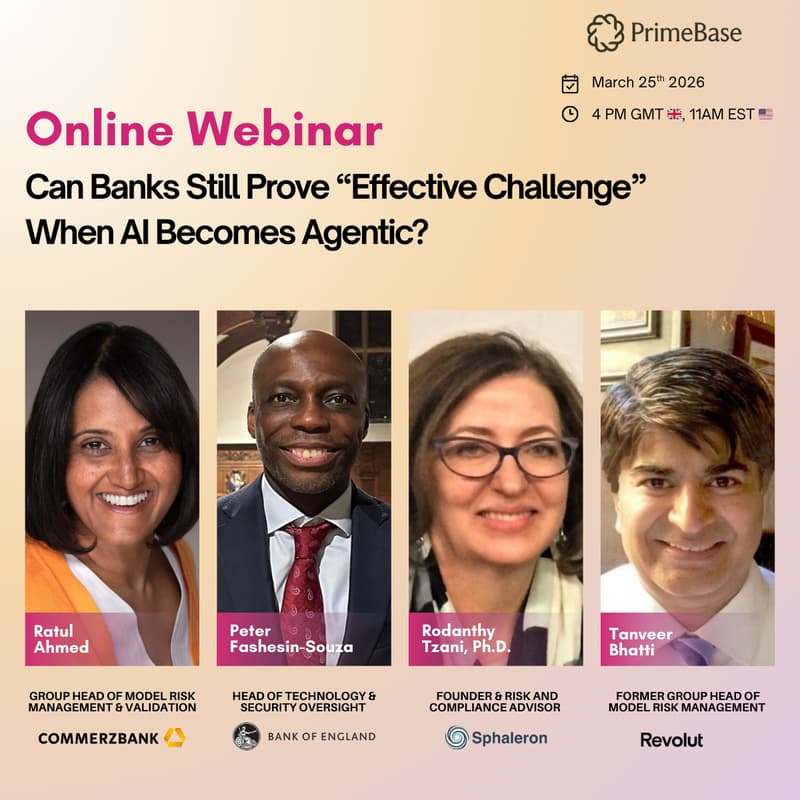
Can Banks Still Prove “Effective Challenge” When AI Becomes Agentic?
Banks are rapidly moving from static models to agentic AI systems: voice agents that negotiate with customers, fraud agents that adapt in real time, decision systems that chain actions, optimise objectives, and continuously learn.
But most governance frameworks were designed for a very different world.
They assume:
point-in-time validation
retrospective monitoring
human-in-the-loop escalation
and behaviour that can be reviewed after the fact
Agentic systems break these assumptions.
When behaviour is continuous, adaptive, and multi-step, what does “effective challenge” actually mean?
How do you prove, to risk committees and regulators, that an AI system was constrained before harm occurred, not just investigated afterwards?
This webinar explores a question many banks are quietly wrestling with but rarely discuss openly:
Is monitoring still enough, or does agentic AI require an entirely new oversight architecture?
What we’ll explore
Why retrospective optimisation and QA/QC start to blur into incident response as systems become agentic
The limits of dashboards, sampling, and LLM-judges when agents discover novel paths to objectives
What regulators increasingly mean by evidence of effective challenge in continuous systems
Whether Human-in-the-Loop governance still holds at machine speed
How risk appetite can (or cannot) be translated into enforceable constraints for autonomous systems.
MEET THE SPEAKERS
Ratul Ahmed
Group Head Model Risk Management
& Validation at Commerzbank.
Ratul leads Model Risk Management and Validation at one of Germany’s largest banks, bringing over 20 years of experience in senior risk leadership roles. Her work sits at the intersection of model governance, regulatory engagement, and large-scale risk transformation, with a particular focus on how institutions adapt their control frameworks as technology and regulation evolve.
Peter Fashesin-Souza
Head of Technology and Security
Oversight at Bank of England.
Peter leads second line of defence oversight for Technology and Security Risk management at the Bank of England, covering enterprise-wide technology risks and specialist risk domains. He is an experienced risk governance and change professional with a strong track record in transforming technology capabilities to enable more proactive risk management and stronger business outcomes.
Rodanthy Tzani, Ph.D
Founder & Risk and Compliance Advisor @ Sphaleron
Rodanthy is a former Federal Reserve leader and former Head of Model Risk Management at New York Life Insurance Company, with deep experience across prudential supervision, operational resilience, and enterprise risk governance. She has advised financial institutions on managing emerging technology risks and translating regulatory expectations into practical oversight frameworks, particularly for high-impact, high-velocity decisioning environments.
Tanveer Bhatti
Former Group Head of Model Risk
Management at Revolut.
Tanveer Bhatti is a senior risk leader with deep experience building and scaling model risk and AI governance capabilities across both global systemically important banks and high-growth fintechs.
Between 2020 and 2025, Tanveer was the architect of Revolut’s Group Model Risk function, a core pillar in the firm’s successful UK banking licence mobilisation. He built the function from the ground up, establishing the team, governance framework, and overseeing the end-to-end build-out of the Model Risk Management technology platform.
Tanveer led second-line oversight of proprietary AI and ML models screening 970M+ transactions per month at Revolut, contributing to the prevention of £600M+ in fraud, while ensuring regulatory credibility in a rapidly evolving risk environment.