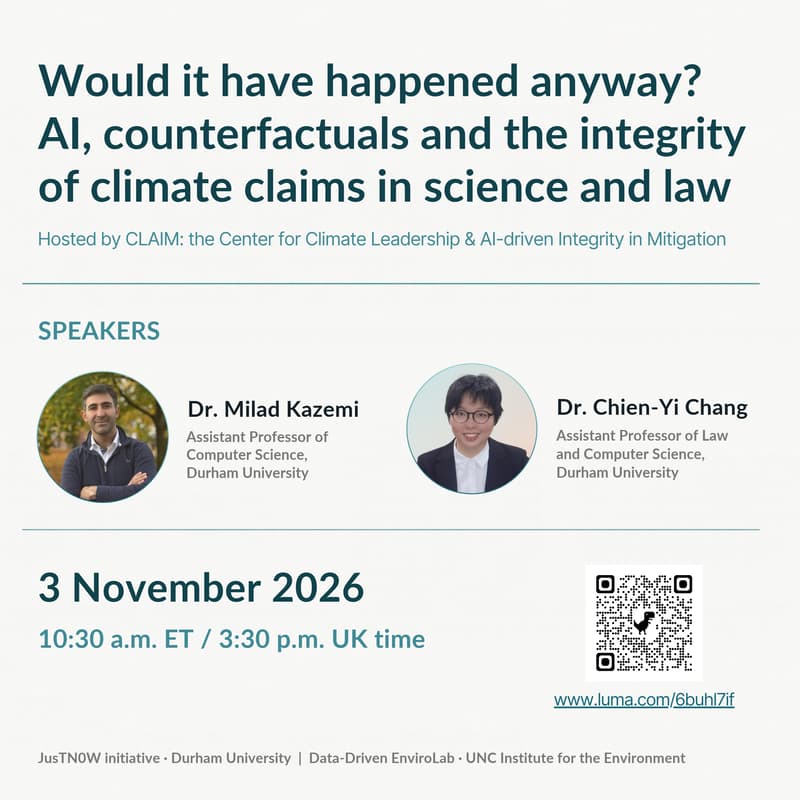
Would it have happened anyway? AI, counterfactuals and the integrity of climate claims in science and law
Many climate claims rest on a counterfactual. An offset is only meaningful if the reductions would not have happened anyway, and support for a coal region assumes that the region would otherwise have fared worse. Language models are increasingly used to read and summarise such claims, yet they can sound confident while being wrong, and it is rarely clear which of their answers a person should check. In this talk, we suggest three standards for AI that touches climate commitments: its claims should be checkable against their sources, its reliability should be stated and backed by expert audits, and its answers to "would it have happened anyway?" should be honest about what the evidence can support, which is often a range rather than a single number. The law has long asked the same question, through the but-for test in negligence, additionality in carbon markets and causation between States, and its civil standard of proof is all or nothing: when the honest answer is a range, the burden of proof decides. We draw on tools we have built with climate lawyers at Durham for nationally determined contributions and Article 6 of the Paris Agreement; on calibrate-then-delegate, which decides, with stated guarantees, when an AI system should pass a case to a more capable model or a person; on our study of how 119 national climate plans refer to the IPCC and to best available science; and on TC-Next, a model that gives a common basis for comparing AI cyclone forecasts.
Speakers:
Dr. Milad Kazemi is an Assistant Professor in the Department of Computer Science at Durham University. His research develops methods that help learning-enabled systems meet formal requirements with quantified confidence, combining formal methods, uncertainty quantification and counterfactual inference. He is a member of the core team of Durham’s JusTN0W initiative on just transitions to net zero, where he leads the AI-based systems and digital twin infrastructures cluster. Before joining Durham in 2026, he was a Research Fellow at King’s College London working on counterfactual reasoning and trustworthy AI, and he received his PhD in Computer Science from Newcastle University. His work has appeared at venues including NeurIPS, AAAI, AAMAS and USENIX Security.
Dr. Chien-Yi Chang is an Assistant Professor of Law at Durham Law School and an Assistant Professor of Computer Science at Durham University. Her research works across law and technology in both directions: how law should govern artificial intelligence and data, and how AI can inform legal and policy analysis. Her areas include artificial intelligence and technology law, data governance, and AI for climate and the environment. She is a member of the core team of Durham's JusTN0W initiative on just transitions to net zero, where she leads the Sustainable AI Governance cluster and serves as Academic Lead for Communications and Engagement at Durham's Centre for Sustainable Development Law and Policy.
https://unc.zoom.us/j/93386845630
This virtual webinar series on AI and the environment is hosted by CLAIM: Center for Climate Leadership and AI-driven Integrity in Mitigation, Data-Driven EnviroLab