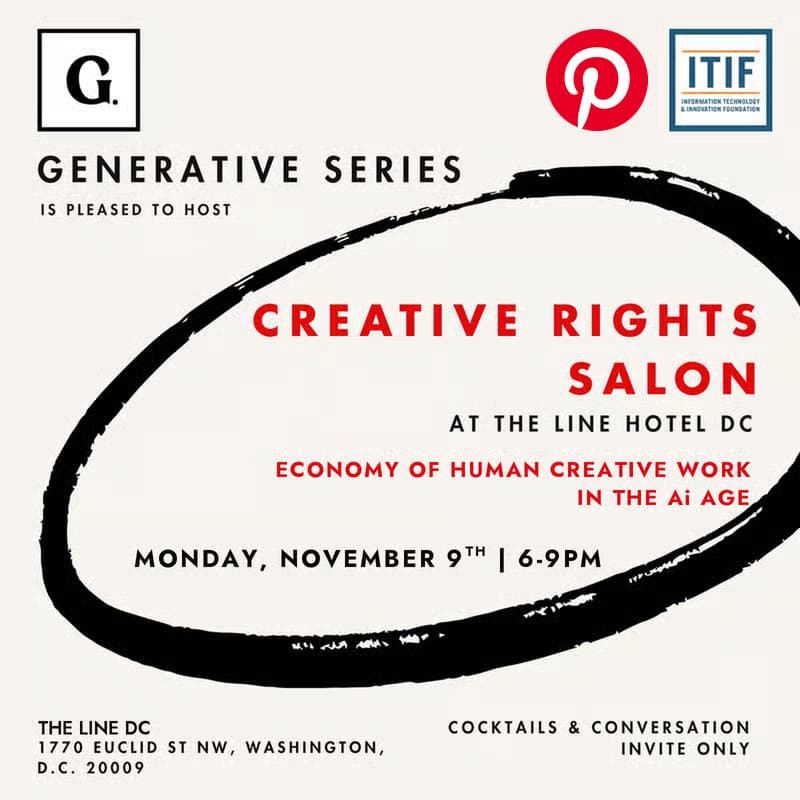
The Generative Series Creative Rights Salon: Economy of Human Creative Work in the AI Age, co-hosted with ITIF (Invite Only)
On Monday, November 9, the Generative Series returns to The LINE DC for a salon conversation on these hard questions, just after the midterms. Following our September salon on intellectual property, this salon looks beyond IP to the other policy levers we might pull to support human creativity in the age of AI.
Co-hosted by the Generative Series and ITIF, with Kevin Bankston of CDT and Georgetown Law, alongside congressional leaders, Pinterest. This is an intimate, invite-only room of 40-50 politicians, platforms and working creators, with short remarks followed by open conversation and networking.
The debate over AI and creative work has mostly been framed around copyright. But even if courts rule that AI companies must pay for what they train on, those payments won't sustain most working artists, writers and designers. So what else can policymakers, platforms and creators do?
There’s a much broader set of policy questions relevant to the future of creative work that are often ignored: how can we better protect creative freelancers from economic precarity? How can we promote human authorship financially, or through policy steps like requiring disclosure when AI is used in creative works? How can creatives better leverage collective bargaining to protect them from AI displacement, as the writer and actor guilds in Hollywood have?
These are critical questions because even if courts do end up ruling that AI companies have to pay for the creative works they train on, those payments may not be enough for the vast majority of individual creative workers to live on, and creative industries are still going to be transformed by AI automation. So how can we help ensure a vibrant community and economy of human creative work, regardless of the IP angle?
Four levers matter most: what creators can earn, how creative workers organize, when AI use must be disclosed, and what terms platforms set. We will bring together leaders from Congress, labor, creatives, and tech platforms in one room to talk about all four.
Pinterest is helping to support this salon.
Speakers
Juli Schwartz, House Judiciary Committee
Brings the view from the committee that oversees copyright and intellectual property law in Congress.
Arturo Reyes, Office of Rep. Valerie Foushee
Offers a congressional perspective on supporting creators and the creative economy.
Jesse Barba, Head of Government Affairs, Pinterest
Will speak on creators' rights beyond copyright: how discovery, attribution, fair compensation and practical protections shape creators' livelihoods, and how Pinterest aims to use AI to make discovery more inclusive while keeping human creativity at the center.
Umair Kazi, Director of Policy & Advocacy, The Authors Guild
Will share findings from the Guild's author income surveys on how AI is affecting writers' earnings, along with the lawsuits and the Guild's legislative priorities.
M Winberry, Graphic Artists Guild Advocacy Committee
An Assistant Creative Director who helped build the Guild's "No Artist, No Art" campaign and its Generative AI Ethical Use Guidelines, speaking from the working artist's side.
Josh Feldman, Senior Director, ARTECHOUSE
Will share how ARTECHOUSE builds its tech-driven exhibitions, with a case study from a past show.
Michelle Lopes Maldonado, Associate Director of AI Policy, ITIF
A three-term former member of the Virginia House of Delegates; co-host.
Kevin Bankston, Senior Advisor on AI Governance, Center for Democracy & Technology; co-host.
Nihal J. Krishan, Co-founder, Generative Series; Director, The Dialogue America
Award-winning AI and tech policy journalist and Former CFR International Affairs Fellow; host.
Read about our September 30 salon: Homage, Theft, or an Ordinary Wednesday? Inside D.C.'s Creative Rights Ai Salon
Invite only. RSVP required. Curated speakers, Q&A, cocktails.
Presented by The Generative Series with ITIF.