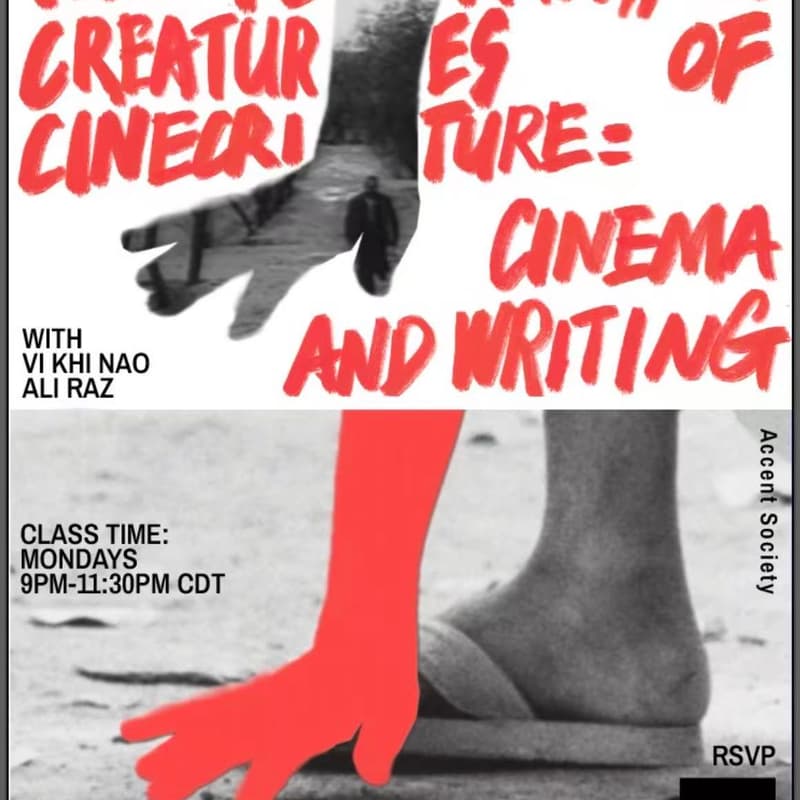

8-Week Cinema and Writing Workshop x Vi Khi Nao x Ali Raz : The Flamboyant Creatures of Cinecriture
Accent Society has invited Vi Khi Nao and Ali Raz to be our mentors.
Vi Khi Nao’s writing ranges from the half-dreamt to the hallucinatory—however, as fluid as these works are in reality, genre, and language, they are consistently grounded in interrogating the existing societal structures of economic disparity, patriarchy, and colonialism, especially as they intersect with her Vietnamese heritage. Her works draw energy from different mediums, adhering to an openhearted ethos that is reinforced by her frequent creative collaborations with other artists.
Ali Raz is a writer who creates postmodernism in her writing instead of merely channeling it. In her piece, “The Birds,” she merges film criticism, nature theory, mathematics, and philosophy to examine how life is defined through eluding frameworks. Her novella Aliens embraces the ambience and archetypes of post-apocalyptic science fiction while also distinguishing itself by playing with genre, romantic conventions, and even typesetting. Regardless of the setting of her works, they each are marked by the surreal.
Nao and Raz’s expansive interdisciplinary praxis makes them perfectly suited to teach “The Flamboyant Creatures of Cinecriture: Cinema and Writing.” In this class, students will learn how to interpret film and literature as synergistic artistic mediums. Their extensive history of borrowing techniques from the other can be used as a new schema for artistic analysis and creation.
Course Overview
This is a class about film and writing. Not screenwriting, not criticism. It’s a class that invites you into the juxtaposed aesthetics of these two art forms so that you, The Writer, are morphed by the text of film and the film of text. The class will allow you the opportunity to bungee jump or somersault into the trampoline of text and to dive into the swimming pool of cinema, where two genres of ingestion will reframe your practice as litterateurs and cinephiles. Together, we will glean from the gravitational center of a word–cinecriture–that was willed into existence by Agnès Varda from the depths of the French New Wave. Cinecriture announced the asymptotic desire for a specifically feminine film-writing: a cinema that was as masterful as a modernist novel, while carving a space within it for a feminine aesthetic (whatever that might be.) From cinecriture’s direct descendents such as Marguerite Duras or Chantal Ackerman, to distant cousins such as Forough Farrokhzad or Shrin Neshat, to scandalous illegitimate offspring–Apichatpong Weerasethakul, Leslie Thornton–this course will explore the wild exuberance that cinecriture has been, continues to be, and can be. This to say that we will watch and read for the range of relations that exist, or can be willed into existence, between the written word, the cinematic image, the written image, and the cinematic word. What has to happen, on the page and on the screen, for such substitutions to be more than just a language-game? How can we write cinema and film words? Readings are split between literary texts (fiction, poetry) and exciting currents in film theory. Generating ways for these two impulses, the literary and the theoretical, to mutually inflect each other will be one of our tacit aims along the way. In addition to our close readings and viewings, this course will also incorporate generative writing assignments and peer critique of each others’ work every week.
Workshop Time
June 1st — July 20th
Every Monday
California Time
6-8:30pm
New York Time
9pm-11:30pm
Beijing TIme
10am-12:30pm
Course space limited to 6-15 people. 5 early bird seats available.
The workshop will run once a week for eight weeks in 2.5 hours each sessions. Students should review the texts and films associated with Week 1 before the first class and then adhere to the syllabus for additional materials to be reviewed for each session.
All assigned texts will be available as PDFs in a shared Google folder. All screenings are either available on free / library-card-affilitated streaming services or will be uploaded to a shared Google Folder. Therefore, students will need to incur no additional costs to complete the course.
The class will include in-class discussions, peer reviews, writing exercises, and a Zoom conference with the instructors at least once during the course.
The ideal student for this course is open-minded and committed to learning, an individual who seeks out the structure and rigor involved when participating in a seminar. If you are interested in literature or film, or want to know more about how technique truly functions in different artistic disciplines, then this class is for you. If you are an artist wondering how to find their voice, then this class will absolutely provide you with the tools to do so.
Workshop Course Outline
Syllabus
The readings and films listed under each week are the assignments should be reviewed prior to each session.
Week 1: Cinecriture
Tolga Theo Yalur, “Cinécriture in Agnès Varda’s Filmosophy” (article)
The Gleaners and I (Agnès Varda, 2000)
Varda focuses her eye on gleaners: those who scour already-reaped fields for the odd potato or turnip. Her investigation leads from forgotten corners of the French countryside to off-hours at the green markets of Paris, following those who insist on finding a use for that which society has cast off, whether out of necessity or activism.
Week 2: Skin Saliva / Language Limits
Excerpts from Laura Marks, The Skin of the Film: Intercultural Cinema, Embodiment, and the Senses
Memories that evoke the physical awareness of touch, smell, and bodily presence can be vital links to home for people living in diaspora from their culture of origin. How can filmmakers working between cultures use cinema, a visual medium, to transmit that physical sense of place and culture? In The Skin of the Film Laura U. Marks offers an answer, building on the theories of Gilles Deleuze and others to explain how and why intercultural cinema represents embodied experience in a postcolonial, transnational world. Much of intercultural cinema, Marks argues, has its origin in silence, in the gaps left by recorded history. Filmmakers seeking to represent their native cultures have had to develop new forms of cinematic expression. Marks offers a theory of “haptic visuality”—a visuality that functions like the sense of touch by triggering physical memories of smell, touch, and taste—to explain the newfound ways in which intercultural cinema engages the viewer bodily to convey cultural experience and memory. Using close to two hundred examples of intercultural film and video, she shows how the image allows viewers to experience cinema as a physical and multisensory embodiment of culture, not just as a visual representation of experience. Finally, this book offers a guide to many hard-to-find works of independent film and video made by Third World diasporic filmmakers now living in the United States, Great Britain, and Canada. The Skin of the Film draws on phenomenology, postcolonial and feminist theory, anthropology, and cognitive science. It will be essential reading for those interested in film theory, experimental cinema, the experience of diaspora, and the role of the sensuous in culture.
Tampopo (Itami Juzo, 1985)
In this humorous paean to the joys of food, a pair of truck drivers happen onto a decrepit roadside shop selling ramen noodles. The widowed owner, Tampopo, begs them to help her turn her establishment into a paragon of the “art of noodle-soup making”. Interspersed are satirical vignettes about the importance of food to different aspects of human life.
Two People Exchanging Saliva (Musteata & Singh, 2025)
In a society where kissing is punishable by death, and people pay for things by receiving slaps to the face, Angine, an unhappy woman, shops compulsively in a department store. There, she becomes fascinated by a playful salesgirl. Despite the prohibition of kissing, the two become close, raising the suspicions of a jealous colleague.
Week 3: Frames & Seconds
Vi Khi Nao, Sheep Machine
Sheep Machine is a textual inscape, a poetically painted nonfictional pasture where mechanical violence and visceral fear coalesce into a kind of science prosody, a post-human panorama whose beauty lies in the ruins of reality it depicts. Influenced by Leslie Thornton’s film of sheep feeding in a field as a conveyor belt of cable cars ascend and return from a mountain in the Swiss Alps, Vi Khi Nao takes perception into tumultuous terrains, into a pastoral-celestial void in which temporality is transcended, progress is a bourgeois invention, and god is a liability for our life spent in hunger and grazing. Vi Khi Nao’s Sheep Machine is grace said at the ontological last supper.
Eugenie Brinkema, “How I Have Not Written Certain of My Readings” (article)
Sheep Machine (Leslie Thornton, 2011)
In complex digital works that tread a line between film, video, and installation, Leslie Thornton examines how technologies dominate American culture, constructing our realities and shaping our sense of history, time, and the natural world. Thornton is best known for Peggy and Fred in Hell (1985–2010), a video series in which she presents a dystopian vision of two children apparently raised by a television set and living in isolation from others. More recently she produced Luna (2013), a triptych of vertical flat-screen monitors, each displaying shifting, kaleidoscopic images—fluctuating between representation and abstraction—of the iconic parachute jump tower at Coney Island. The 250-foot-tall ride, constructed in 1939, is envisioned in various different time periods, which Thornton alludes to through visual and aural effects. In earlier work, she incorporated archival footage related to Hiroshima and the atomic age, addressing themes of trauma and anxiety.
Week 4: Randomness & Chance
Sophie Calle, The Address Book
Having found a lost address book on the street in Paris, artist Sophie Calle copied the pages before returning it anonymously to its owner. She then began contacting the people—in essence, following him through the map of his family, friends, lovers, and acquaintances.
Sophie Calle’s written accounts of these encounters—juxtaposed with her photographs—originally appeared as serial in the French newspaper Libération over the course of one month in 1983. Now, The Address Book, a key and controversial work in Calle’s oeuvre, is being published for the first time in its entirety in English as a beautiful trade edition artist’s book, designed in collaboration with the artist.
As The Address Book entries accumulate, so do the vivid impressions of its owner, Pierre D., while suggesting ever more complicated stories as information is gifted, parsed, and withheld. A multitude of details—from the seemingly banal to the potentially revelatory—are collaged into a fragile and strangely intimate portrait of Pierre D.; while Calle, over the course of her pursuit, also turns the interrogation on herself, her own fears, assumptions, and obsessions.
Part conceptual art, part character study, part confession, part essay, Sophie Calle’s The Address Book is, above all, a prism through which desire and the elusory, persona and identity, the private and the public, knowledge and the unknown are refracted in luminous and provocative ways.
Mysterious Object at Noon (Apichatpong Weerasethakul, 2000)
A camera crew travels through Thailand asking villagers to invent the next chapter of an ever-growing story.
Week 5: X without Y
Shahrnush Parsipur,Women Without Men: A Novel of Modern Iran
Shortly after the 1989 publication of Women Without Men in her native Iran, Shahrnush Parsipur was arrested and jailed for her frank and defiant portrayal of women’s sexuality. Now banned in Iran, this small masterpiece was eventually translated into several languages and introduces U.S. readers to the work of a brilliant Persian writer. With a tone that is stark, and bold, Women Without Men creates an evocative allegory of life for contemporary Iranian women. In the interwoven destinies of five women, simple situations such as walking down a road or leaving the house become, in the tumult of post-WWII Iran, horrific and defiant as women escape the narrow confines of family and society only to face daunting new challenges.
Now in political exile, Shahrnush Parsipur lives in the Bay Area. She is the author of several short story collections including Touba and the Meaning of Night.
Selections from Forough Farrokhzad
Forugh Farrokhzad was an Iranian poet, a screenwriter, a painter, and a filmmaker. She was born in Mazandaran, north of Tehran, to a large family, and is one of Iran’s preeminent mid-20th-century writers. She married at 17, had a son, and divorced in 1954.
Women Without Men (Shirin Neshat, 2009)
Against the tumultuous backdrop of Iran’s 1953 CIA-backed coup d’état, the destinies of four women converge in a beautiful orchard garden, where they find independence, solace and companionship.
The House is Black (Forough Farrokhzad, 1963)
Set in a leper colony in the north of Iran, The House is Black juxtaposes “ugliness,” of which there is much in the world as stated in the opening scenes, with religion and gratitude.
Week 6: Judgment
Akira Lippitt, “Half-Star: Showgirls and Sex-Bombs” (article)
Bhrigupati Singh, “Writing with Love and Hate” (article)
Excerpt from Eugenie Brinkema, The Forms of the Affects
What is the relationship between a cinematic grid of color and that most visceral of negative affects, disgust? How might anxiety be a matter of an interrupted horizontal line, or grief a figure of blazing light? Offering a bold corrective to the emphasis on embodiment and experience in recent affect theory, Eugenie Brinkema develops a novel mode of criticism that locates the forms of particular affects within the specific details of cinematic and textual construction. Through close readings of works by Roland Barthes, Hollis Frampton, Sigmund Freud, Peter Greenaway, Michael Haneke, Alfred Hitchcock, Søren Kierkegaard, and David Lynch, Brinkema shows that deep attention to form, structure, and aesthetics enables a fundamental rethinking of the study of sensation. In the process, she delves into concepts as diverse as putrescence in French gastronomy, the role of the tear in philosophies of emotion, Nietzschean joy as a wild aesthetic of repetition, and the psychoanalytic theory of embarrassment. Above all, this provocative work is a call to harness the vitality of the affective turn for a renewed exploration of the possibilities of cinematic form.
Showgirls (Paul Verhoeven, 1995)
Fresh to Las Vegas with no connections, Nomi Malone takes a job as an exotic dancer. Her talents are quickly noticed by Cristal, a headlining dancer who senses an opportunity to bolster her own act. But Nomi won’t play second fiddle and soon begins her venomous path to the top, ruthlessly backstabbing anyone who gets in her way.
Week 7: The Hysterical Aesthetic
Rebecca Curtis, “The Christmas Miracle” (article)
Women on the Verge of a Nervous Breakdown (Pedro Almodóvar, 1988)
After being dumped by her lover, Pepa finds her life and the lives of those around her spiraling out of control in a deliciously chaotic series of events.
Week 8: Present Tense
Laura Paul, Film Elegy
Formatted to look like words projected in a movie theater, Laura Paul’s Film Elegy is an evocative tribute to the medium. Framed by the death of filmmaker Amy Halpern, who the author worked for early in her career, the text tracks the relationship of an apprentice to a mentor who is no longer there. “I mourn film and cinema,” Paul writes, “I cry tears of lubricating fluid for the machines of our projections.” Throughout the book, Paul crafts a skillful lexicon of punctuation to invoke sprocket holes, flickering light, and cutaway shots as a celebratory lament for a craft that may soon belong solely to the past. Film Elegy is for anyone who’s ever loved a person or a motion picture and for those who wish for the dreams of the screen to manifest into a better reality for all.
Marie Buck and Matt Walker, Spoilers
Marie Buck and Matthew Walker’s Spoilers is a book about movies: about watching movies and talking about movies, about being in the dark, alone and together, and about life as a movie and movies as ways of understanding life. Set against the early days of the pandemic, Spoilers charts the growing intimacy of its two speakers, using movies as aids to memory and as ways of marking time—“Near the beginning, we begin to discuss movies.” The speakers rediscover and relate formative experiences in the feel of a VHS cassette and the mystery of the projection booth, in the frustrations of digital playback glitches and the solitude of solo screenings.
Through both glancing references and longer meditations, Spoilers engages an expansive array of filmmakers and films—among them Béla Tarr, William Greaves, Mary Poppins, The Exorcist, Jean Painlevé, Claire Denis, The Notebook—that underscore moments in the narrators’ lives both transformative and mundane. Past and present movie viewings constellate into an experimental, braided memoir preoccupied with sociality and isolation, memory and loss, God and death. At the project’s center is a consideration of the act of witnessing: movies as witness; relationships as witnessing and being witnessed by another person; the impossibility of ever fully knowing another’s embodied experience. By turns confessional, epistolary, dreamlike, and didactic—often funny and always kind—Spoilers affords us new ways of thinking about how we use works of art to be together even when we’re alone.
Excerpts from Vi Khi Nao, Swimming with Dead Stars
A hypnotic sojourn of planetary proportions through the terrestrial contingencies of bodies, health, poverty, and salvation
Maldon is an adjunct literature instructor at a prestigious East Coast university, with a deteriorating heart condition and no insurance. She finds herself caught between the demands of her job and the needs of her body, triggering economic and emotional strains that cause her to fantasize about taking her own life. But Maldon, who has pledged to safeguard her mother ever since their arrival in the US on a refugee ship from postwar Vietnam, has vowed to forgo suicide for as long as her mother is living.
In time, her heart worsens rapidly, and she ventures cross-country to a place called Cloud for the operation that may save her life. In Cloud, Maldon is joined by old friend planet Neptune, who is hermaphroditic, peculiar, and has agreed to accompany Maldon through the operation.
Swimming with Dead Stars is a hallucinatory meditation on the stars and planets, the precariousness of our existence, the cruel inequities of labor and healthcare, chickens and ice cream, and the grace that comes from enduring the physical and psychic pain wrought by pernicious social forces that enslave us all.
About the Instructors
Vi Khi Nao is a Vietnamese American writer and interdisciplinary artist whose work spans poetry, fiction, nonfiction, film, and cross-genre collaboration. She is the author of seven poetry collections, including A Bell Curve Is A Pregnant Straight Line (11:11 Press, 2021), Human Tetris (11:11 Press, 2019), Sheep Machine (Black Sun Lit, 2018), Umbilical Hospital (Press 1913, 2017), and The Old Philosopher, winner of the 2014 Nightboat Poetry Prize. Her fiction works include the short story collection A Brief Alphabet of Torture, which won the 2016 FC2 Ronald Sukenick Innovative Fiction Prize, and the novel Fish in Exile(Coffee House Press, 2016). Her work has appeared in Conjunctions, the Los Angeles Review of Books, Chicago Review, Glimmer Train, The Baffler, McSweeney’s, and The Best American Nonrequired Reading anthology. Nao’s visual art and drawings have been published in NOON and The Adirondack Review, and her video, digital, and literary installations have been exhibited at the Perry and Marty Granoff Center for the Creative Arts in Providence, Rhode Island, and at Malmö Konsthall, one of Europe’s largest contemporary art spaces. Her work is celebrated for its fearless formal experimentation, lyrical intensity, and emotional precision, often navigating the landscapes of displacement, intimacy, and the human body.A former Black Mountain Institute fellow, she lives in Iowa City.
The Italy Letters
A mesmerizing epistolary tale of a sensual queer love affair set against the backdrop of Las Vegas’ gritty underbelly.
The Italy Letters is a slim, powerful shot of literary fantasia from one of America’s best-kept secrets. Long an underground favorite, visionary writer Vi Khi Nao weaves an unforgettable and highly distinctive story of a love affair suffused with longing, erotic passion, and heartbreak—all while painting a picture of the gritty underside of Las Vegas.
This beautiful and mesmerizing novel by a queer Vietnamese American writer is a brilliant and unclassifiable work of fiction that takes the form of a series of letters written by the unnamed narrator to her lover in Italy … part of a stream-of-consciousness narrative that is by turns poignant, bawdy, funny, and disturbing—and often beautifully poetic.
Along the way, the story touches on the immigrant experience, LGBTQIA identity, social class, writing, betrayal, sex, and homesickness. The result is an authentically distinctive piece of writing from a writer on the cusp of wide acclaim.
Blurbs
“For years, Vi Khi Nao has been one of the most interesting and bewitching writers of an English sentence. With this book she expresses all the loneliness and longing and absurdity of what it’s been like to live out this past decade in America, in sentences you want to lift off the page, put in your mouth, and swallow down whole.” —Madeleine Watts, author of The Inland Sea
“Vi Khi Nao’s work crosses mediums — poetry, film, and visual art, to name a few — and her intensely lyrical latest novel has a similar range, putting the erotic side by side with political and personal history.” – New York Magazine’s Vulture
“Vi Khi Nao’s fictional language is full of magical slippages … an esoteric sadness seeps up through surface deadpan and pizzazz.” —Jonathan Lethem
Ali Raz is a fiction and essay writer working between literature and cinema. She is the author of two books—a novella, Alien (11:11 Press, 2022), and a collaborative poetry project Human Tetris (11:11 Press, 2019, co-authored with Vi Khi Nao)—as well as short stories and essays that have appeared, among other places, in LA Review of Books, The Believer, 3:AM Magazine, and Mid Theory Collective. Her current manuscript, The Vanishing String, was a finalist for the 2026 FC2 Ronald Sukenick Innovative Fiction Prize.
In a city infested with aliens, a haunted alien hunter sets out on a hazardous quest involving a secret radio station, a seemingly omniscient group called “The Syndicate,” and a host of either friends or foes. Laced with intergalactic paranoia, soft-boiled charisma, and the slick ambience of a horror show, these streets will permit only one outcome…
Blurbs
“An exhilaratingly quiet adventure of extraterrestrial proportions.”—Vi Khi Nao
“Noirish, enigmatic, hilarious, and queer AF, Alien is a must!” —Jessica Alexander
“Alien is a rogue transmission from the xenomorphic cityscape. Tune into the signal.” —Mike Corrao
“Ali Raz’s neo-noir Alien is a story of blood and lipstick written in ‘mirrored handwriting.’” —Candice Wuehle
“These pages throb and sparkle, revealing glimmers of defiant life in a world where nothing can live.”—David Leo Rice
“A brilliant fable of belonging and not-belonging, of having and seeking, of being alien, unawares.”—Steve Tomasula