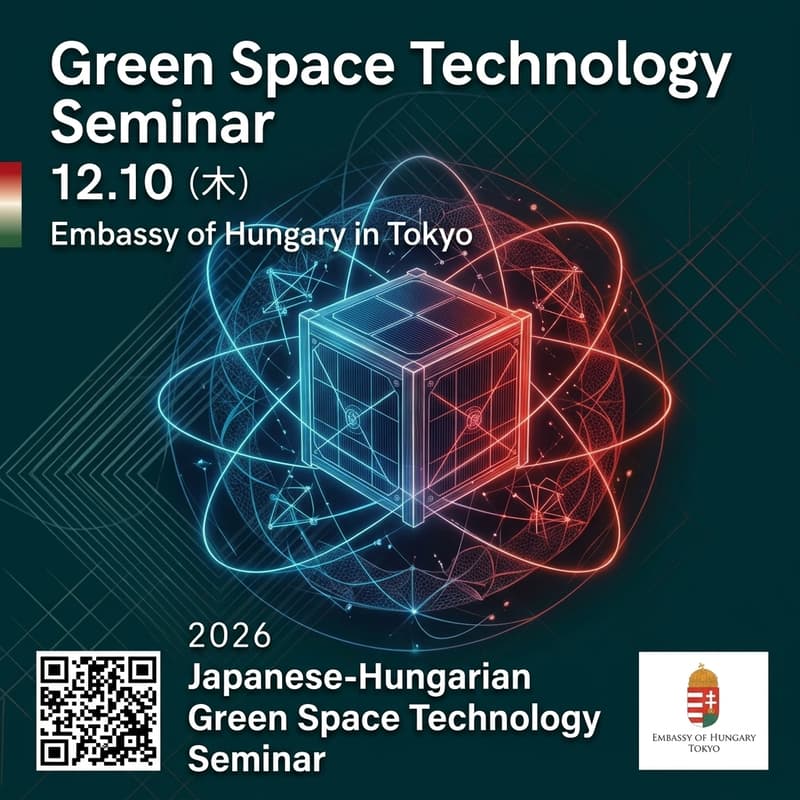

Japanese-Hungarian Green Space Technology Seminar
Beyond LignoSat: Industrializing Sustainable Wooden Spacecraft & High-Density Organic Aerospace Materials
Hosted by: Embassy of Hungary in Tokyo & Robinia Hungary Holding Ltd.
Date & Time
Thursday, December 10, 2026
16:00 – 20:00 JST (Doors open at 16:00)
Location
Embassy of Hungary in Tokyo
2-17-14 Mita, Minato-ku, Tokyo 108-0073, Japan
About This Event
This prestigious bilateral event is jointly organized by the Embassy of Hungary in Tokyo, and Robinia Hungary Holding Ltd. (Dánszentmiklós, Hungary). The seminar serves as a strategic platform bridging European and Japanese expertise, focusing on the theme: Green Space Technology.
As humanity expands its orbital footprint, traditional metal satellites contribute to growing space debris and high-altitude stratospheric pollution caused by alumina particle re-entry. To address these challenges, the RobiniaLignoSat-1 mission introduces high-density hardwood architectures (utilizing Black Locust / Robinia pseudoacacia) as a game-changing solution for next-generation orbital platforms.
This seminar brings together leading aerospace researchers, satellite manufacturers, space industry executives, and institutional partners from Japan and Europe to explore the commercialization, engineering advantages, and future applications of organic space materials.
Key Highlights & Technical Showcase
Zero-Debris Lifecycle: Complete atmospheric ablation upon re-entry at ~80 km altitude, converting entirely into H2O and CO2 without harmful alumina particle emissions.
Advanced Material Performance: Superior launch resilience and structural stability under extreme thermal cycling.
Radiation & Thermal Protection: Enhanced hydrogen-rich shielding against cosmic rays and natural VUV / atomic oxygen erosion barriers via specialized laser charring surface treatments.
Invisible Infrastructure: Non-conductive hardwood properties allowing internal antenna placement, eliminating external deployment mechanisms and drag.
Extraterrestrial Silviculture: Exploring Robinia pseudoacacia as a nitrogen-fixing pioneer species for lunar timber economies and space habitat construction.
Event Agenda (Continuously updated)
16:00 – 16:30 | Registration & Arrival
Guest check-in and welcome soft-drinks
16:30 – 16:45 | Opening Remarks
Welcome address by H.E. the Ambassador of Hungary to Japan
16:45 – 17:30 | Technical Presentation & Keynote
Industrializing Sustainable Wooden Spacecraft: High-Density Hardwood Architectures for Next-Generation Orbital Platforms
Presenters: Prof. Arnold Gucsik & Mr. Tamás Pásztory (Robinia Hungary Holding Ltd.)
17:30 – 18:00 | Q&A & Technical Discussion
Open discussion with space technology experts, partners, and academic representatives
18:00 – 20:00 | Networking Reception & Buffet
Standing reception featuring Hungarian wine and culinary specialties, offering an informal networking opportunity with diplomats, researchers, and industry leaders
Who Should Attend?
Aerospace engineers, satellite operators, and CubeSat developers
New Space startups and commercial space enterprise executives
Academic researchers in materials science and space sustainability
Government officials, space agency representatives, and investors
Abstract & Paper Publication Opportunity
We would like to draw your attention specifically to the academic and professional publication opportunities associated with this event. All accepted abstracts and extended short papers will undergo peer review and will be formally published in the official volume: Proceedings of the Japanese-Hungarian Green Space Technology Seminar 2026.
We highly welcome submissions and presentations addressing our core green space technology tracks:
Track A: Wooden satellites: Future perspectives
Track B: Potential to use wooden structures in a spacecraft and ISS: Advantages and Disadvantages
Track C: Wooden structures on planets such as the Moon and Mars.
Important Timeline:
Abstract Submission Deadline: 20 November 2026
Notification of Acceptance: 30 November 2026
Seminar Date: 10 December 2026
Venue: Embassy of Hungary, Tokyo, Japan
Please find attached the detailed Author Submission Guidelines and the formatting template for the Proceedings volume. Submissions and registration requests should be sent directly to the organizing secretariat at Prof. Arnold Gucsik, sopronianglicus@gmail.com, arnold.gucsik@robiniahungary.com (phone: +36304120153).
As seating at the Embassy venue is limited, we kindly encourage you to submit your abstract and confirm your participation at your earliest convenience. Please feel free to forward this invitation to relevant department members, researchers, and experts within your network.
PROCEEDINGS OF THE JAPANESE-HUNGARIAN GREEN SPACE TECHNOLOGY SEMINAR 2026
10 December 2026 | Embassy of Hungary in Tokyo, Japan
Organized by: Embassy of Hungary in Tokyo, Japan & Robinia Hungary Holding Ltd., Dánszentmiklós, Hungary
1. Author Submission & Formatting Guidelines
All authors submitting camera-ready abstracts or extended abstracts to the Japanese-Hungarian Green Space Technology Seminar 2026 must adhere to the parameters outlined below:
General Specifications
Manuscript Types & Length:
Extended Abstracts / Short Papers: 2–8 pages (A4), inclusive of embedded figures, tables, and references.
Language & Tone: English (consistent UK or US spelling). Technical and academic tone. Botanical taxa and Latin scientific names must be italicized with authorities cited where relevant (e.g., Ginkgo biloba L., Acer campestre L.).
Page Layout: Standard A4 page size (210 × 297 mm) with 25.4 mm (1.0 inch) margins on all sides.
Typography & Structure Hierarchy
Title: 16 pt, Bold, Centered or Left-aligned, Title Case.
Author Names: 11 pt, Bold, separated by commas. Mark institutional affiliations using numerical superscripts (¹, ²) and indicate the corresponding author with an asterisk (*).
Affiliations: 9.5 pt, Italic, providing Department, Faculty/Institute, University/Organization, City, and Country. Include the corresponding author’s email address.
Section Headings: 12–13 pt, Bold.
Abstract Body: 10 pt, Regular, Justified alignment, 1.15 line spacing, 6 pt spacing after paragraphs.
Keywords: 3 to 6 terms, lowercase (unless proper nouns), separated by semicolons.
Citation & Reference Style
Style Guide: APA 7th Edition (author-date in-text citations, e.g., Tanaka & Horváth, 2024; Kovács et al., 2025).
Reference Section: 9 pt font, hanging indent (0.5 inch / 1.27 cm).
Reference Limit: Maximum 5–10 references for standard abstracts; maximum 25 for extended abstracts. Include DOIs formatted as clickable URLs where available.
Figures and Tables (For Extended Abstracts)
Resolution: Minimum 300 dpi for photographs; 600 dpi for diagrams and vector drawings.
Captions: 9 pt, centered below figures (e.g., Figure 1: Runoff retention rates across substrate formulations) and above tables (e.g., Table 1: Thermal conductivity of experimental mixes).