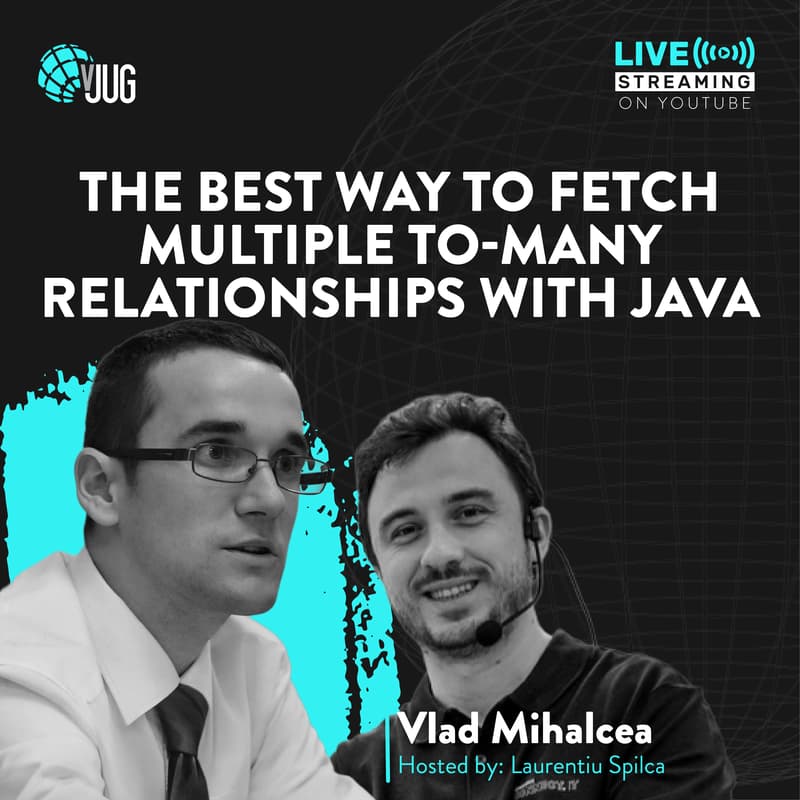

The best way to fetch multiple to-many relationships with Java
Fetching a multi-level hierarchy from a relational database is a classic performance bottleneck. If you do it wrong, you end up with the dreaded N+1 query problem or a Cartesian Product that brings your application to its knees.
In this session, Java Champion Vlad Mihalcea dives deep into the most efficient strategies for retrieving complex data structures—specifically for scenarios where you need to store that result set in a cache like Redis.
Date: 14 May 2026
Timing:
5:00 PM (UTC): Live stream kicks off
5:10 PM (UTC): The best way to fetch multiple to-many relationships with Java by Vlad Mihalcea
6:00 PM (UTC): That’s a wrap, live stream ends
In this talk, we're going to analyze the best way we can fetch a multi-level hierarchy from an RDBMS so that we can store the result set in a cache, such as Redis.
I'm going to go through various solutions and analyze the performance impact of each option. From plain JDBC to JdbcTemplate, Spring Data JDBC, Spring Data JPA, and Blaze Persistence.
Therefore, we are going to compare how all these options work and conclude what is the most efficient way to fetch a multi-level hierarchical structure with the most common Java data access technologies.
Vlad Mihalcea, Author, Database performance tuning aficionado, Java Champion
Vlad is a Java Champion, creator of Hypersistence Optimizer (https://vladmihalcea.com/hypersistence-optimizer/) and Hypersistence Utils OSS project (vladmihalcea/hypersistence-utils).
He is passionate about communities, technical leadership, system architecture, and database systems.
He wrote hundreds of articles about Java, JPA, Hibernate, and SQL on his blog (https://vladmihalcea.com), and he is the author of the High-Performance Java Persistence book and video course series.
Your Host: Laurentiu Spilca
Laurentiu Spilca is a Principal Development Consultant and Java Champion with extensive experience building and troubleshooting distributed systems at scale. He is passionate about software security, system design, and helping developers understand complex concepts through clear, practical explanations.
Laurentiu is also an author, trainer, and content creator, known for his work on Java, Spring, and modern application architecture. Through books, courses, and talks, he focuses on making advanced topics accessible to engineers at all levels.