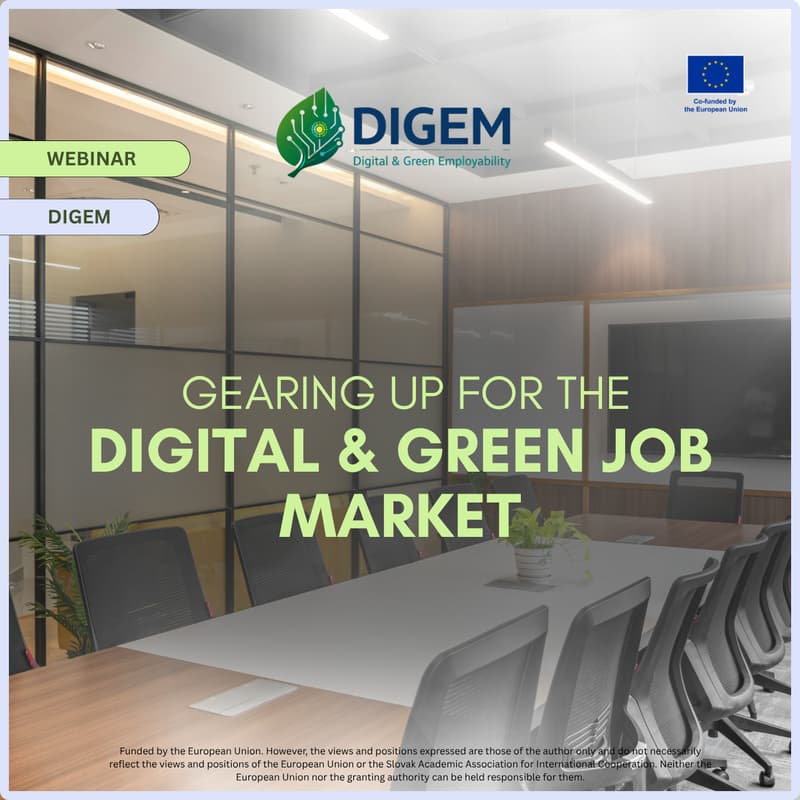

DIGEM: Gearing Up for the Digital & Green Job Market
Are you ready for the future of work? Over 70% of new jobs in Europe now require advanced digital skills, while the European Green Deal is simultaneously transforming industries toward zero-carbon and circular business models.
To thrive in today’s labor market, it is no longer enough to look at "digital" and "green" as separate paths. They are moving together.
Join the DIGEM Project Consortium (The Common Ones, Aj Ty v IT, and Learnable) for a fast-paced, 60-minute session where we break down the high-impact findings from our latest European research report. Instead of boring theories, we are shining a spotlight directly on the practical skills, emerging trends, and existing free tools you can use right away to stay ahead of the curve.
What You Will Learn:
🤖 AI Literacy & The "Skills-First" Shift: Discover how generative AI is shifting employment demands from traditional university degrees to verifiable digital skills, and learn about the ethical frameworks shaping AI in education.
🌱 Green Competences & Eco-Systems: Demystify the EU’s GreenComp framework. Find out why tech literacy needs a sustainability mindset, and explore specialized toolkits designed to help early-stage innovators and small businesses scale green ideas.
🧠 Protecting Your Digital Wellbeing: Learn how to navigate demanding digital workspaces without cognitive burnout. We will introduce the concept of "learning nuggets"—bite-sized, flexible learning strategies that prevent digital overload.
Who Is This For?
Adult (Ages 25–35) looking to pivot into future-ready, resilient career pathways.
Educators, Trainers, & Career Coaches looking for fresh resources and frameworks to upskill their learners.
Community Leaders, & Employment Services interested in cross-border innovation in employment and the twin digital-green transition.
--------------------------
Project Reference: 2025-2-SK01-KA210-ADU-000376507
Funded by the European Union. However, the views and positions expressed are those of the author only and do not necessarily reflect the views and positions of the European Union or the Slovak Academic Association for International Cooperation. Neither the European Union nor the granting authority can be held responsible for them.