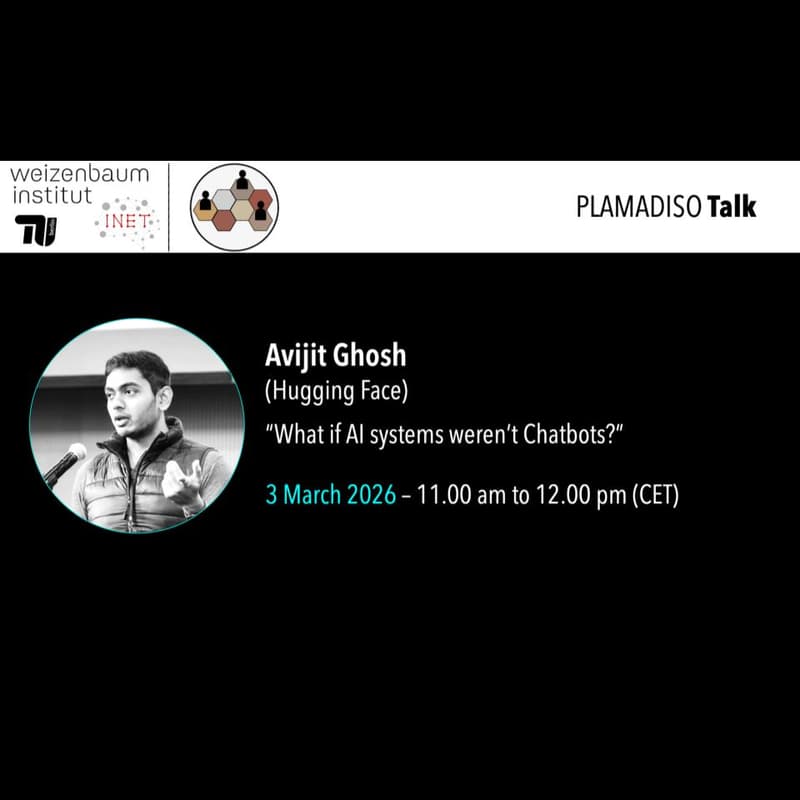
PLAMADISO: Avijit Ghosh (Hugging Face): What if AI systems weren't chatbots?
Abstract: The rapid convergence of artificial intelligence (AI) toward conversational chatbot interfaces marks a critical moment for the industry. This paper argues that the chatbot paradigm is not a neutral interface choice, but a dominant sociotechnical configuration whose widespread adoption reshapes social, economic, legal, and environmental systems. We examine how treating AI primarily as conversational assistants has extensive structural downsides. We show how chatbot-based systems often fail to adequately meet user needs, particularly in complex or high-stakes contexts, while projecting confidence and authority. We further analyze how the normalization of chatbot-mediated interaction alters patterns of work, learning, and decision-making, contributing to deskilling, homogenization of knowledge, and shifting expectations of expertise. Finally, we examine broader societal effects, including labor displacement, concentration of economic power, and increased environmental costs driven by sustained investment in large-scale chatbot infrastructures. While acknowledging legitimate benefits, we argue that the current trajectory of AI development reflects specific value choices that prioritize conversational generality over domain specificity, accountability, and long-term social sustainability.
We conclude by outlining alternative directions for AI development and governance that move beyond one-size-fits-all chatbots, emphasizing pluralistic system design, task-specific tools, and institutional safeguards to mitigate social and economic harm.
Bio: Dr. Avijit Ghosh is a Technical AI Policy Researcher at Hugging Face and a Research Affiliate at the the University of Connecticut. He sits at a critical junction between AI research and policy responses to ongoing legislative and regulatory movements. His research examines critical challenges in AI safety: from algorithmic bias to agent autonomy to standardization efforts in AI Evaluation and Vulnerability Disclosure. His work has been covered in the press, including articles in The New York Times, Forbes, The Guardian, Propublica, Wired, and the MIT Tech Review. His research has influenced AI regulation, established best practices for AI Documentation, and advanced the democratization of machine learning technology while ensuring it serves human wellbeing. Dr. Ghosh has been an invited speaker as a Responsible AI expert at various high-impact events such as SXSW, MIT Sloan AI Conference, and the Summit on State AI Legislation. He has also organized academic workshops as a member of QueerInAI and engaged with policymakers at various levels in the United States, United Kingdom, and Singapore. His work has led to real-world impact, including helping shape regulation in New York City and causing Facebook to remove their biased ad targeting algorithm.
Organizer and Moderator: Dr. Volker Stocker is an economist who specializes in the digital economy and the Internet ecosystem. Since May 2019, he has been leading the multidisciplinary research group “Digital Economy, Internet Ecosystem, and Internet Policy” at the Weizenbaum Institute (Gprior to September 2022, the group was named “Work and Cooperation in the Sharing Economy”). Additionally, Volker is an associated researcher in the Internet Architecture and Management Group at TU Berlin and at the Max Planck Institute for Informatics in Saarbrücken, and an affiliated scholar with the Dynamic Competition Initiative (EUI & UC Berkeley Haas School of Business). Furthermore, Volker is a board member of the International Telecommunications Society (ITS), and Co-Chair of the ITS Europe.