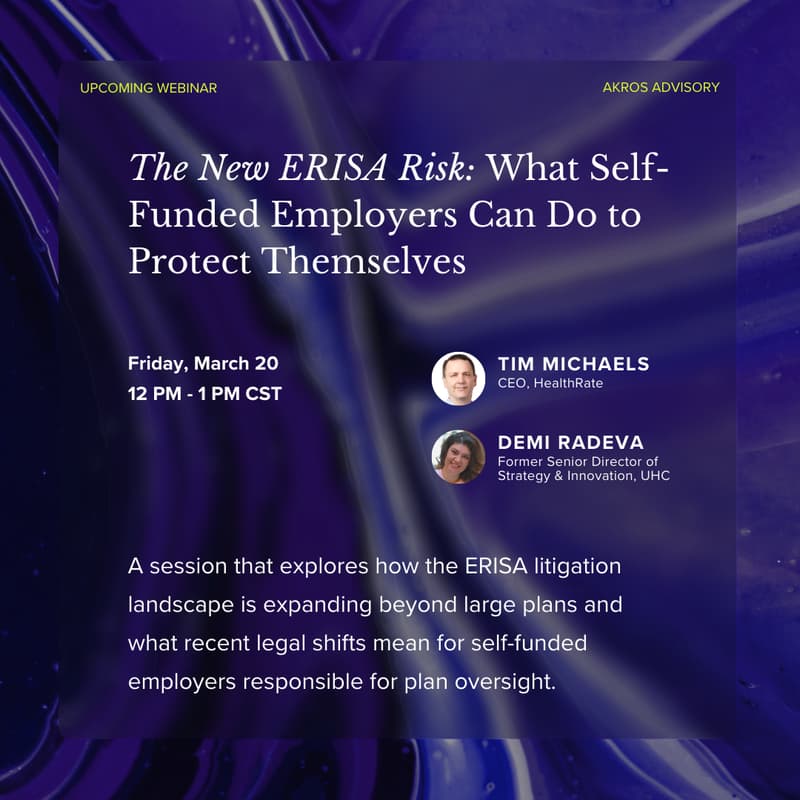
The New ERISA Risk: What Self-Funded Employers Can Do to Protect Themselves
ERISA litigation is no longer limited to billion-dollar plans. In 2024 alone, there were 53 ERISA settlements totaling more than $200 million, with an average settlement of $4.6 million. Smaller and mid-sized plans are increasingly being targeted, and many complaints follow nearly identical playbooks.
At the same time, the Supreme Court’s decision in Cunningham v. Cornell has shifted the burden of proof in certain fiduciary breach cases. Employers may now be required to affirmatively demonstrate that they are acting prudently. Hiring a TPA or ASO is no longer enough. Plan sponsors remain responsible for oversight, documentation, and decision-making.
So what does this mean in practice for self-funded employers?
In this session, we will break down:
What has changed in the ERISA risk landscape
Why many expect continued litigation
Where employers may be most exposed.
We will explain what “affirmative defense” looks like in the healthcare context, how high-cost claims and contracted rate variation can trigger scrutiny, and why documenting your fiduciary process is becoming essential.
You will leave with a clearer understanding of your risk exposure and a practical framework to assess whether your current oversight process would stand up to review.
Who this webinar is for:
Self-funded employers (CFO, benefits committee, risk officers)
TPAs with delegated authority
Stop-loss carriers and MGUs
Regional health plans
This is a market-driven discussion designed to help employers better understand the environment they are operating in and prepare accordingly.