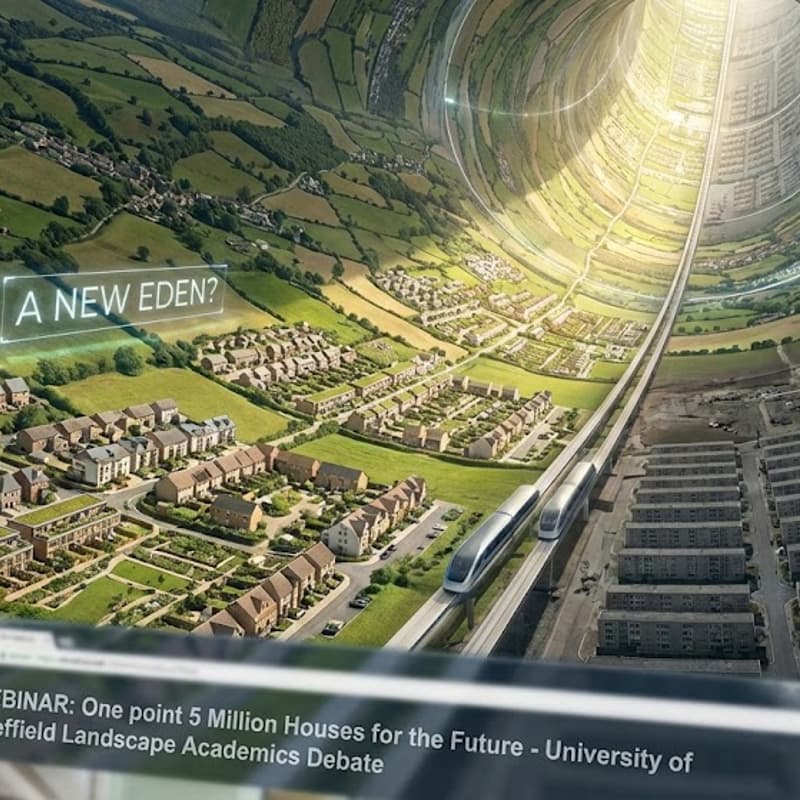
Webinar // 1.5 Million Homes for the Future: A New Eden — or Tomorrow’s Slums? // Landscape at the University of Sheffield
The UK Government’s ambition to deliver 1.5 million new homes in five years marks one of the most far-reaching planning shifts in a generation. Framed as “turbocharging” growth, the reforms promise faster delivery, new definitions of grey belt land, and so-called golden rules for affordable housing, services, and green space.
But what does this really mean for landscapes, biodiversity, social life, and long-term climate resilience?
This public webinar brings together landscape academics from the University of Sheffield to critically explore what is at stake. Moving beyond slogans of “builders not blockers,” the discussion asks whether rapid housing delivery can genuinely create liveable neighbourhoods, connected ecological networks, and landscapes that communities can care for — or whether we risk repeating the mistakes that produce isolation, ecological loss, and future vulnerability.
Through a series of short provocations from Sheffield Landscape followed by an extended roundtable debate, speakers will examine:
Housing landscapes as social and environmental infrastructure, not just visual add-ons
The feasibility of protecting ecological networks at speed and scale
How gardens, communal green space, and everyday landscapes shape belonging
The risks of short-term fixes versus the need for long-term stewardship and climate resilience
Who should attend?
Landscape architects, planners, architects, ecologists, urban designers, and policy professionals
Those working at the intersection of landscape and other disciplines — health, housing, climate, governance
Students and prospective students curious about studying landscape architecture and its future relevance
Anyone concerned about how today’s planning decisions will shape our planetary and social futures
Whether you are designing places, shaping policy, studying the built environment, or simply asking what kind of landscapes future generations will inherit, this webinar offers a timely space for critical reflection and debate.
Join us for the conversation.