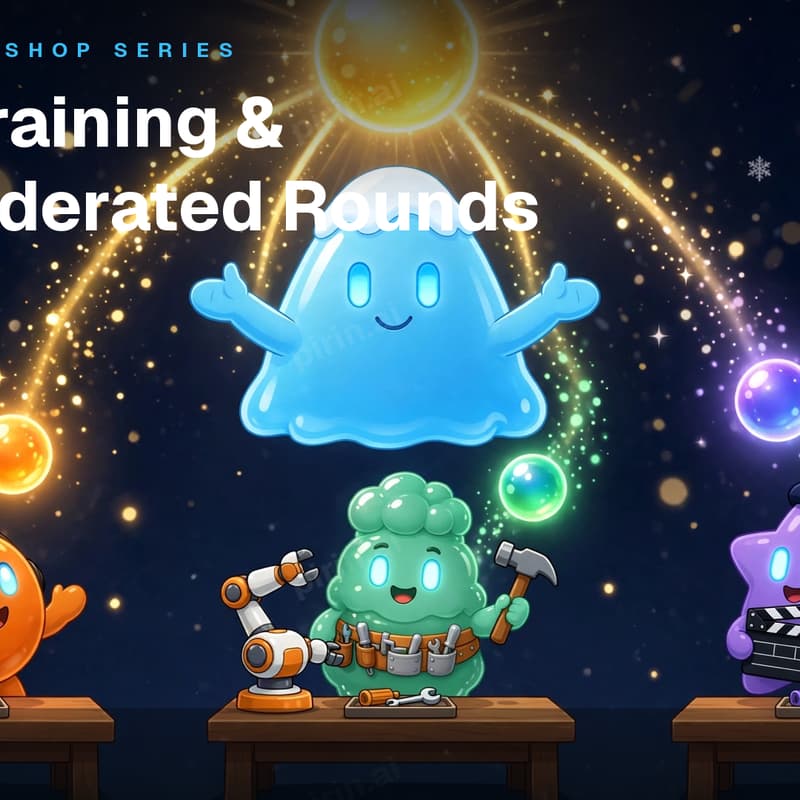

Local Training & First Federated Rounds
zk0.bot is an open-source federated-learning network for robot arms: independently owned SO-101 arms train one shared SmolVLA model on data that never leaves the owner's desk — only model updates move. This is session 4 of 6 in the zk0.bot Workshop Series at Pirin.ai's Build Table, walking the arc from a first assembled node to the M1 experiment: local-only vs federated vs centralized training on a real fleet, held-out sites, pre-registered bars.
You leave with a locally fine-tuned policy measured against your raw baseline on your own arm, your node's first federated round completed, and the aggregated checkpoint evaluated on your own regression set.
What you'll leave with
Local baseline numbers, one completed federated round, and an aggregated checkpoint scored on your own arm.
Workshop outline
Local first, always: no node joins a round without its own locally trained baseline — the bootstrap gate, and your control group for every federated number.
Fine-tuning SmolVLA on your episodes: the recipe, the VRAM reality (~10–16 GB, hours not days); judge on rollouts, not loss.
Full action-expert fine-tunes — not LoRA: federated LoRA cost SmolVLA −20pp in the head-to-head; rounds move full action-expert updates (~0.8 GB/round for the full model).
What a round actually moves: updates out, aggregated checkpoint back, raw episodes zero bytes ever — the privacy architecture is that there is no upload.
Choosing the aggregator: evidence, not loyalty — external head-to-heads favor FedAvg; zk0's own published config favors FedProx + dynamic scheduling; M1 A/Bs it under zk0's config.
The protocol inside the round: calibration standard + action normalization enforced by the harness; aggregation grouped by embodiment class; uncalibrated nodes are refused with a fix list.
Live round: the room's nodes submit, the aggregator averages, the checkpoint versions out with provenance — and rollback to the last battery-passing checkpoint demonstrated.
Read your round on your own arm: aggregated vs local-only on your regression set; no regression, no promotion.
Bring: Your node with Session 3 episodes (sim-node path available), GPU box.
Slides: shared with confirmed guests ahead of the session.
The full zk0.bot Workshop Series:
Session 1 — Node Setup (Nov 30): https://luma.com/jcowyitm
Session 2 — Calibration Standard (Dec 7): https://luma.com/zunvvhi1
Session 3 — Data Sprint (Dec 14): https://luma.com/lyf25edz
Session 4 — Training & Rounds (Jan 4): https://luma.com/7ca8lhrn
Session 5 — Reading Results (Jan 18): https://luma.com/v5wpxrvw
Session 6 — The M1 Experiment (Feb 1): https://luma.com/myfflwx5
Hybrid: 16 seats at the East 6th studio (bring a laptop), or join by video. Instant confirmation. 3:00-5:00 PM CT.
Two stipend seats per session for operators who can't swing the $99 — pick the Stipend Seat ticket and tell us what you're building.
Next step: Stay current through the weekly check-ins — Session 5 turns your round into evidence.
Background: Data Beats Parameters — why zk0 trains a 450M robot model · Community: zk0 Discord · Code: ivelin/zk0
This session is recorded. Short clips may feature participants who opt in.