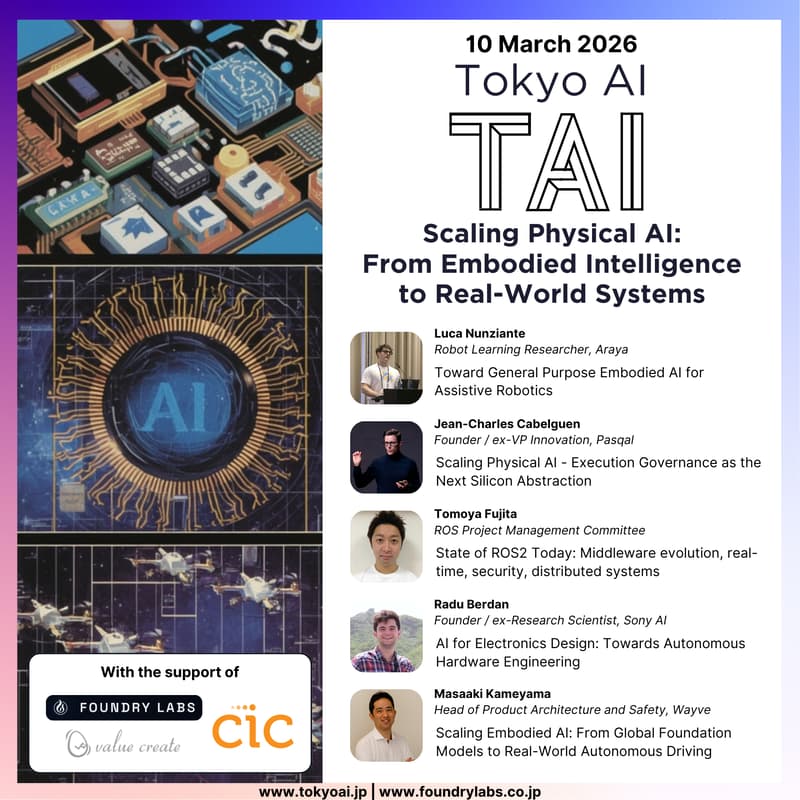

Scaling Physical AI: From Embodied Intelligence to Real-World Systems
This evening program explores how Physical AI is moving from theory to deployed, safety-critical systems by bridging learning, execution, infrastructure, and hardware design.
Across assistive robotics, humanoid control, developer platforms, autonomous hardware engineering, and self-driving vehicles, the talks trace a coherent arc: from general-purpose embodied intelligence and intent decoding, through execution governance as a missing system abstraction, to the software and hardware stacks required to scale reliably in the real world.
Speakers from research, open-source robotics, deeptech startups, and industry offer complementary perspectives on how Physical AI systems are architected, governed, and validated when intelligence must ultimately execute under real-world constraints.
Agenda
18:00 Doors open
18:15 - 18:35 Toward General Purpose Embodied AI for Assistive Robotics (Luca Nunziante - Robot Learning Researcher, Araya)
18:35 - 18:55 Scaling Physical AI - Execution Governance as the Next Silicon Abstraction (Jean-Charles Cabelguen, ex-VP Innovation, Pasqal)
18:55 - 19:15 State of ROS2 Today: Middleware evolution, real-time, security, distributed systems (Tomoya Fujita - ROS Project Management Committee)
19:15 - 19:35 AI for Electronics Design: Towards Autonomous Hardware Engineering (Radu Berdan, ex-Research Scientist, Sony AI)
19:35 - 19:55 Scaling Embodied AI: From Global Foundation Models to Real-World Autonomous Driving (Masaaki Kameyama - Head of Product Architecture and Safety, Wayve)
20:00 - 21:00 Networking & Food & Drinks
21:00 Doors close
Speakers
Talk 1 - Toward General Purpose Embodied AI for Assistive Robotics
Speaker: Luca Nunziante (Robot Learning Researcher, Araya)
Abstract: Assistive robotics demands a form of embodied intelligence that is robust, adaptive, and deeply aligned with human intent. This talk explores the path toward general-purpose embodied AI in the context of Brain-Robot Interfaces, where control policies must generalize across tasks, user intent must be decoded reliably from biosignals, and interaction must remain seamless and intuitive. Luca examines the core challenges at the intersection of AI, neuroscience, and robotics that must be solved to translate ambitious research goals into everyday assistive systems.
Bio: Luca Nunziante is a robot learning researcher at Araya with a background in computer science and robotics. He holds an MSc in Artificial Intelligence and Robotics from La Sapienza University of Rome. His research focuses on robot control and learning, with recent emphasis on reinforcement learning and vision-language models for embodied systems.
Talk 2 - Scaling Physical AI - Execution Governance as the Next Silicon Abstraction
Speaker: Jean-Charles Cabelguen (ex-VP Innovation, Pasqal)
Abstract: As AI systems move from simulation into physical machines, execution, rather than planning, becomes the dominant determinant of safety, performance, and reliability. This talk introduces execution governance as a missing architectural layer between AI intent and physical action. Jean-Charles presents a system-level approach that enforces physical invariants, manages energy and authority over time, and aligns safety and performance across multiple time scales. He discusses how this abstraction reshapes robotics architecture and influences the role of embedded systems and semiconductors in scalable Physical AI.
Bio: Jean-Charles Cabelguen is the founder of Kyostra, where he develops motion governance systems for humanoid and advanced robotic platforms. His background spans biomechanics, decentralized cloud computing, hardware security, and quantum computing. With over a decade of experience building deep-tech ventures, he focuses on system-level abstractions that enable reliable, certifiable embodied intelligence in real-world environments.
Talk 3 - State of ROS2 Today: Middleware evolution, real-time, security, distributed systems
Speaker: Tomoya Fujita (ROS Project Management Committee)
Abstract: ROS 2 has matured into a production-grade middleware for distributed, real-time robotic systems. This talk provides a focused snapshot of the ROS ecosystem in 2026: the current state of the Kilted Kaiju release, what’s coming in the next LTS, and how the Open Source Robotics Alliance is reshaping project governance. Tomoya also shares ecosystem metrics on adoption and contribution, offering insight into how ROS 2 supports scalable, safety-critical robotic deployments.
Bio: Tomoya Fujita is a software engineer and architect at Sony and a core maintainer of ROS 2. He serves on the ROS Project Management Committee, mentors Google Summer of Code contributors, and is a Senior Editor on the IEEE Robotics and Practice Board. His work centers on middleware architecture, real-time systems, and open-source robotics governance.
Talk 4 - AI for Electronics Design: Towards Autonomous Hardware Engineering
Speaker: Radu Berdan (ex-Research Scientist, Sony AI)
Abstract: While software development has been transformed by automation, electronics design remains largely manual and error-prone. This talk explores how large language models and agent-based AI systems are beginning to change that reality. Radu examines emerging workflows for schematic verification, functional circuit generation, and end-to-end design automation, outlining a trajectory toward autonomous hardware engineering that mirrors the evolution of modern software development.
Bio: Radu Berdan is the founder of Galvano AI, an autonomous electronics engineering platform. He holds a PhD from Imperial College London, where he specialized in memristive systems and advanced microelectronic architectures, and previously founded ArC Instruments, where he worked on high-performance testing platforms for characterising ‘en masse’ novel memory technologies. His career spans semiconductor architecture, embedded systems, and applied machine learning, with significant experience across neuromorphic computing and AI accelerators in Japan.
Talk 5 - Scaling Embodied AI: From Global Foundation Models to Real-World Autonomous Driving
Speaker: Masaaki Kameyama (Head of Product Architecture and Safety, Wayve)
Abstract: Autonomous driving demands systems that generalize across environments without reliance on handcrafted rules or HD maps. This talk examines Wayve’s embodied AI approach, built on a single end-to-end foundation model trained across multiple regions. Masaaki shares lessons from scaling this architecture from research to production, including deployment in Japan, and discusses how unified AI-first system design reshapes safety strategy, validation, and global rollout for autonomous mobility.
Bio: Masaaki Kameyama leads global product architecture and safety at Wayve, overseeing the transition of embodied AI from research into production autonomous driving systems. Previously, he led perception and sensor architecture programs at Woven by Toyota and developed automotive camera systems at Continental in Japan and Germany. He holds a Master’s degree in Intelligent Systems from King’s College London.
Organizers
Ilya Kulyatin: An entrepreneur with work and academic experience in the US, Netherlands, Singapore, UK, and Japan, with an MSc in Machine Learning from UCL. Now helping Japan grow the local AI ecosystem through a not-for-profit community, Tokyo AI (TAI), while building an AI-native system integrator and solutions provider, Foundry Labs株式会社.
Supporters
Tokyo AI (TAI) is the largest technical AI community in Japan, with 4,000+ members mainly based in Tokyo (engineers, researchers, investors, product managers, and corporate innovation managers).
Value Create is a management advisory and corporate value design firm offering services such as business consulting, education, corporate communications, and investment support to help companies and individuals unlock their full potential and drive sustainable growth.
Privacy Policy
We will process your email address for the purposes of event-related communications and ongoing newsletter communications. You may unsubscribe from the newsletter at any time. Further details on how we process personal data are available in our Privacy Policy.