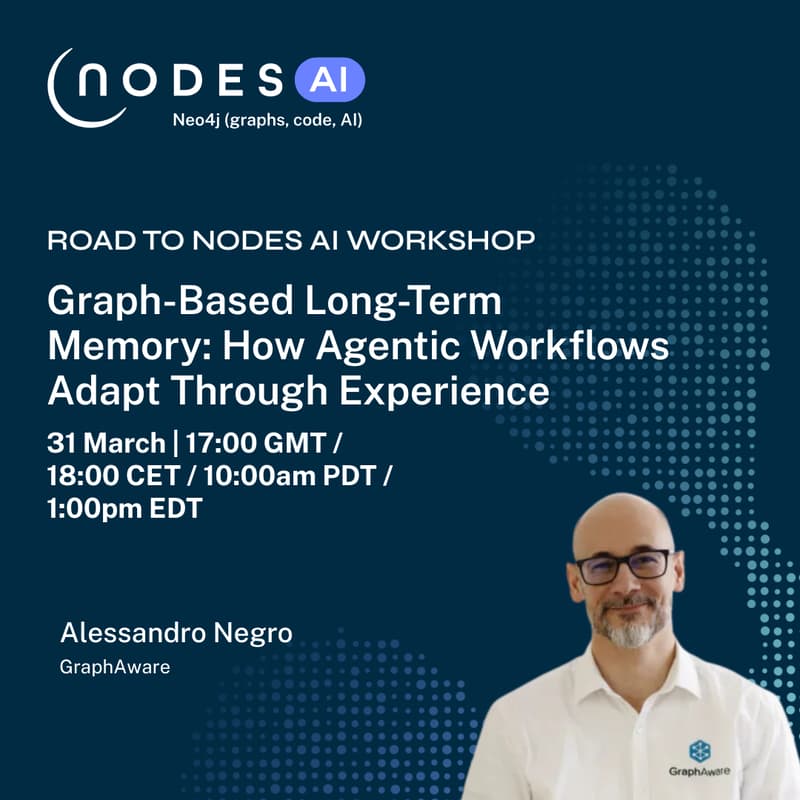

Road to NODES AI - Graph-Based Memory: How Agentic Workflows Adapt
This session is designed to demonstrate how AI agents can move beyond stateless execution and begin learning from their own experiences. While techniques such as RAG and prompt engineering improve individual LLM interactions, they do not provide agents with a structured way to retain, analyze, and reuse knowledge from past executions. In this workshop, you will explore how Neo4j can be used as a long-term memory system that enables agentic workflows to improve continuously over time.
The workshop introduces a graph-based memory architecture that captures complete agent execution traces, including tool choices, reasoning steps, reflections, and retrieved context, as connected graph structures. You will see how these traces form a dynamic and evolving “playbook” that agents refine through reinforcement learning and human feedback. By querying and analyzing this graph memory, agents learn not just better answers, but better strategies: when to invoke specific tools, how to structure multi-step workflows, and how to apply successful patterns to new problems.
Through practical examples and demonstrations, you will learn how to model agent executions in Neo4j, extract actionable patterns using Cypher, and retrieve relevant strategies based on structural similarity. Real-world use cases, including applications in law enforcement such as criminal network analysis and suspect nomination, will illustrate how graph-based memory enables agents to develop domain-specific orchestration patterns that transfer across contexts.
You will learn:
How to design graph-based long-term memory for agentic workflows using Neo4j
How to capture and model agent execution traces as reusable graph structures
How agents can improve tool selection, reflection, and retrieval strategies over time
How to query graph memory to distil and reuse successful decision-making patterns
How to apply graph-based memory to real-world, high-impact domains