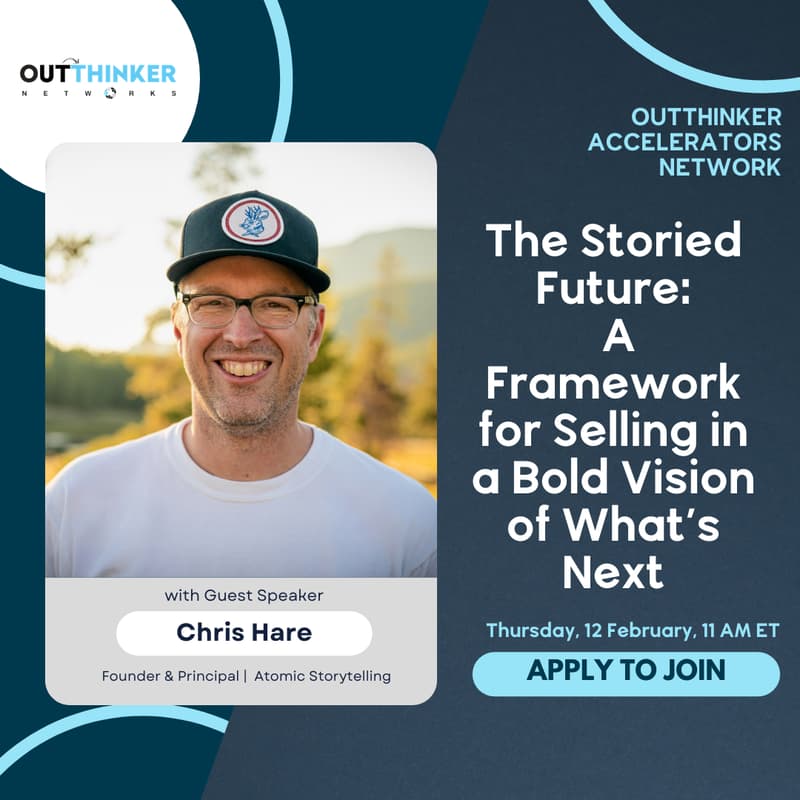

The Storied Future: A Framework for Selling in a Bold Vision of What’s Next
The Storied Future: A Framework for Selling in a Bold Vision of What’s Next
You know that feeling—the moment a vision for the future takes hold of you and refuses to let go. A new product. A new strategy. A better way of doing things. It consumes you. You test it from every angle. You build the business case. You anticipate the objections. You walk into the room ready.
And then it happens.
You share the idea, and it dies on the table.
Not because it’s wrong. But because they don’t see it. They’re anchored to the present. The gravity of the status quo wins. Your vision feels risky, abstract, or threatening. And suddenly, you’re not discussing the future—you’re defending it.
Chris Hare knows this pain well. Over the years, he’s failed, repeatedly, to convince senior leaders at some of the world’s biggest companies to adopt bold new ideas across products, strategy, and narrative. Those failures became the raw material for a different approach, one that has since helped him turn ideas into reality at companies ranging from midmarket industrials to trillion-dollar titans.
The breakthrough came from a simple shift: stop starting in the present.
In 2006, Amazon CTO Werner Vogels described the discipline of working backwards—beginning not with features or feasibility, but with a clear vision of the customer experience. Former Amazon leaders Colin Bryar and Bill Carr later captured this idea in Working Backwards, describing it as a systematic way to create clarity by anchoring teams in the future.
Chris has taken this concept one step further.
Instead of writing only press releases or narratives about the future, he now creates storytelling artifacts from the future—often in the form of HBR-style magazines—written as if the future has already arrived. These artifacts allow leaders to experience the outcome of a strategy before committing to it. And not just experience it, but see the transformation that will result from their buy-in and how that will impact their success within the company.
In this session, Chris will walk through a real example: a future-dated thought leadership magazine written from 2027 that imagines how narrative intelligence can become a core operating system inside a wealth management firm. Rather than pitching a strategy, the magazine shows how Chris’s vision for the future can shift how leaders talk about decisions, how culture shifts, how clients experience change, and how value is created over time.
The result is not persuasion. It’s shared understanding.
These storied artifacts give teams something concrete to react to, refine, and align around. They lower defensiveness, surface real risks earlier, and transform abstract vision into something tangible enough to believe in.
In this roundtable, you’ll learn how to:
Use future-state storytelling to pressure-test bold ideas before heavy investment
Create alignment without diluting ambition or forcing consensus
Shift from “selling an idea” to helping leaders see themselves in a future worth building
Apply working-backwards thinking to strategy, transformation, and thought leadership
You’ll leave with:
A repeatable framework for creating future-dated storytelling artifacts
A clear understanding of when to use decks, documents, or future artifacts—and why
A practical way to overcome the gravity of the status quo in high-stakes decisions
This session isn’t about telling better stories.
It’s about using storytelling as strategic infrastructure—so the future becomes something people can see, feel, and choose together.
About Chris:
Chris Hare is the founder of Atomic Storytelling, where he helps midlife executives, combat veterans, and high-net-worth leaders use narrative intelligence to find deeper purpose, clarify what’s next, and create meaningful impact. He is also Head of Narrative Strategy at Stillpoint Global Advisors, advising leaders through high-stakes transformations. Creator of the Atomic Storytelling™ methodology, Chris is known for uncovering the authentic stories that set leaders apart—building executive brands rooted in clarity, confidence, and trust. He regularly speaks, facilitates workshops, and leads immersive storytelling experiences for leaders ready to shape the future.
Previously, Chris founded The Storied Future, crafting strategic narratives and thought leadership for Fortune 100 companies, high-growth startups, and mission-driven leaders. Earlier in his career, he led creative and content marketing at Amazon, Microsoft, and VML, where he launched global storytelling initiatives—including Amazon’s Day One Stories of Entrepreneurship. Chris also hosts The Storied Future, featuring leaders from Microsoft, NASA, Netflix, and Bain, and offers pro bono therapeutic storytelling for combat-wounded veterans to support healing and resilience.