
Advocacy in Action: Women in Civil Rights Law
About the speakers:
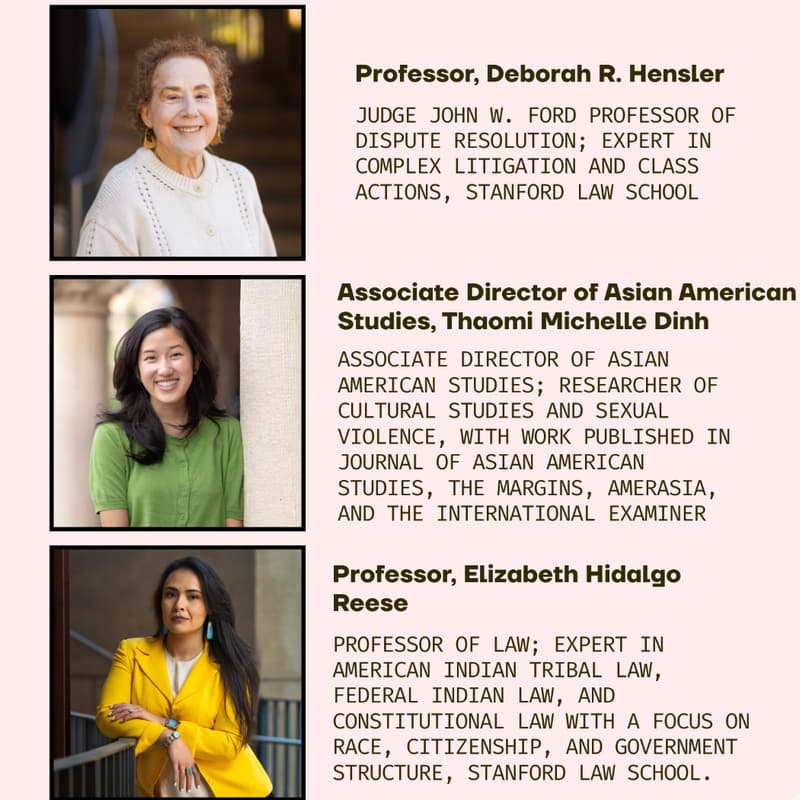
Elizabeth Hidalgo Reese, Yunpoví (Tewa: Willow Flower) is a scholar of American Indian tribal law, federal Indian law, and constitutional law focusing on the intersection of identity, race, citizenship, and government structure. Her scholarship examines the way government structures, citizen identity, and the history that is taught in schools, can impact the rights and powers of oppressed racial minorities within American law.
Professor Reese is a nationally recognized expert on tribal law and federal Indian law and frequent media commentator on developments within the doctrine, particularly at the U.S. Supreme Court. Professor Reese is also a prominent Native policy expert and advocate. From 2023-2024, she served as the Senior Policy Advisor for Native Affairs at the White House, working within the Domestic Policy Council. In that role, she advised President Biden on all matters involving Tribal Nations and coordinated, spearheaded, or shaped Native policy development across federal agencies. Reese oversaw the Administration’s preparations for the Supreme Court’s decision in Brackeen v. Haaland, assisted with the designation of Baaj Nwaavjo I’tah Kukveni National Monument, advised the President on supporting the Haudenosaunee Nationals Lacrosse Team’s participation in the Olympics, and helped develop and shape Executive Order 14112: Reforming Federal Funding and Support for Tribal Nations To Better Embrace Our Trust Responsibilities and Promote the Next Era of Tribal Self-Determination.
Prior to joining SLS, she served as the Harry A. Bigelow Teaching Fellow and Lecturer in Law at the University of Chicago. Previously, Professor Reese worked at the National Congress of American Indians where she supported tribal governments across the country as they implemented expanded criminal jurisdiction over non-Indians under the 2013 Violence Against Women Act. Her comprehensive five-year report on the tribal prosecutions thus far—which documented not only outcomes and unforeseen complications but the surge of tribal law innovation brought on by expanded jurisdiction—has been widely cited everywhere from Congress to Supreme Court briefs. Reese began her legal career as a civil rights litigator at the NAACP Legal Defense and Educational Fund where she led a desegregation case in one of the largest school districts in Florida and worked on the challenge to Alabama’s Voter ID law.
Reese served as a law clerk to Judge Diane Wood on the United States Court of Appeals for the Seventh Circuit and Judge Amul Thapar on the Eastern District of Kentucky Court (now the Sixth Circuit). She also was a fellow at the Senate Judiciary Committee, and at the U.S. Department of Justice in the Civil Rights Division’s Appellate Section.
Deborah R. Hensler is the Judge John W. Ford Professor of Dispute Resolution at Stanford Law School, where she teaches courses on complex and transnational litigation, arbitration law and policy, the legal profession, and empirical research methods.
Professor Hensler’s empirical research on dispute resolution, complex litigation, class actions, and mass claims has won international recognition. A political scientist and public policy analyst who was the director of the RAND’s Institute for Civil Justice before joining the Stanford Law School faculty, she has testified before state and federal legislatures in the United States on issues ranging from alternative dispute resolution to asbestos litigation and mass torts and consulted with judges and lawyers within and outside of the United States on the design of class action regimes. Professor Hensler is the organizer of the Stanford Globalization of Class Actions Exchange (globalclassactions.stanford.edu), which is spearheading international collaborative research on class actions and group litigation procedures by scholars in Asia, Europe, Latin and North America, and the Middle East. Noted for her decades-long scholarship on asbestos litigation and class actions in the United States, her research and publications have described and interpreted the trajectory of mass claims world-wide. She is the lead author of Class Action Dilemmas: Pursuing Public Goals for Private Gain (RAND, 2000), co-editor of The Globalization of Class Actions (Sage, 2009), and co-editor and lead author of Class Actions in Context: How Culture, Economics and Politics Shape Collective Litigation (Elgar, 2016).
At Stanford, Prof. Hensler teaches seminars on complex litigation, transnational litigation, arbitration law and policy, the legal profession, and research design for empirical legal studies. With Dean Emeritus Paul Brest, she co-founded the law school’s Policy Laboratory and helped shepherd it in its early years. She has taught graduate level courses at Universidade Catolica de Lisboa, Hong Kong University, the University of Melbourne (Australia), Paris Dauphine University and guest lectured at Tilburg University (Netherlands), Katholieke Universiteit Leuven (Belgium), Nagoya University (Japan), and Universidad Torcuato di Tella (Buenos Aires).
Professor Hensler is a fellow of the American Academy of Arts and Sciences and the American Academy of Political and Social Science and was awarded a personal chair in empirical studies of mass claims resolution by Tilburg University (Netherlands). In 2014, she was awarded an honorary doctorate in law by Leuphana University (Germany). She serves on the RAND Institute for Civil Justice Board of Advisors and on the advisory board of the Civil Justice Research Institute, a joint project of the University of California, Irvine, and the University of California Berkeley Law School. In 2018, she served on the Academic Expert Panel for the Litigation Funding Inquiry of the Australian Law Reform Commission.