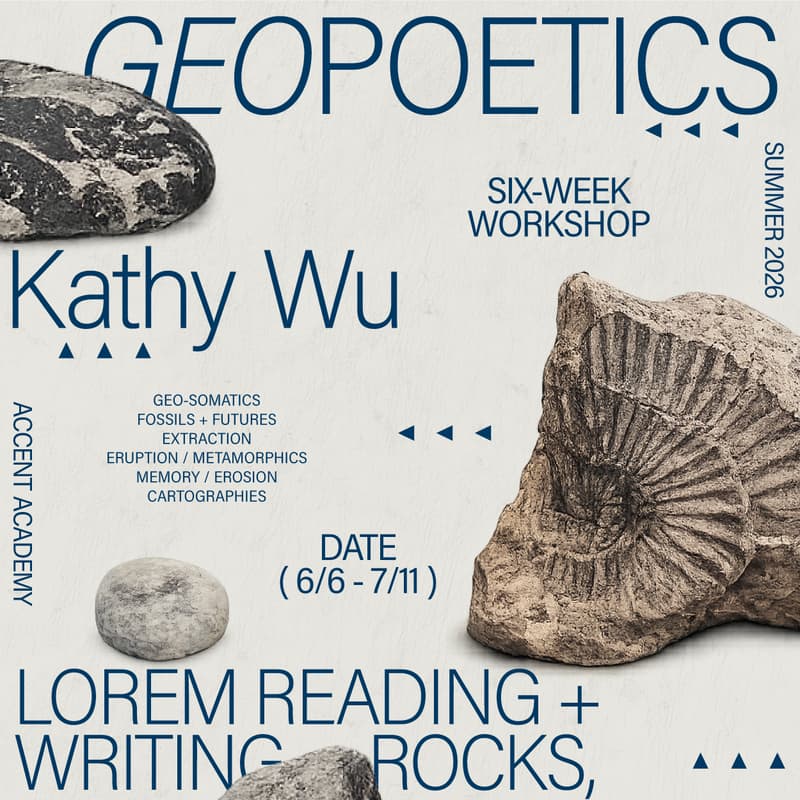

Six Week GEOPOETICS Workshop x Kathy Wu ▤• reading + writing rocks, •▧ geo-glyphs, tectonic gestures
◜ • ▤ • ▥ • ▧ • ▨ • ▤ • ▥ • ▧ • ▨ • ◝
• •
▤ GEOPOETICS ▤
• reading + writing rocks, •
▧ geo-glyphs, tectonic gestures ▧
• •
◟ • ▤ • ▥ • ▧ • ▨ • ▤ • ▥ • ▧ • ▨ • ◞
Summer 2026
Zoom
Instructor: kathy wu
Let us never forget: that the poem was entombed in a collapse of the earth. By habit, rather than commodity, the singularity and multiplicity of things were presented as divided couples and dualities, before the genres and species were discovered. This cadence allowed for a better distinction between things… But we’re also waiting for the renewed perception of differences to reveal themselves as such, and for the poem to reemerge once more.
— Édouard Glissant
DESCRIPTION
This workshop engages in cross-disciplinary language arts via geologic matter. How might reading, writing, and making with stone extend what Ursula K. LeGuin calls, “the meter of eternity”? How might fossil, tectonic plate, and planet show us new spatial and temporal scales of inscription, elegy, and literary possibility beyond the Anthropocene?
In this course, we will create language art projects both on and off the page, with the options to work with digital media, artist books, and multi-sensory art works. Through reading, journaling, and projects, we will engage geologic and geopolitical themes, beginning with ecopoetics, moving through extractivism, and extending into the politics of territory markers and lines.
Yoko Ono
WEEK 1
▥ GEO-SOMATICS
Before class:
*Find a geological object – could be a rock, pebble, small jar of sand, fossil – that you will want to keep with you throughout the course of the workshop.*
To read in class:
Ursula K LeGuin, Author of the Acacia Seeds
(Soma)tic Exercise #42 BETWEEN CORRESPONDING WAVES by CA Conrad
Yoko Ono, excerpts from Grapefruit (Snow piece, Walking piece)
Pauline Oliveros, Deep Listening
Take a one minute field recording near you. While listening to the recording, write a poem describing the sounds, textures, materials. What is the smallest thing you hear? What is the largest?
Listen:
Alvin Lucier, I Am Sitting in a Room
Annea Lockwood, hydrophone recordings
For next week:
SCORE POEMS
Write several scores (or sets of instructions) to be completed with your geologic object. Perform one of the scores.
Document the performance and show it alongside the score, whether it is through writing, photographs, sound recordings, etc.
WEEK 2
▣ FOSSILS + FUTURES (FALLOUT)
To read in class:
Eunsong Kim, romance #1 – write 100-item collective list poem titled “On what will remain”
: rock neverended :, Kimberly Alidio, : once bones teeth coral : (excerpts)
Inger Christensen, Alphabet (excerpts)
Hone Tuwhare “No Ordinary Sun” (I will try to find a recording of him reading it)
Look at:
Arthur Ganson, Gear with Concrete
Trevor Paglan, The Last Pictures (2012), alongside Voyager Golden Record
Isao Hashimoto - Earthly Observatory - Map of every nuclear explosion
Tetsumi Kudo Fossil in Hiroshima
For next week:
LITANY + LIST POEMS
Refine your list poem into a list poem of at least 15 things which will survive us in 10,000 plus years.
Write a list poem of all the things which won’t.
Optionally, do drawing or rubbing of an object on your list.
Find a document or news article about a specific mineral or mined object and bring it in next week. Share what you learned about that mineral.
WEEK 3
□ EXTRACTION
To read in class:
Mark Nowak with Ian Teh, Coal Mountain Elementary (excerpts)
Audre Lorde Coal Poem (hear her read at LoC at timestamp 42:30)
Bonus:
OAK FLAT, Lauren Redniss (excerpts)
Kathryn Yusoff, A Billion Black Anthropocenes or None, Chapter 4: Insurgent Geology: A Billion Black Anthropocenes Now
Neptune Frost, Saul Williams
Yuri Herrera, Silent Fury
For next week:
DOCUMENTARY POETICS
Transform or translate an existing text – like a legal document, a news article, a data set – as a starting point for something else. Use color, or scissors, or glue, or heat, or photoprocessing, or…. Try a process you haven’t done before. Perhaps you transform/translate/transmute a familiar object or subject into something else.
WEEK 4
◘ ERUPTION / METAMORPHICS
To read in class:
Laura Moriarty, Personal Volcano (excerpts)
Callum Angus, Natural History of Transition, Rock Jenny (excerpts)
Look:
Ana Mendieta, Volcán
Cecilia Vicuna River
Crystallography, Christian Bok
Bonus:
Dyke, Sabrina Imbler (excerpts)
Bread, Kamau Braithwaite
Rings of Fire, Carlos Santo Perez
Eleni Sikelianos, Your Kingdom, Poem: Volcanoes (National Park)
For next week:
CONCRETE POETICS
Write one concrete poem on either erosion or eruption. Taking a moment to reflect on poems such as Braithwaite’s BREAD, or Laura Moriarty's PERSONAL VOLCANO, can you pay extra attention to the shape of your poem? The enjambments, how they create slowness or speed.
Maybe you are interested in the typographic rag of your poem as a kind of shoreline? Or a concrete poetics where each poem is a contour of land? Think about these questions as you write your poem.
Beverly Buchanan
WEEK 5
◉ MEMORY / EROSION
In class:
Take short, 15 min walk. Modify something small in your landscape and document it. Using one continuous line, can you create a map of that walk?
To read in class:
Imani E. Jackson, From “Flag”, Land Mouth (excerpts)
Watch/Look:
Ana Mendieta, Siluetas / Also: Ana Mendieta, Alma Silueta en Fuego
Raul Zurita, Escritura Material
Beverly Buchanan, Marsh Ruins, Ruins, Rituals
Alan Michaelson, Earth’s Eye, Mantle
Megan Cope, Weelam Ngalut (Our Place) Rematriation Walangala
For next week:
CONCRETE POETICS PT 2
Change the shape of your poem from last week.MAP
Bring in a map.
Alan Michelson
WEEK 6
▧ CARTOGRAPHIES
To read in class:
Ofelia Zepeda, Proclamation
Yesenia Montilla, Maps
Francisco X Alcaron’s Four Directions
Meiko Shiomi Spatial Poem 5
Look at:
Hua Xi, Spatial Poetry
Renee Gladman, Prose Architectures
Damian Zucconi, Fata Morgana
Joaquin Torres-Garcia, Ámerica Invertida
In class:
Counter-cartography tracing activity on a map of your choice.
Email me a poem for class chapbook!
LEARNING ETHOS — TO ADD TOGETHER!
Be sensitive to what classmates may find upsetting or triggering.
Within this art and writing course, we may engage in found text, paraphrasing, using and reusing materials in our environment. I hope to offer a generous space which, above all, critically considers power relations alongside creative acts of appropriation.
Learning made visible can be a generous and brave practice– for example, changing your mind out loud, or rewriting old writing. Take knowledge as a verb and a progression.
Note:
The class registration fee is non-refundable.
Workshop recording will be shared for internal use after the class.