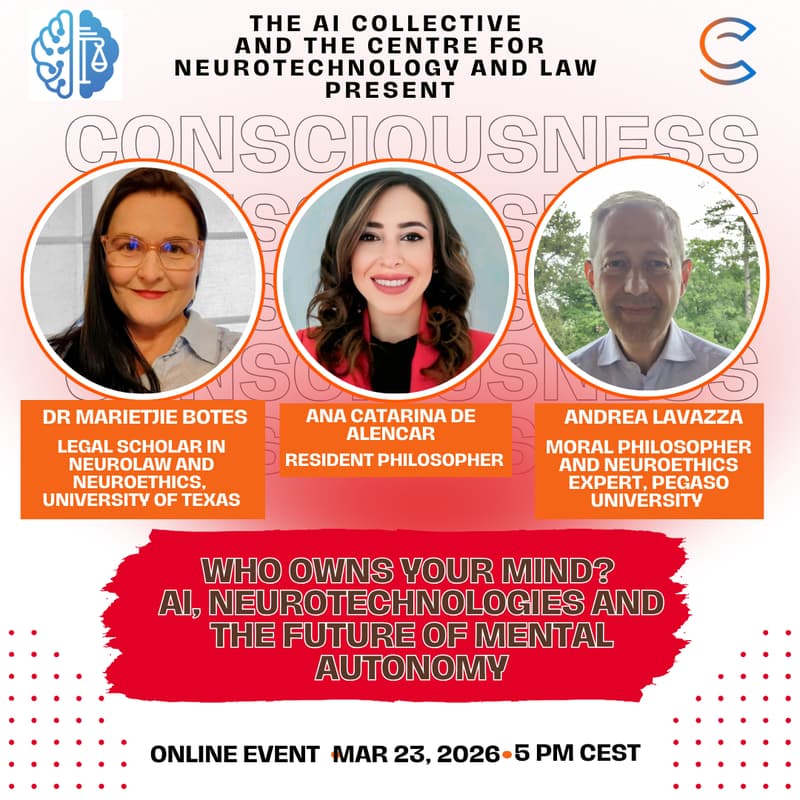

Who Owns Your Mind? AI, Neurotechnologies and the Future of Mental Autonomy
The Mind Under Control – Session 1
Who Owns Your Mind? AI, Neurotechnologies and the Future of Mental Autonomy
What if your thoughts were no longer invisible?
What if emotions, impulses, and intentions could be captured, inferred, stored, or even sold?
The Mind Under Control is a three-part online conversation series, presented through a partnership between The AI Collective and The Centre for Neurotechnology and Law — an international research hub dedicated to understanding the interaction between neural technologies, legal frameworks, and human rights (www.neurotechlaw.com).
The series explores how neurotechnologies and AI-driven systems are reshaping privacy, autonomy, and fundamental rights across key areas of contemporary life. From the private mind to the workplace and public security, it asks a fundamental question: who truly holds power over human cognition in the age of neural data?
The first session focuses on the most intimate and controversial frontier of technological governance: the human mind. Advances in brain-computer interfaces, neural wearables, affective AI, and emotion-recognition technologies are enabling unprecedented access to mental states, emotions, and cognitive patterns. These developments challenge long-standing assumptions about mental autonomy, informed consent, and the legal boundaries of surveillance.
Are we witnessing the emergence of a new form of surveillance, one that targets cognition itself rather than behavior? Should mental privacy and cognitive liberty be recognized as new fundamental human rights? And can existing legal frameworks meaningfully protect individuals against opaque, emotionally invasive systems?
This session brings together internationally recognized experts in neurolaw, neuroethics, and philosophy to critically examine these questions from legal, ethical, and policy perspectives.
Key topics
Neural data as a new category of sensitive data
Mental, cognitive, and emotional privacy
The limits of informed consent in opaque and inferential systems
Mental sovereignty and cognitive freedom in the age of AI
Ethical and legal blind spots in current regulation
Speakers
Dr. Marietjie Botes is an internationally recognized legal scholar specializing in neurolaw, neuroethics, and data governance, with over 20 years of experience as a practicing attorney in health law and biotechnology. She is currently based at the Pestilli Neuroscience Lab, University of Texas at Austin, where she leads comparative legal research within the BRIDGE (Brain Research International Data Governance and Exchange) Project, focusing on the protection, sharing, and governance of brain data across jurisdictions in North America, Latin America, Europe, and Africa. Her work addresses brain-computer interfaces, neurodata, AI-enabled neurotechnologies, and their implications for mental privacy, cognitive liberty, identity, autonomy, and human dignity. Dr. Botes holds advanced degrees in law, including a doctorate in biotechnology law, and serves in multiple international advisory, editorial, and ethics bodies.
LinkedIn: dr-marietjie-botes-71151b55
Andrea Lavazza is a moral philosopher with an international profile in neuroethics and the philosophy of cognitive neuroscience. He is Associate Professor at Pegaso University (Naples) and Adjunct Professor of Neuroethics at the Universities of Milan and Pavia. His research focuses on the ethical challenges posed by neurotechnologies, including brain privacy, mental integrity, free will, and emerging issues such as cerebral organoids. Lavazza has authored over 200 academic publications (h-index 30) and serves on the board of the Italian Society for Neuroethics. In 2024 and 2025, he was included in the Stanford/Elsevier World’s Top 2% Scientists List, reflecting the global impact of his work.
LinkedIn: andrea-lavazza-49a88325
Facilitator and Series Curator
Ana Catarina de Alencar is an international lawyer and ethicist based in Paris, working at the intersection of AI governance, law, and emerging technologies. She is a PhD researcher at the Université de Lille, where she develops an interdisciplinary project on emotional AI combining legal analysis and neurobiological insights. Ana holds a Master’s degree in Philosophy and Technology of Law, is the author of Artificial Intelligence, Ethics and Law (2022), and has taught courses on political philosophy, digital rights, GDPR, and AI regulation. She is a member of Open Ethics AI and Women in AI Governance, and serves as Resident Philosopher at The AI Collective.
LinkedIn: ana-catarina-de-alencar-6b022990
📅 March 23
🕔 5:00 PM (Paris Time)
🕔 4:00 PM (London Time)
🌐 Online | 60 minutes
This session is ideal for researchers, legal professionals, policymakers, technologists, ethicists, and anyone interested in AI governance, neurotechnology, and the future of mental autonomy.
The AI Collective is a global non-profit community uniting 100,000+ pioneers – founders, researchers, operators, and investors – exploring the frontier of AI in major tech hubs worldwide. Through events, workshops, and community-led research, we empower the AI ecosystem to collaboratively steer AI’s future toward trust, openness, and human flourishing.
All attendees and organizers at events affiliated with The AI Collective agree to our privacy policy and are subject to our code of conduct.