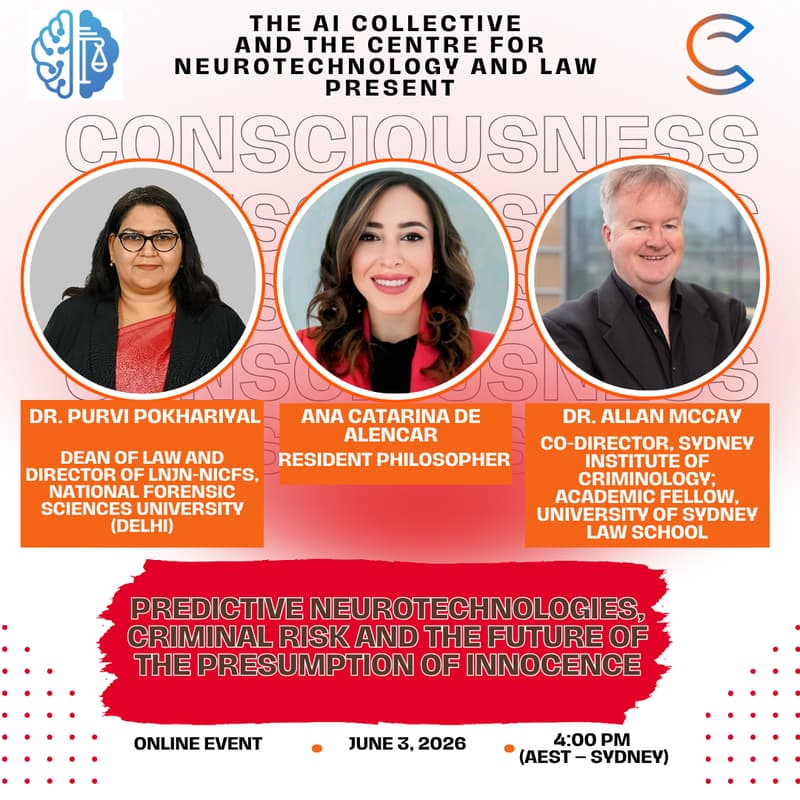

Predictive Neurotechnologies, Criminal Risk and the Future of the Presumption of Innocence
As part of Humans in AI Week at The AI Collective, we are very glad to host a new session exploring a question that may sound familiar to anyone who has watched Minority Report: What happens when technologies become capable of predicting human behaviour before actions even occur?
Technologies aimed at detecting deception, assessing criminal risk, analyzing cognitive patterns, and interpreting neural signals are already being explored in security, investigative, and forensic contexts in different parts of the world.
Can brain data become evidence?
What happens when the State tries to predict criminal behaviour?
Where are the ethical and legal limits of cognitive surveillance?
Could “pre-crime” logic reinforce social, racial, or cognitive bias?
📅 June 3, 2026
🕓 4:00 PM – Sydney (AEST)
🕗 8:00 AM – Paris (CEST)
🕖 7:00 AM – London (BST)
🕚 11:00 PM – San Francisco (PDT), on June 2
🕧 12:30 PM – Delhi, India (IST)
🌐 Online
This event is part of The Mind Under Control, a conversation series organized through a partnership between The AI Collective and The Centre for Neurotechnology and Law (https://www.neurotechlaw.com/).
🎥 Registered participants will receive access to the event recording.
Event Description
When the State enters the human mind, who still remains free?
Inspired by the iconic film Minority Report, this session explores a question that is no longer confined to science fiction: what happens when the State claims it can access, decode, or even predict criminal intent before a crime is committed?
Technologies that aim to predict criminal behavior, detect deception through neural signals, or assess criminal risk based on brain data and cognitive patterns are already being tested in interrogations, investigations, and security contexts in several countries. These developments raise profound legal, ethical, and human rights concerns, particularly regarding the presumption of innocence, mental autonomy, and the permissible limits of state power.
This event brings together internationally recognized experts in criminology, law, forensic justice, and neurotechnology to critically examine how predictive neurotechnologies challenge foundational principles of criminal law and democratic legal systems.
Key themes include:
The use of neurotechnology in interrogations and criminal investigations
“Pre-crime” logic and predictive justice
Racial, social, and cognitive bias embedded in neuro-cognitive systems
The use of brain data as evidence in judicial proceedings
Risks of technological coercion, invisible pressure, and forms of technological torture
Ethical and legal limits on state access to mental and neural data
Rather than offering definitive answers, the session opens a critical space to reflect on how emerging neurotechnologies may redefine freedom, responsibility, and due process, and whether existing legal frameworks are capable of responding to these challenges.
Speakers
Dr Allan McCay
Co-Director, Sydney Institute of Criminology
Academic Fellow, University of Sydney Law School
Dr Allan McCay is Co-Director of the Sydney Institute of Criminology and an Academic Fellow at the University of Sydney Law School. He is one of the world’s leading legal scholars working at the intersection of neurotechnology, criminal law, and human rights.
He was commissioned by the Law Society of England and Wales to author the report Neurotechnology, Law and the Legal Profession (2022), the first comprehensive legal analysis of brain–computer interfaces and other neurotechnologies for the legal profession. This landmark report received international media coverage across more than 20 countries, including by the BBC and The Times. The Law Society subsequently published his 2023 update, and Dr McCay is currently working on a further update.
In addition to numerous publications on neurotechnology and law, Dr McCay authored the first peer-reviewed academic article addressing the challenges posed by neurotechnology to human rights in Australia. He is the author and editor of major foundational works in the field, including Free Will and the Law: New Perspectives (Routledge, 2019) and Neurointerventions and the Law: Regulating Human Mental Capacity (Oxford University Press, 2020).
Dr McCay is a member of the Australian Human Rights Commission Expert Reference Group on Human Rights and Neurotechnology, Standards Australia’s Brain–Computer Interface Committee, and the international Minding Rights Network, a global group of scholars working on fundamental rights and emerging technologies. He is also an Associate Editor of the journal AI & Society, a member of the Law Society of New South Wales Taskforce on AI and other tools shaping the legal profession, and an Affiliate of Auckland University’s Natural, Artificial, and Organisational Intelligence Institute.
He trained as a solicitor in Scotland, practiced as a commercial litigator with Baker McKenzie in Hong Kong, and has been admitted to practice in two Australian jurisdictions.
Prof. Purvi Pokhariyal
Dean, School of Law, Forensic Justice & Policy Studies
Director, Lok Nayak Jayaprakash Narayan National Institute of Criminology and Forensic Science (LNJN-NICFS)
National Forensic Sciences University (NFSU), Delhi
Professor Purvi Pokhariyal is a distinguished academic leader and legal professional with over 25 years of experience in legal education and more than 15 years in academic administration. She currently serves as Dean of the School of Law, Forensic Justice & Policy Studies and as Director of the Lok Nayak Jayaprakash Narayan National Institute of Criminology and Forensic Science (LNJN-NICFS) at the National Forensic Sciences University (NFSU), Delhi Campus. She also holds the position of Director (Academics, Research & Consultancy) at NFSU.
Her academic expertise spans Criminal Justice Studies, Forensic Justice, Constitutional Law, Technology Law, Cyber Crime Investigation, and Artificial Intelligence and Law. Professor Pokhariyal has served extensively as a consultant and resource person for governmental and non-governmental organizations and has worked closely with law enforcement agencies, judicial academies, and public prosecution institutions to strengthen legal and forensic education.
Internationally, she has served as Visiting Faculty at HOF University in Germany, Global Professor at Tashkent State University of Law, and is a member of the Roma Tre Inter-Faculty Center on Space Law, reflecting her engagement with emerging and transnational legal challenges.
A prolific researcher and editor, Professor Pokhariyal has authored and edited several influential works, including Forensic Justice, Analysis of Judicial Approach on Forensic Evidence, and Artificial Intelligence and Law. She is currently editing a forthcoming Springer volume titled Neurotechnology and Neuro-Rights: Legal Implications, which addresses critical international issues at the intersection of neuroscience, emerging technologies, and human rights law.
Her leadership includes serving as the first female Chairperson of the Indian Society of Criminology (2022–2024). Her contributions have been recognized through numerous awards, including the Senior Social Scientist Award, Best Law Professor Award, and the Times Group Wonder Woman Award.
Moderator & Series Curator
Ana Catarina de Alencar
International Lawyer, Ethicist, and PhD Researcher
Resident Philosopher, The AI Collective
Ana Catarina de Alencar is an international lawyer and ethicist based in Paris, working at the intersection of AI governance, law, and emerging technologies. She is a PhD researcher at the Université de Lille, where she is developing an interdisciplinary research project on emotional AI that combines legal analysis with neurobiological and ethical perspectives.
She holds a Master’s degree in Philosophy and Technology of Law and is the author of Artificial Intelligence, Ethics and Law (2022). Ana has taught courses on political philosophy, digital rights, GDPR, and AI regulation, and regularly engages in public and academic discussions on the societal impact of emerging technologies.
She is a member of Open Ethics AI and Women in AI Governance and currently serves as Resident Philosopher at The AI Collective, where she curates and moderates interdisciplinary conversations on AI, law, ethics, and human rights.
The AI Collective is a global non-profit community uniting 150,000+ pioneers – founders, researchers, operators, and investors – exploring the frontier of AI in major tech hubs worldwide. Through events, workshops, and community-led research, we empower the AI ecosystem to collaboratively steer AI’s future toward trust, openness, and human flourishing.
All attendees and organizers at events affiliated with The AI Collective agree to our privacy policy and are subject to our code of conduct.